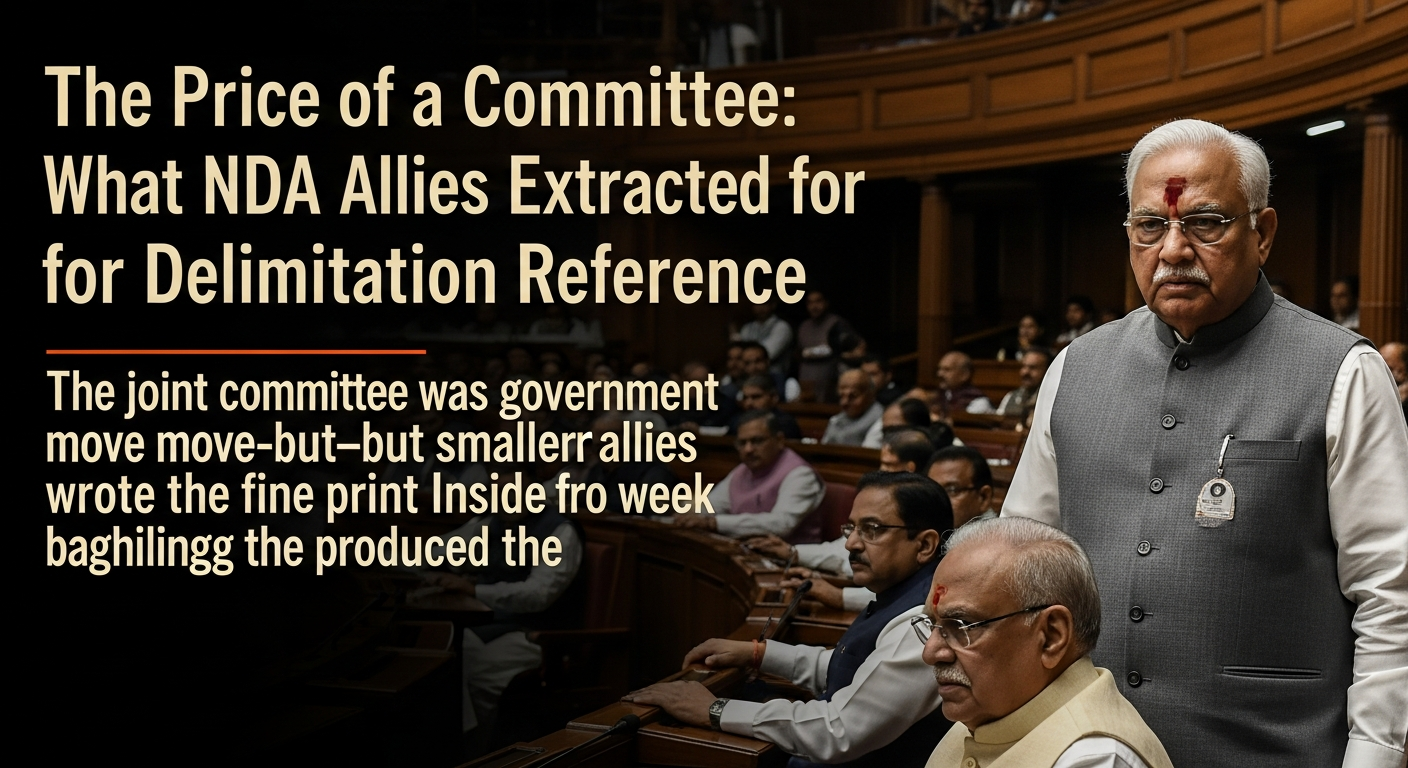
The decision to refer the delimitation package to a joint committee was announced as procedure. The week of negotiation that preceded it, described by four people familiar with the discussions, was anything but — and the smaller NDA allies emerged with concessions that reshape the bill's politics.
The JD(U)'s price was the women's-reservation schedule. The party, whose Bihar base watched the Nari Shakti Vandan Act stall for three years, demanded the implementation timeline move from executive discretion to statutory text — deadlines a court can enforce. The redrafted schedule, government drafters confirm, is now justiciable in precisely the way the 2023 Act was not.
The TDP's asks were arithmetic. Andhra Pradesh sits awkwardly in every delimitation model — southern in geography, growing in population — and the party extracted a review clause: the 850-seat allocation formula returns to Parliament after two censuses, converting a permanent settlement into a renewable one. The eastern allies took the Rajya Sabha question: a government commitment, recorded in the committee's terms of reference, to examine upper-house rebalancing in tandem.
Each concession trims the government's freedom of movement inside the committee, and each was the price of the committee existing at all. The alternative — another floor defeat — was priced by everyone at the table.
The allies' leverage is the session's quiet lesson. A government seventeen seats short of a two-thirds majority negotiates differently from the majorities of the last decade, and the delimitation file — the most consequential constitutional project of the parliament — is being drafted by coalition mathematics. The committee convenes July 28 with the fine print already written.