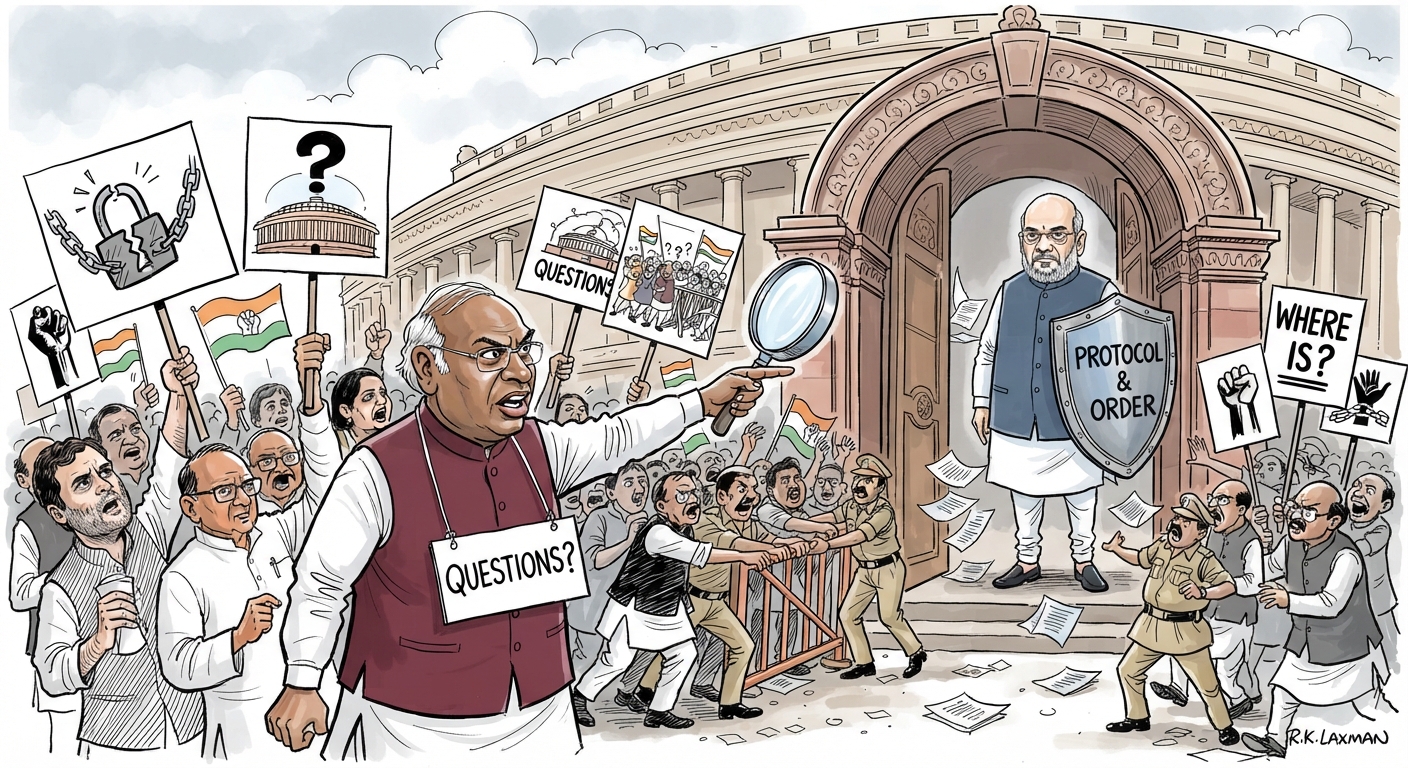
NEW DELHI — The ongoing monsoon session of Parliament witnessed heightened political friction on July 30, 2026, as lawmakers representing the opposition INDIA alliance staged a coordinated demonstration at Makar Dwar. Gathering at 10:30 AM inside the Parliament complex, leaders across multiple parties raised slogans against recent law enforcement operations in the national capital and revisited controversy surrounding municipal administration and temple Trust accounting in Ayodhya.
The morning protest directly impacted legislative business, contributing to consecutive adjournments in both the Lok Sabha and Rajya Sabha during the pre-noon hours. With banners and placards in hand, opposition parliamentarians sought formal statements from key Cabinet members, signaling a sharp escalation in political confrontation mid-way through the parliamentary sitting.
The immediate catalyst for the demonstration at Makar Dwar was the law enforcement response to a high-profile student demonstration in Delhi on July 20. Opposition leaders alleged that authorities deployed excessive force, citing the use of tear gas and physical containment measures against assembly participants. The incident has quickly become a focal point for opposition parties seeking to challenge the administration's civil oversight and police management within the Union Territory of Delhi.
KEY FACTS
- Opposition gathering convened at Makar Dwar in Parliament at 10:30 AM on July 30, 2026.
- Demonstration focused on police actions during the July 20 Delhi student protests.
- Mallikarjun Kharge demanded a formal explanation or resignation from Home Minister Amit Shah.
- Protesters raised allegations concerning Ram Mandir donation management in Ayodhya.
- The joint demonstration resulted in multiple morning adjournments across both Houses.
Escalation on the Steps of Parliament
Addressing assembled reporters and party workers outside the main legislative building, Leader of the Opposition in the Rajya Sabha, Mallikarjun Kharge, spearheaded the charge against the Treasury benches. Kharge demanded that Union Home Minister Amit Shah deliver a comprehensive statement explaining the tactical rationale behind the police intervention on July 20, asserting that responsibility for administrative excess ultimately rests with the Ministry of Home Affairs.
The opposition leadership went further, stating that in the absence of a satisfactory explanation or accountability measures regarding the July 20 event, the Home Minister ought to tender his resignation. Government representatives, however, have consistently maintained that law enforcement agencies acted strictly within established protocols to maintain public order and prevent unpermitted security breaches in central Delhi.
"Home Minister Amit Shah must explain the excessive police force and tear gas used against students, or he must tender his resignation." — Mallikarjun Kharge, Leader of Opposition in Rajya Sabha
Simultaneously, the protest incorporated broader political grievances, with participating MPs raising slogans regarding financial management related to the Ram Mandir complex in Ayodhya. Opposition representatives alleged discrepancies in land acquisition transactions and donation tracking managed by the Sri Ram Janmabhoomi Teerth Kshetra Trust—claims that government authorities and Trust officials have repeatedly refuted with public financial disclosures and audited filings.
By The Numbers
Disruption to Legislative Business
The tactical decision by the INDIA bloc to concentrate its protest at Makar Dwar—the primary entry point for parliamentarians entering the main building—translated into immediate friction once proceedings formally opened at 11:00 AM. As ministers attempted to lay papers on the table and commence the scheduled Question Hour, opposition members carried the momentum of the outdoor demonstration onto the floor of both Chambers.
Persistent chanting and requests for immediate motions of adjournment under pre-established rules disrupted proceedings, forcing the respective presiding officers to suspend business multiple times before noon. The parliamentary secretariat noted that several listed questions regarding infrastructure development, regional trade, and administrative reforms could not be taken up due to the persistent noise and floor disruptions.
Broader Political Context
Political analysts view the synchronized demonstration as part of a calibrated strategy by the opposition alliance to forge operational unity amidst divergent regional priorities. By focusing on central policing in Delhi and revisiting civilizational infrastructure projects in Uttar Pradesh, the INDIA bloc aims to construct a unified narrative targeting central governance mechanisms ahead of upcoming state assembly elections.
Conversely, Treasury benches have criticized the opposition for utilizing parliamentary time for political theatrics rather than engaging in constructive legislative debate. Parliamentary Affairs ministry officials pointed out that crucial national legislation, including budgetary allocations and statutory amendments, face unnecessary delays when morning sessions are systematically derailed by doorway protests and unlisted demands.
As the session progresses, the Treasury benches face the dual challenge of ensuring the passage of essential legislative business while managing high-decibel political confrontations inside the rotunda of Parliament.