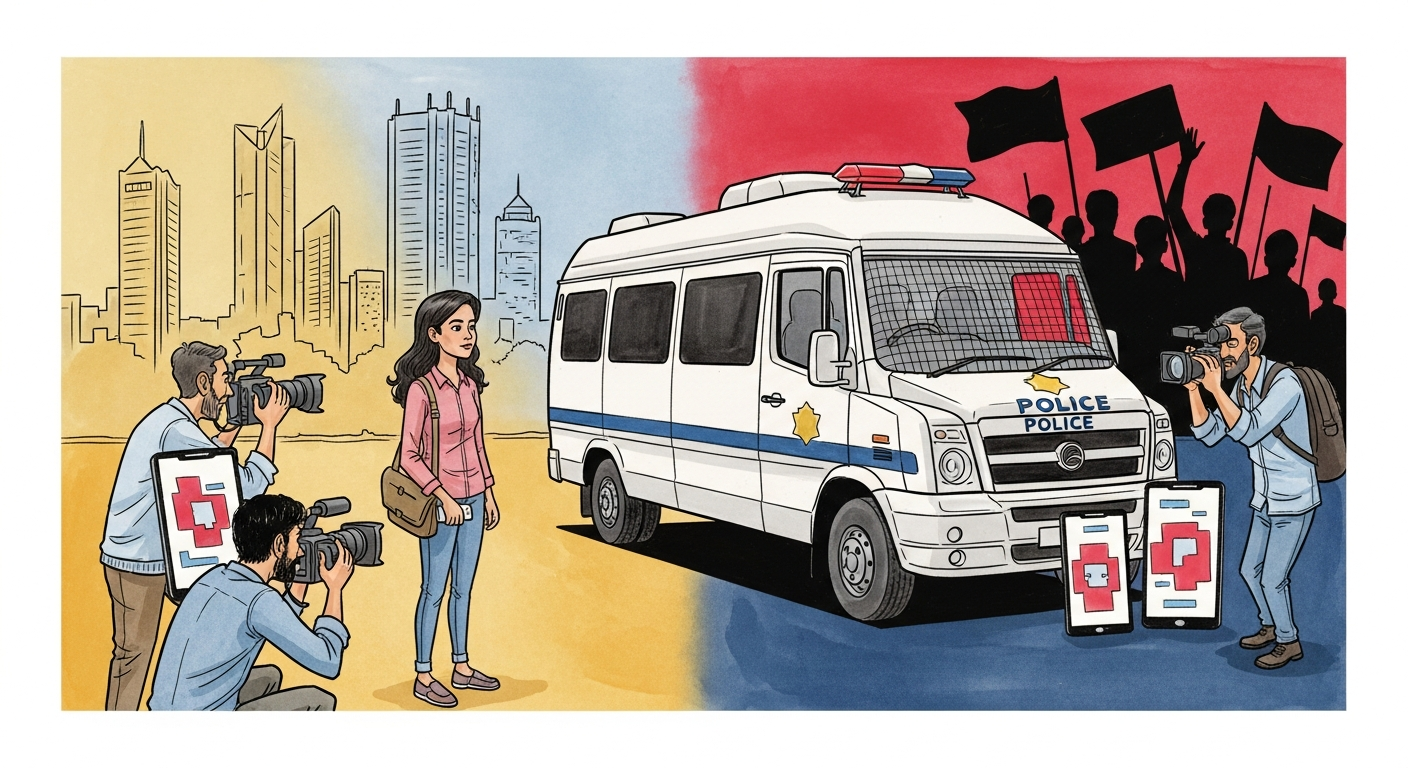
Mumbai’s viral image of a young woman standing before a police vehicle follows a protest pattern that India has already watched unfold across the neighbourhood: a local grievance, a visually arresting confrontation, rapid social-media amplification, celebrity attention and an argument that suddenly reaches far beyond the original street.
The comparison with Bangladesh is not about claiming that the same people, funders or organisers are involved. No reported evidence establishes that. It is about recognising the same pattern of mobilisation that made Bangladesh’s 2024 student protest so consequential: an individual act becomes a symbol; the symbol becomes shareable content; the content becomes a rallying point; and the political argument outruns the original event.
The pattern is now familiar
First comes a concrete trigger. In Mumbai, reports place the viral scene within the student protest and objections to police detentions. In Bangladesh, the 2024 movement began around public-service job quotas. In both cases, the initial issue was specific enough to mobilise students but broad enough to carry wider anxieties about fairness, opportunity and state power.
Then comes the image. Rhiya Ahir standing before a police vehicle supplied Mumbai with a simple, high-contrast visual: one young citizen, one official vehicle, a crowd and a camera. Bangladesh’s July movement similarly produced visual symbols that travelled at speed through phones and social platforms. The Reuters Institute documented how real-time recording and social media helped people document events during that crisis; photographs and videos gave distant audiences an emotional entry point.
The next stage is amplification. Clips are cut, captions are added, influencers and public figures share them, and the original context becomes secondary to what the image represents. This is the point at which a street protest can turn into a national narrative. It does not require a secret manual to happen. It is how contemporary platform politics works.
Why the Bangladesh analogy matters
Bangladesh showed how a student movement can change scale when three forces meet: a grievance that young people recognise, a visible confrontation with authority, and an online ecosystem that turns every moment into evidence, memory and recruitment. The country’s July 2024 uprising also developed under a far more severe environment of violence, arrests and internet restrictions. Mumbai is not Bangladesh, and the two contexts should not be casually equated.
But the communication pattern is recognisable. A protest does not need a central television studio when every participant has a camera. It does not need a single spokesman when a striking frame can become a message in itself. And it does not need formal coordination for ordinary users to reproduce an emotionally effective visual across thousands of accounts.
Toolkit, or a repeatable political method?
“Toolkit” is often used too loosely. If it means a documented operational plan, coordinated accounts, common instructions or funding trails, those claims demand evidence and should be investigated on facts, not on a viral photograph. But if it means a repeatable method of modern agitation, the answer is more straightforward: yes, the method is visible.
Choose an emotionally legible moment. Put a young face at the centre. Make state power visible but not abstract. Create an image that works without a long explanation. Let the platform do the distribution. Bangladesh demonstrated the power of that sequence; Mumbai’s viral bus-standoff scene shows why the sequence remains potent in India.
The democratic responsibility
Recognising a pattern is not a licence to dismiss every protester as manufactured. Nor is viral fame proof of moral authority. Citizens have a right to assemble lawfully; police have a duty to maintain order lawfully; and the press has a duty to distinguish verified organisation from online speculation.
The Mumbai image deserves analysis because it is larger than one person or one vehicle. It is a reminder that today’s protests are fought twice: once on the street and again in the algorithm. Bangladesh showed what can happen when the second battle changes the scale of the first.
Sources: Hindustan Times on the Mumbai incident; India Today on the Mumbai protest videos; Reuters Institute on social-media documentation in Bangladesh's 2024 protests; Amnesty International background on Bangladesh's quota protests.
Editorial clarification: This comparison identifies a similar visual and digital mobilisation pattern. It does not allege shared organisers, foreign funding or coordination without independently verifiable evidence.



