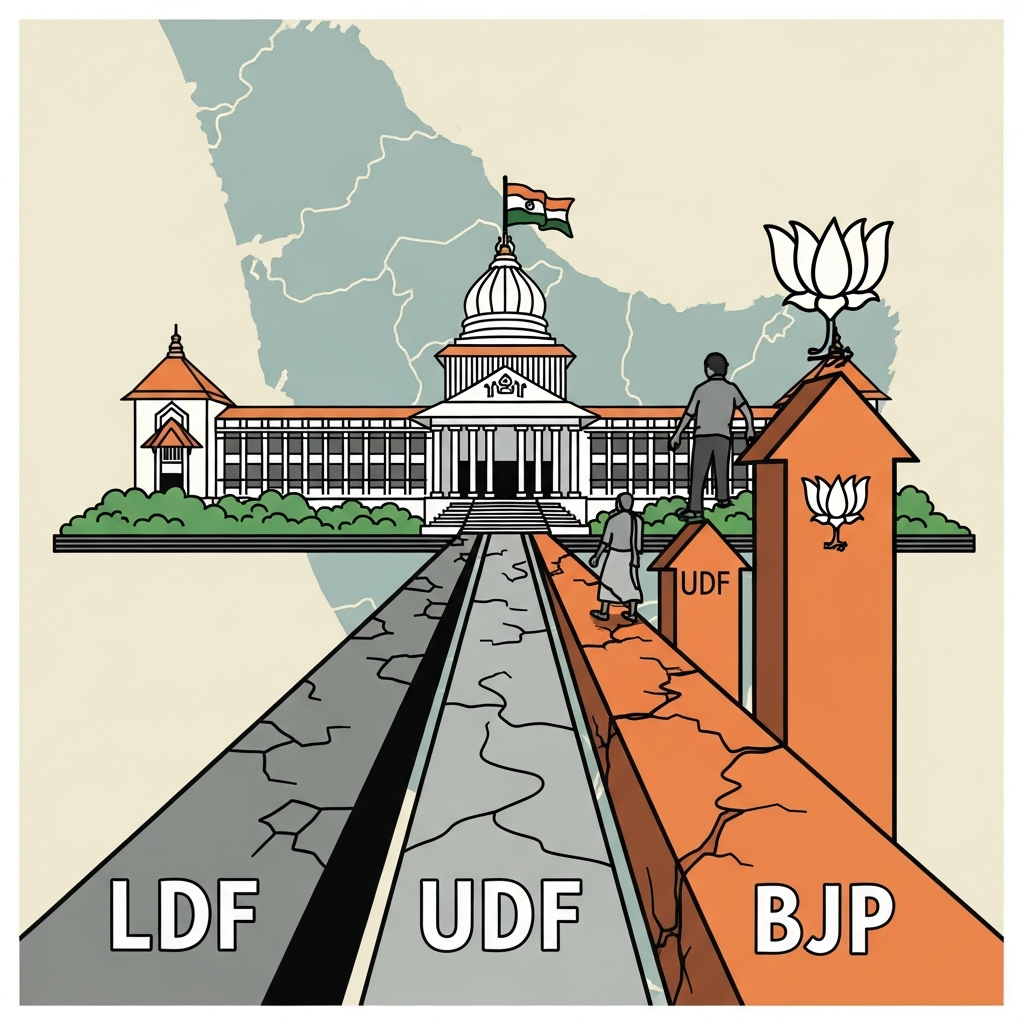
Kerala Assembly Elections: BJP's Ascent, Diminishing Returns for Incumbents
As Kerala gears up for the 2026 Assembly elections, the political atmosphere is charged with anticipation and uncertainty. The traditional duopoly of the Left Democratic Front (LDF) and the United Democratic Front (UDF) faces a significant challenge from a resurgent Bharatiya Janata Party (BJP), which is aggressively vying for a larger share of the political pie. While both the LDF, currently in power, and the UDF grapple with internal fissures and voter fatigue, the BJP is strategically maneuvering to capitalize on the evolving socio-political dynamics of the state.
The LDF: A Battle Against Anti-Incumbency
The incumbent LDF, led by Chief Minister Pinarayi Vijayan, is facing the formidable hurdle of anti-incumbency. After two consecutive terms in power, the government is under scrutiny for its handling of various issues, including the state's fiscal situation, infrastructure development, and employment generation. While the LDF can point to achievements in social welfare programs and healthcare initiatives, these accomplishments are often overshadowed by controversies and allegations of corruption.
One of the key challenges for the LDF is the perception of economic stagnation. Kerala's dependence on remittances from expatriates, coupled with a relatively weak industrial base, has created concerns about long-term economic sustainability. The government's efforts to attract investment and promote entrepreneurship have yielded limited results, leading to frustration among young job seekers. Moreover, the handling of natural disasters, such as floods and landslides, has drawn criticism, with some accusing the government of inadequate preparedness and response.
Internally, the LDF faces its own set of challenges. The Communist Party of India (Marxist) [CPI(M)], the dominant force in the coalition, is grappling with generational shifts and ideological debates. The party's aging leadership is under pressure to make way for younger, more dynamic leaders who can connect with the aspirations of a new generation of voters. Furthermore, tensions within the coalition, particularly between the CPI(M) and other smaller parties, could undermine the LDF's unity and electoral prospects.
The UDF: A Search for Relevance
The UDF, led by the Indian National Congress, is struggling to regain its lost ground in Kerala politics. After suffering a series of electoral defeats, the UDF finds itself in a state of disarray, plagued by internal squabbles and a lack of clear leadership. The Congress party, in particular, is facing an existential crisis, with dwindling support among traditional vote banks and a failure to articulate a compelling alternative vision for the state.
One of the UDF's main weaknesses is its inability to project a united front. Factionalism within the Congress party has hampered its ability to effectively challenge the LDF government. Senior leaders are often at odds with each other, undermining the party's credibility and confusing voters. Moreover, the UDF's reliance on traditional caste and religious alliances has become increasingly unsustainable in a rapidly changing social landscape.
The UDF's economic policies have also come under scrutiny. Critics argue that the UDF's emphasis on liberalization and privatization has exacerbated inequality and undermined the state's social welfare system. The party's inability to articulate a clear and consistent economic vision has further alienated voters who are concerned about issues such as unemployment, inflation, and access to affordable healthcare.
The BJP: A Rising Force
While the LDF and UDF grapple with their respective challenges, the BJP is steadily gaining ground in Kerala. The party has been strategically working to expand its base of support by appealing to a wider range of voters, including those who are disillusioned with the traditional political establishment. The BJP's focus on issues such as national security, Hindutva ideology, and economic development has resonated with a section of the population that feels marginalized by the existing political order.
One of the BJP's key strengths is its organizational capacity. The party has a well-oiled machinery that is capable of mobilizing resources and reaching out to voters at the grassroots level. The BJP's cadre-based structure and its strong network of volunteers have enabled it to effectively disseminate its message and build support among various communities.
The BJP's aggressive campaign strategy has also contributed to its growing popularity. The party has been actively targeting specific demographics, such as young voters, women, and members of marginalized communities. The BJP's use of social media and other digital platforms has allowed it to bypass traditional media outlets and directly engage with voters.
The BJP's success in Kerala is also linked to broader national trends. The rise of Hindu nationalism and the increasing polarization of Indian society have created a more favorable environment for the BJP to expand its influence in the state. The party's ability to tap into these sentiments and project itself as a champion of Hindu interests has helped it to gain support among a section of the population that feels threatened by the perceived erosion of traditional values.
However, the BJP still faces significant challenges in Kerala. The state's strong tradition of secularism and its diverse religious and ethnic makeup make it difficult for the BJP to replicate its success in other parts of India. The party's Hindutva ideology is often viewed with suspicion by minority communities, who fear that it could lead to discrimination and marginalization.
Key Factors Influencing the 2026 Elections
Several key factors are likely to influence the outcome of the 2026 Kerala Assembly elections:
- Anti-Incumbency: The extent to which voters are dissatisfied with the LDF government will play a crucial role in determining the outcome.
- Economic Performance: The state of the economy and the availability of jobs will be a major concern for voters.
- Social Issues: Issues such as caste, religion, and gender will continue to shape voter preferences.
- National Trends: The broader political climate in India will also have an impact on the elections.
- Alliance Dynamics: The ability of the LDF, UDF, and BJP to forge effective alliances will be crucial for their electoral prospects.
Geopolitical Context and Implications for India
The Kerala Assembly elections also have broader geopolitical implications for India. Kerala's strategic location on the southwestern coast of India makes it a vital gateway for trade and commerce. The state's proximity to the Arabian Sea and its historical links to the Middle East and Southeast Asia give it a unique geopolitical significance.
The outcome of the elections could have implications for India's foreign policy and its relations with neighboring countries. A stable and prosperous Kerala is essential for India's overall economic growth and its ability to project its influence in the region. The state's diverse population and its strong tradition of secularism also make it an important symbol of India's pluralistic identity.
Furthermore, the elections could have implications for India's internal security. Kerala has been a hotbed of political violence and extremism in the past. A peaceful and democratic election is essential for maintaining stability and preventing the spread of radical ideologies.
Forward-Looking Implications
The 2026 Kerala Assembly elections represent a critical juncture in the state's political history. The outcome of the elections will have far-reaching implications for Kerala's future and for India as a whole. Whether the LDF can overcome anti-incumbency, whether the UDF can regain its relevance, and whether the BJP can continue its ascent will depend on a complex interplay of factors, including voter sentiment, economic conditions, social issues, and national trends.
Looking ahead, it is clear that Kerala's political landscape is undergoing a significant transformation. The traditional duopoly of the LDF and UDF is being challenged by a resurgent BJP, which is aggressively vying for a larger share of the political pie. The outcome of the 2026 elections will determine whether Kerala will continue to be governed by the Left or the Congress, or whether the BJP will finally be able to break through and establish itself as a major player in the state's politics.
Regardless of the outcome, the elections are likely to have a profound impact on Kerala's future. The state faces a number of pressing challenges, including economic stagnation, unemployment, and social inequality. The next government will need to address these challenges effectively in order to ensure a prosperous and sustainable future for Kerala.
Moreover, the elections will also have implications for India's broader political landscape. Kerala has long been a bastion of progressive politics and social justice. The state's unique political culture and its diverse population make it an important testing ground for new ideas and policies. The outcome of the elections will provide valuable insights into the evolving dynamics of Indian politics and the challenges and opportunities that lie ahead.
In conclusion, the 2026 Kerala Assembly elections are a pivotal moment in the state's history. The outcome of the elections will have far-reaching implications for Kerala's future and for India as a whole. As the state gears up for the polls, it is essential that voters are informed and engaged in the democratic process. The future of Kerala depends on it.
The BJP's rise presents both opportunities and challenges. A stronger BJP could lead to more efficient governance and a greater focus on economic development. However, it could also exacerbate social tensions and undermine the state's tradition of secularism. The key will be for the BJP to govern in a way that is inclusive and respectful of all communities.
Ultimately, the 2026 Kerala Assembly elections will be a test of the state's democratic values and its ability to adapt to changing times. The outcome will shape the future of Kerala for years to come.