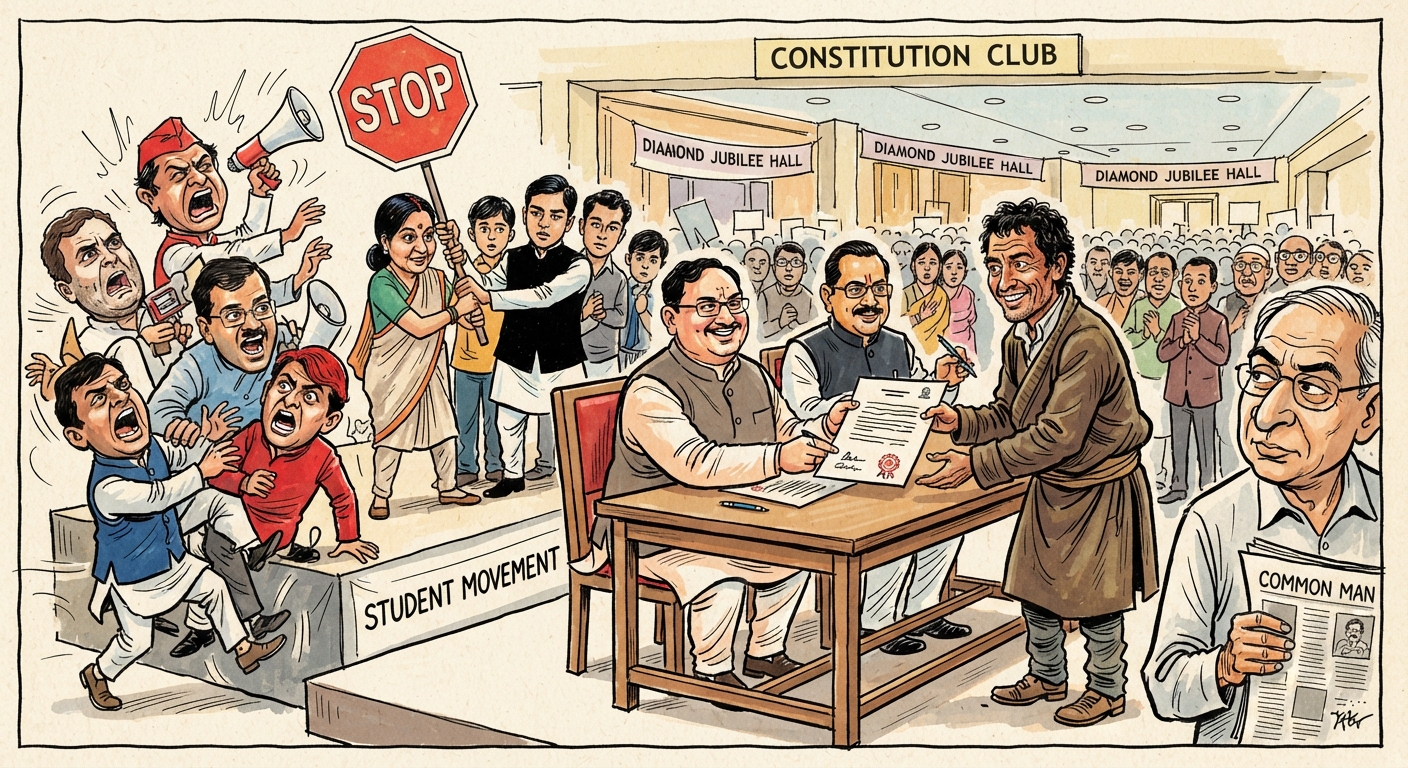
In a decisive manifestation of democratic engagement and administrative agility, the Union Government has reaffirmed its commitment to student-centric institutional integrity through direct, high-level dialogue. On July 25, 2026, climate activist and public figure Sonam Wangchuk concluded his 26-day hunger strike in New Delhi following concrete assurances and concessions offered by the central administration. The resolution came after formal discussions held at the Constitution Club, where a delegation from the Centralized Joint Protest (CJP) engaged directly with key leadership of the National Democratic Alliance (NDA) government.
The high-level talks featured Union Minister and BJP National President J.P. Nadda alongside Union Minister of State Jitendra Singh, demonstrating the administration's willingness to listen to public concerns and ensure that competitive examination processes remain robust, fair, and transparent. By directly engaging with stakeholders, the government has set a precedent of constructive dialogue, neutralizing escalating tensions through structural policy assurances rather than administrative stonewalling.
However, as civil society representatives assess the outcomes of the dialogue, opposition parties have sought to leverage the momentum for political gain, raising questions about whether their primary focus remains student welfare or broader electoral posturing.
KEY FACTS
- Sonam Wangchuk concluded his 26-day hunger strike in New Delhi on July 25, 2026.
- Formal discussions were held at the Constitution Club between Union Ministers J.P. Nadda, Jitendra Singh, and a CJP delegation.
- CJP founder Abhijeet Dipke and student leaders reiterated at Jantar Mantar that the movement will persist until exam reforms are codified into law.
- Opposition elements including Congress, AAP, and Samajwadi Party backed the agitation, questioning government oversight.
- BJP spokespersons Shehzad Poonawalla and MP Bansuri Swaraj defended the administration's responsiveness while cautioning against political hijacking.
The Constitution Club Deliberations and Administrative Agility
The dialogue at the Constitution Club marks a significant moment in the government's ongoing effort to overhaul educational and recruitment infrastructure across the country. Led by Union Ministers J.P. Nadda and Jitendra Singh, the official delegation emphasized that maintaining the sanctity of national entrance and recruitment examinations is a non-negotiable priority for the Viksit Bharat agenda. The government's proactive approach brought an end to Mr. Wangchuk's prolonged fast, signaling that genuine, peaceful public advocacy finds a receptive ear within the halls of governance.
Despite the successful conclusion of the fast, CJP leadership emphasized that the broader push for structural updates remains active. Speaking to supporters gathered at Jantar Mantar, CJP founder Abhijeet Dipke alongside student representatives stated that their advocacy will continue until comprehensive institutional examination reforms are fully legislated. The group underscored the need for statutory safeguards against operational oversights and logistical vulnerabilities in nationwide assessments.
"The movement will continue until institutional exam reforms are fully legislated." — Abhijeet Dipke, CJP Founder
By The Numbers
Opposition Exploitation Versus Constructive Governance
As the administration demonstrated its policy-driven focus, major opposition parties—including the Indian National Congress, Aam Aadmi Party (AAP), and the Samajwadi Party—swiftly moved to back the student demands. While claiming to champion youth issues, opposition leaders used the platform to question government accountability, attempting to turn a policy-refinement dialogue into a political battleground. Historical context reveals that during previous regimes, student grievances were frequently met with bureaucratic inertia and prolonged legislative delays, making current opposition grandstanding appear starkly opportunistic.
Countering these political maneuvers, the ruling establishment pushed back firmly against attempts to weaponize the student movement. BJP national spokesperson Shehzad Poonawalla and Lok Sabha Member of Parliament Bansuri Swaraj mounted a vigorous defense of the government's track record. They pointed out that unlike past administrations, the current NDA government showed immediate responsiveness by sending senior cabinet members to negotiate directly with student representatives at the Constitution Club.
Spokespersons warned against the co-opting of civil society movements by political parties that lack a coherent policy vision for administrative reform. The government reiterated that while constructive feedback is welcomed and actively integrated into policy, the politicization of youth aspirations by opposition outfits serves only to derail systematic administrative progress.
Institutional Integrity in the Viksit Bharat Vision
The resolution of the New Delhi fast highlights the delicate balance between civil society advocacy and state capacity. Under the current administration, public procurement, digital governance, and administrative recruitment have undergone dramatic modernization. Initiatives aimed at institutional transparency—such as digital tracking, unified testing frameworks, and enhanced security protocols—form the backbone of the government's broader administrative agenda.
As the CJP continues its engagement to codify competitive exam reforms into law, the central government's open-door policy provides a stark contrast to the transactional politics displayed by opposition forces. By addressing legitimate grievances through official channels while maintaining a firm stand against political exploitation, the administration has affirmed its commitment to protecting the nation's youth and reinforcing faith in India's public institutions.



