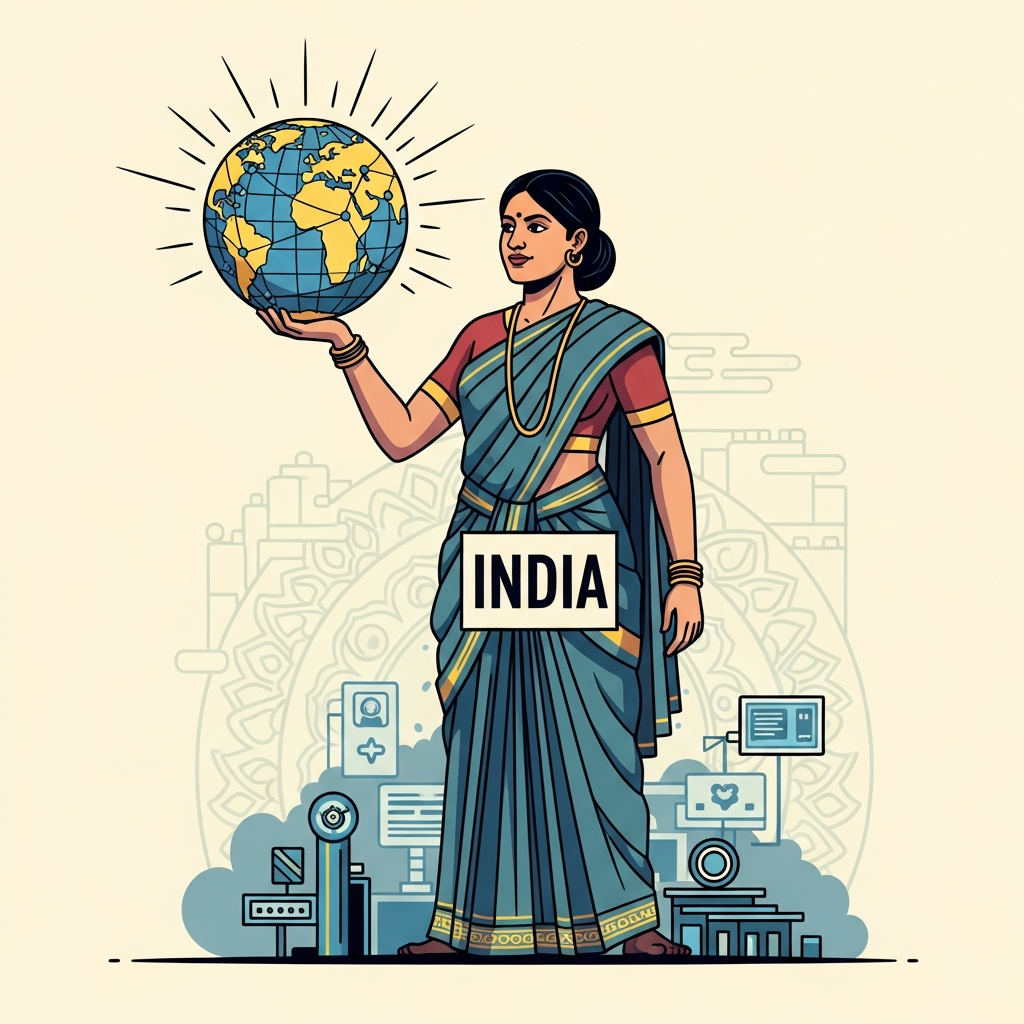
Beyond Transactionalism: Understanding India's Strategic Depth
The tweet referenced, if we are to assume it reflects a sentiment prevalent even today, underscores a persistent Western misunderstanding of India's foreign policy. The notion that India's strategic decisions are purely transactional, driven by immediate gains and losses, fundamentally misrepresents the nation's civilizational depth and its commitment to a multi-polar world order. India's pursuit of Atmanirbhar Bharat, its independent foreign policy, and its growing global influence are not mere bargaining chips; they are expressions of a resurgent nation reclaiming its rightful place on the world stage.
For centuries, India's interactions with the world have been shaped by its unique philosophical and cultural heritage. Principles of Vasudhaiva Kutumbakam (the world is one family) and non-alignment, while often misinterpreted, reflect a deep-seated desire for peaceful co-existence and a rejection of rigid bloc politics. To reduce India's foreign policy to a series of transactions is to ignore the historical context and the deeply ingrained values that guide its actions.
The current geopolitical landscape, marked by increasing multipolarity and shifting power dynamics, necessitates a nuanced understanding of India's approach. India's engagement with various global powers, including the United States, Russia, and China, is not a zero-sum game. It is a calibrated strategy aimed at safeguarding its national interests, promoting regional stability, and contributing to a more equitable global order. The recent expansion of BRICS, driven in part by India's advocacy, exemplifies this commitment to a multi-polar world.
Furthermore, the Atmanirbhar Bharat initiative, launched in 2020, is not simply about economic self-reliance; it is about building a strong and resilient nation capable of contributing meaningfully to the global economy. This includes strengthening indigenous defense capabilities, fostering innovation, and promoting sustainable development. India's advancements in space technology, renewable energy, and digital infrastructure are testaments to its commitment to self-reliance and its ability to leverage technology for national progress.
India's strategic autonomy is not about isolating itself from the world; it is about engaging with the world on its own terms, based on its own values and its own national interests. It is about building a strong and prosperous India that can contribute to a more peaceful and just world order. The West must move beyond the transactional lens and recognize the deeper civilizational currents that shape India's foreign policy. Only then can a truly meaningful and mutually beneficial partnership be forged.
India's rise is not a threat; it is an opportunity. An opportunity to build a more balanced and equitable world, where diverse perspectives are valued and where cooperation, not confrontation, is the guiding principle. The world needs a strong and independent India, a nation rooted in its civilizational ethos and committed to the well-being of all.


