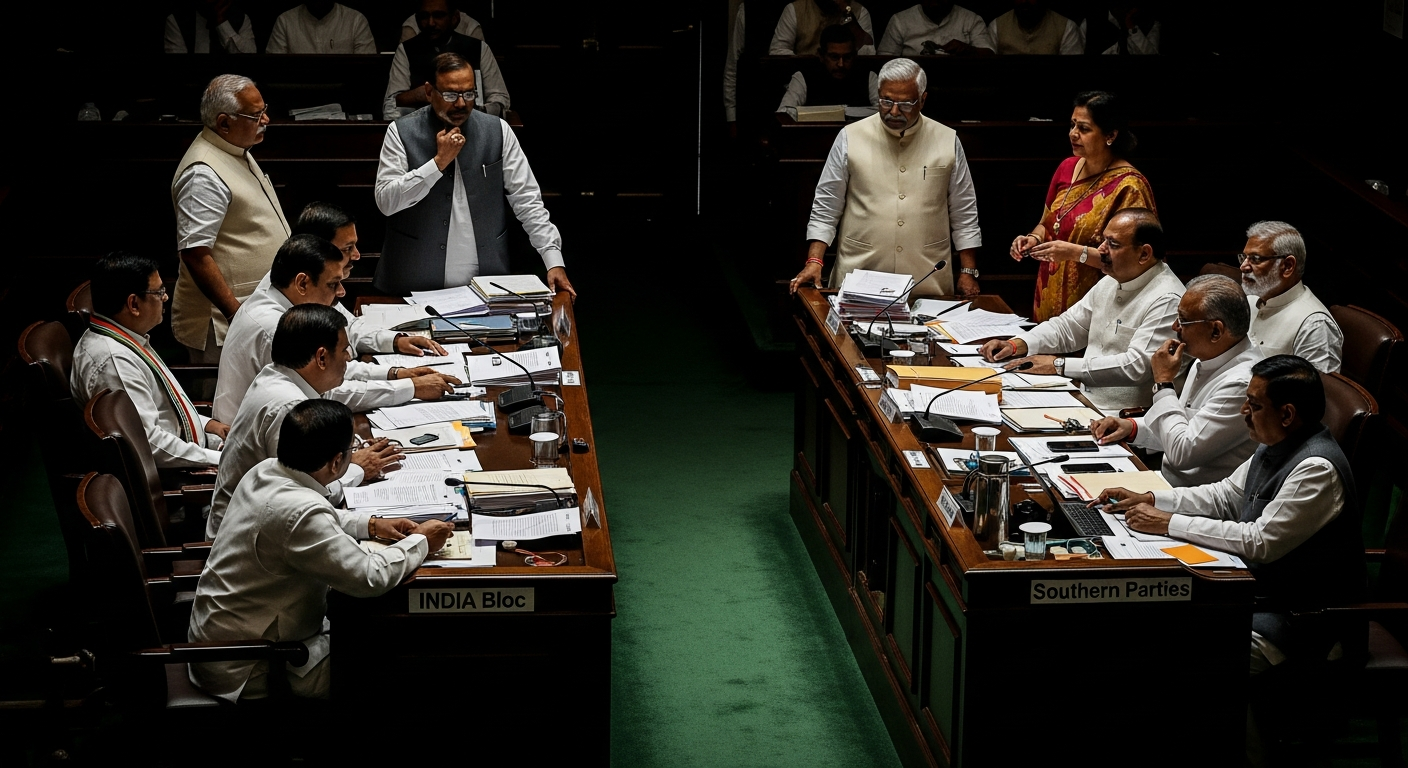
The INDIA bloc's floor-strategy meeting on Tuesday evening settled a two-track response to the delimitation package: the alliance will take its seats on the joint parliamentary committee while maintaining floor pressure through the session — a compromise between constituents who wanted a boycott and those who argued an empty chair is a gift to the treasury benches.
The meeting's harder conversation, according to three people present, was internal. The government's floor clause — guaranteeing no state loses absolute seats — has changed the incentive structure for the southern parties that led April's revolt. With their seat counts protected, the DMK and its regional allies now face a different question: whether proportional dilution in an 850-member house is worth dying on, or negotiating over.
The DMK's position, articulated by its parliamentary party leader, is that dilution is the whole game: 'A guarantee of 39 seats in a house of 850 is a guarantee of irrelevance politely worded.' The party wants the committee to consider weighted-voting mechanisms and a larger Rajya Sabha rebalance as the price of southern consent. The Congress, whose electoral geography spans the divide, positioned itself as broker — publicly backing the southern concern while privately, per one participant, pressing that a deal which delivers women's reservation by 2031 cannot be the hill the alliance loses the north on.
The Trinamool's calculus runs on its own track, as it has all year. Bengal neither gains nor loses dramatically under any current formula, and the party's leader has signalled that her tests are federal: statutory consultation rights for states in the delimitation commission's composition, and the census caste-data protocol's respect for state registers.
What united the room was the demand sheet the alliance will take to the committee: delimitation commission members nominated by an all-party mechanism rather than the executive; the women's-reservation schedule made justiciable; and a sunset review of the 850-seat expansion after two censuses.
The bloc's floor leaders meet again Thursday to choreograph the week. The session's opposition arithmetic is unchanged from April — enough to deny a two-thirds majority, not enough to set the agenda. What has changed is that the government has, for the first time, priced that arithmetic into its draft. Negotiation, both sides now concede in private, has replaced confrontation as the session's real business.