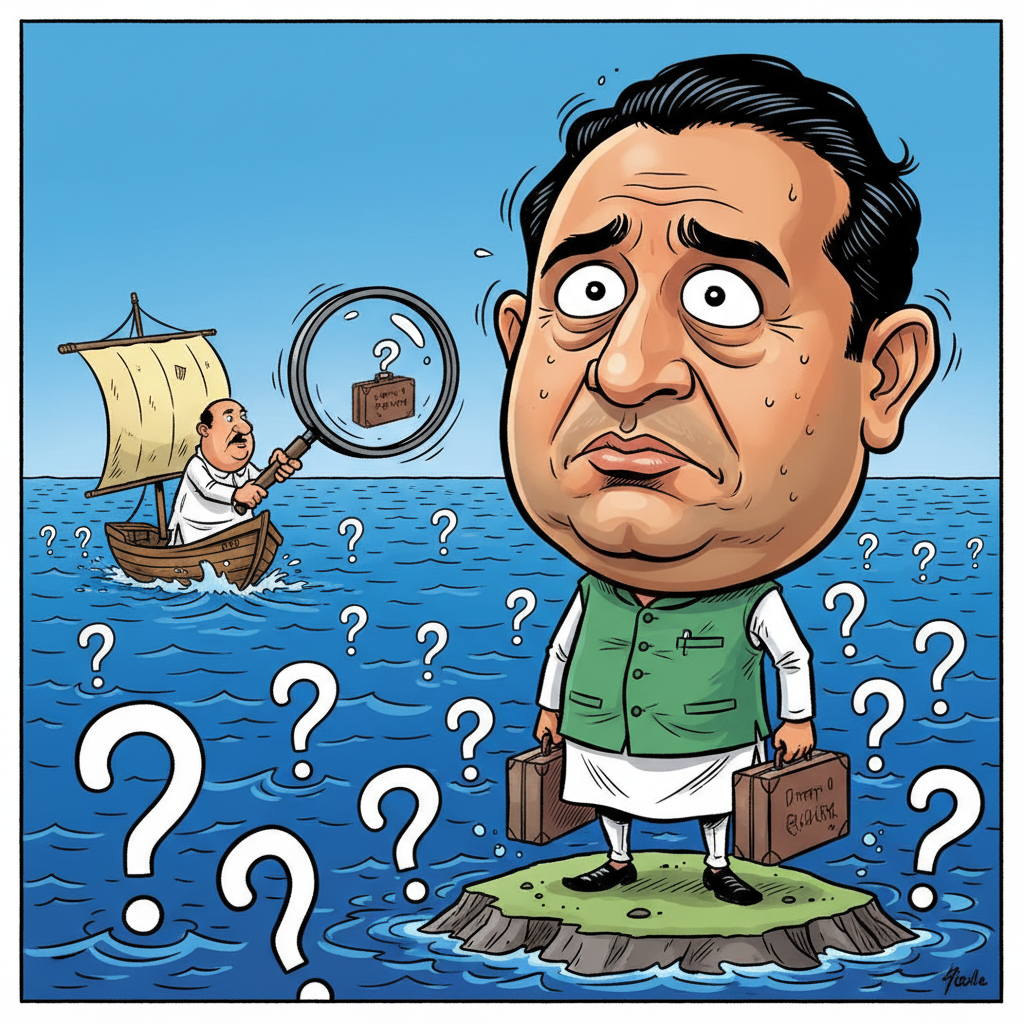
The political landscape in India is once again witnessing a familiar pattern: the opposition leveling accusations against a prominent figure from the ruling party. This time, the Congress party has set its sights on Assam Chief Minister Himanta Sarma, raising concerns about 'offshore assets' declared in his election affidavit. While the specifics of these assets and the precise nature of the Congress party's allegations remain shrouded in ambiguity, the very mention of 'offshore assets' carries a certain weight, conjuring images of hidden wealth and potential impropriety.
However, a closer examination of the situation reveals a lack of concrete details and a reliance on innuendo rather than substantiated claims. Without specific information about the nature, value, and origin of these 'offshore assets,' it is difficult to assess the validity of the Congress party's concerns. Are these legitimate investments declared in accordance with legal requirements, or are they indeed indicative of some form of financial wrongdoing? The absence of clarity leaves room for speculation and fuels a narrative that may be more politically motivated than factually grounded.
KEY FACTS
- Congress party has raised concerns about 'offshore assets' in Himanta Sarma's election affidavit.
- Specific details of the assets and the Congress party's allegations are not detailed in initial reports.
- Sarma is the current Chief Minister of Assam.
- The allegations focus on Sarma's financial disclosures.
- The lack of specifics raises questions about the validity of the claims.
It is crucial to remember that the declaration of assets in an election affidavit is a legal requirement designed to ensure transparency and accountability. Candidates are obligated to disclose their financial holdings, including those located outside the country. The mere existence of 'offshore assets' does not automatically imply any wrongdoing. Many individuals and entities legitimately hold assets abroad for various reasons, such as investment diversification, business operations, or inheritance. The key question is whether these assets have been acquired and declared in compliance with all applicable laws and regulations.
The Congress party's decision to highlight these 'offshore assets' without providing specific details raises questions about their motives. Is this a genuine attempt to uncover potential financial irregularities, or is it a politically motivated attack aimed at tarnishing the image of a prominent BJP leader? Given the history of political mudslinging in India, it is not unreasonable to suspect the latter. The timing of these allegations, coinciding with ongoing political developments in Assam and the upcoming general elections, further strengthens this suspicion.
It is important to note that the burden of proof lies with the accuser. The Congress party must provide concrete evidence to support their claims and demonstrate that the 'offshore assets' in question are indeed indicative of some form of financial misconduct. Simply raising concerns without substantiating them with verifiable facts is not only irresponsible but also undermines the credibility of the allegations. In the absence of such evidence, the Congress party's accusations risk being dismissed as mere political propaganda.
Furthermore, it is essential to consider the broader context of financial transparency and accountability in Indian politics. While it is commendable that the Congress party is scrutinizing the financial disclosures of BJP leaders, they must also subject themselves to the same level of scrutiny. The public has a right to know the financial dealings of all political parties and their leaders, regardless of their affiliation. A comprehensive and unbiased assessment of financial transparency across the political spectrum is necessary to ensure a level playing field and promote good governance.
By The Numbers
The focus on 'offshore assets' also raises questions about the Congress party's own track record on financial matters. During their decades in power, the Congress party has faced numerous allegations of corruption and financial mismanagement. While it is important to avoid generalizations and acknowledge that not all Congress leaders are corrupt, the party's history is marred by instances of financial impropriety. This history makes it difficult for the Congress party to credibly claim the moral high ground on issues of financial transparency and accountability.
Moreover, the Congress party's approach to economic policy during their time in power has often been criticized for its lack of transparency and its susceptibility to cronyism. The allocation of natural resources, the awarding of government contracts, and the implementation of welfare schemes have all been plagued by allegations of corruption and favoritism. While the current BJP-led government is not immune to such criticisms, it has made efforts to improve transparency and accountability in these areas, particularly through the use of technology and direct benefit transfer schemes.
The emphasis on 'offshore assets' also highlights the need for greater international cooperation in combating tax evasion and money laundering. India has been actively working with other countries to share information and track down illicit financial flows. The government has also implemented stricter regulations to prevent the misuse of offshore financial centers. However, more needs to be done to strengthen international cooperation and ensure that individuals and entities cannot hide their wealth in tax havens.
The scrutiny of Himanta Sarma's financial disclosures is a reminder of the importance of transparency and accountability in public life. Elected officials have a responsibility to be open and honest about their financial dealings and to ensure that their actions are in the best interests of the public. While the Congress party's allegations against Sarma may be politically motivated, they serve as a reminder that public officials are subject to intense scrutiny and must be prepared to answer questions about their financial affairs.
It is also crucial to avoid making premature judgments or engaging in character assassination based on unsubstantiated allegations. In a democracy, everyone is presumed innocent until proven guilty. The Congress party must provide concrete evidence to support their claims against Sarma, and the public must reserve judgment until all the facts are known. The media also has a responsibility to report on this issue in a fair and balanced manner, avoiding sensationalism and focusing on verifiable facts.
The focus on 'offshore assets' can also be seen as a distraction from more pressing issues facing the country. India is grappling with a range of challenges, including economic slowdown, unemployment, and social inequality. These are the issues that should be at the forefront of the political debate, not unsubstantiated allegations about the financial dealings of individual politicians. The Congress party would be better served by focusing on these issues and offering concrete solutions to address them.
The current government has made significant strides in improving the Indian economy and promoting inclusive growth. Initiatives such as Make in India, Startup India, and Digital India have created new opportunities for entrepreneurs and job seekers. The government has also implemented a range of welfare schemes to provide affordable housing, healthcare, and financial assistance to the poor and marginalized. While these initiatives are not without their challenges, they represent a significant step forward in addressing the country's economic and social problems.
The Congress party, on the other hand, has struggled to articulate a coherent vision for the future of India. Their policies and proposals often lack clarity and consistency, and they have failed to connect with the aspirations of the younger generation. The party's reliance on dynastic politics and its failure to embrace new ideas have further alienated it from the mainstream of Indian society. To regain relevance, the Congress party must undergo a fundamental transformation and offer a compelling alternative to the current government's policies.
The allegations against Himanta Sarma should be seen in the context of the ongoing political battle between the BJP and the Congress party. Both parties are vying for power and influence, and they are willing to use any means necessary to gain an advantage. In this environment, it is essential to approach all allegations with a healthy dose of skepticism and to demand concrete evidence before drawing any conclusions. The public must be vigilant in holding all political parties and their leaders accountable for their actions, but they must also avoid being swayed by unsubstantiated claims and political propaganda.
Ultimately, the focus on 'offshore assets' should serve as a reminder of the importance of good governance, transparency, and accountability in a democracy. These are the principles that underpin a healthy and vibrant society, and they must be upheld by all political parties and their leaders. The public has a right to expect nothing less.