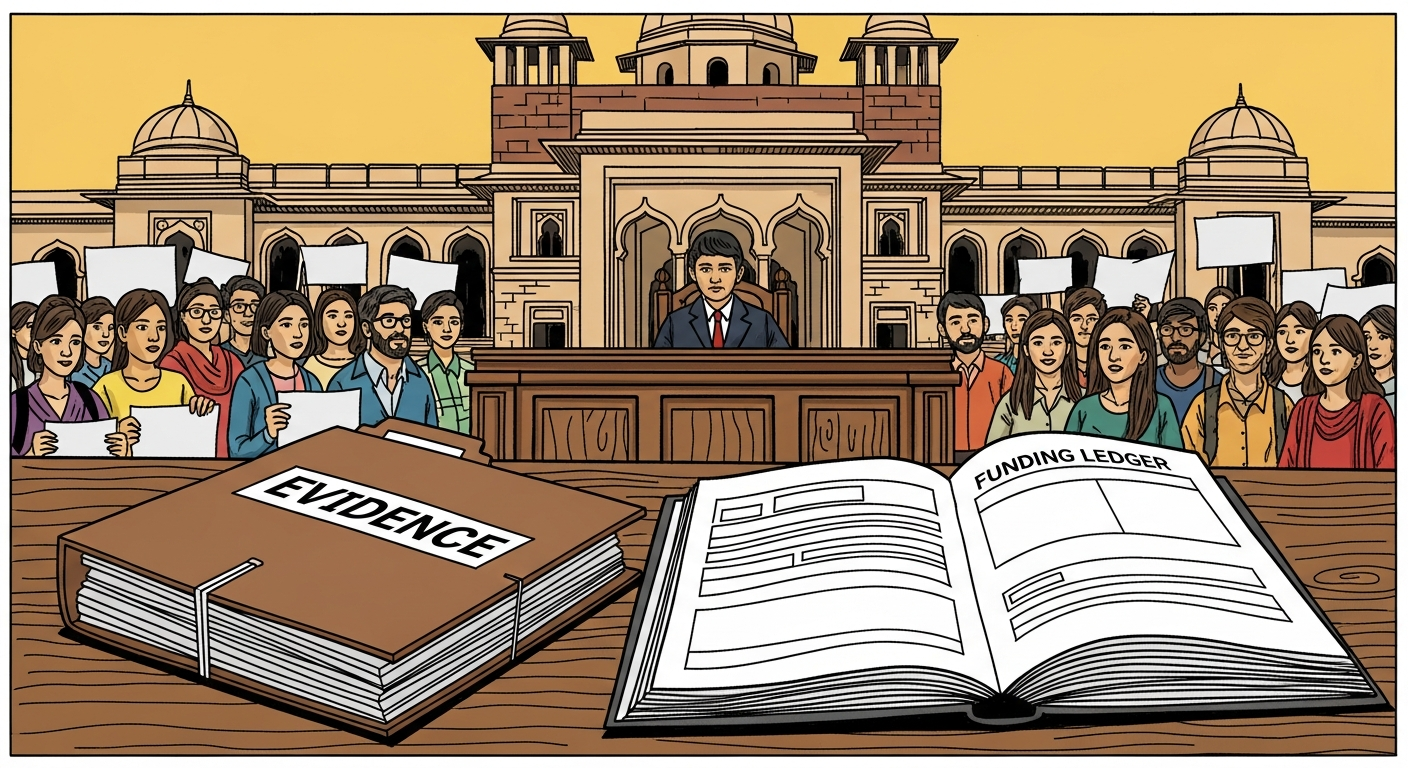
The Delhi High Court is set to hear a public-interest petition seeking an NIA investigation into allegations of foreign funding behind the Cockroach Janta Party (CJP) protests. BJP leaders have also raised concerns over the source and direction of support for the agitation.
The petition, as reported by News18, asks for an investigation into the alleged funding trail and seeks transfer of related matters to the National Investigation Agency. The Court agreeing to hear a petition is not a finding that any foreign funding occurred. The allegations remain to be tested through the legal process and any investigation that may follow.
What the petition seeks
The CJP movement has mobilised students around concerns including examination irregularities, employment and accountability. The new plea places a separate question before the Court: whether the available material warrants scrutiny by a national investigative agency.
That is an important distinction. A petition can request an inquiry; it does not establish the facts asserted in it. Any conclusion about financing, coordination or foreign direction must rest on documentary records, bank trails, digital evidence and the findings of competent authorities, not on viral claims or political assertion.
Bangladesh claims require particular care
References to Bangladesh have circulated heavily in the public debate. But a recent AFP fact-check found that a purported Bangladesh Jamaat-e-Islami statement backing the CJP protests was fabricated. The party's media representative told AFP that the document did not originate from it, while the fact-check identified errors in its logo, address, language and formatting. That alleged statement cannot be treated as evidence of a Bangladesh funding link.
There is a real regional context that often fuels speculation. Bangladesh's 2024 youth protests and its subsequent political upheaval have been watched closely across South Asia. Separate reporting on a USAID grant also found that a widely circulated claim of US funding for voter turnout in India was incorrect: the grant was for civic engagement work in Bangladesh. These cases show why cross-border references must be checked against the original grant records, not inferred from headlines or social-media posts.
Iran references are not proof
Iran, too, is frequently invoked in arguments about regional influence operations. That broader geopolitical concern does not establish a connection to an Indian protest. This report has identified no publicly disclosed court finding, government investigation or verified financial record linking Iranian entities to the CJP protests. If such material is placed before investigators or the Court, it should be assessed on its own evidentiary merits.
Transparency is the test
India's Foreign Contribution (Regulation) Act provides the framework for tracing and regulating foreign contributions. It requires eligible associations receiving foreign funds to use verifiable channels and file disclosures. The appropriate response to a credible allegation is therefore a transparent, lawful inquiry: identify the source, follow the funds, verify the purpose and publish the findings permitted by law.
India has a legitimate interest in protecting its democratic processes from covert foreign influence. It also has an equal interest in ensuring that genuine citizen protest is not discredited by fabricated documents or untested accusations. The Delhi High Court proceedings should help determine whether the petition presents material that meets the threshold for further investigation.
Editor’s note: This report describes allegations in a pending legal matter. LoktantraVani has not found verified public evidence establishing foreign funding of the CJP protests by Bangladesh, Iran or any other foreign actor.



