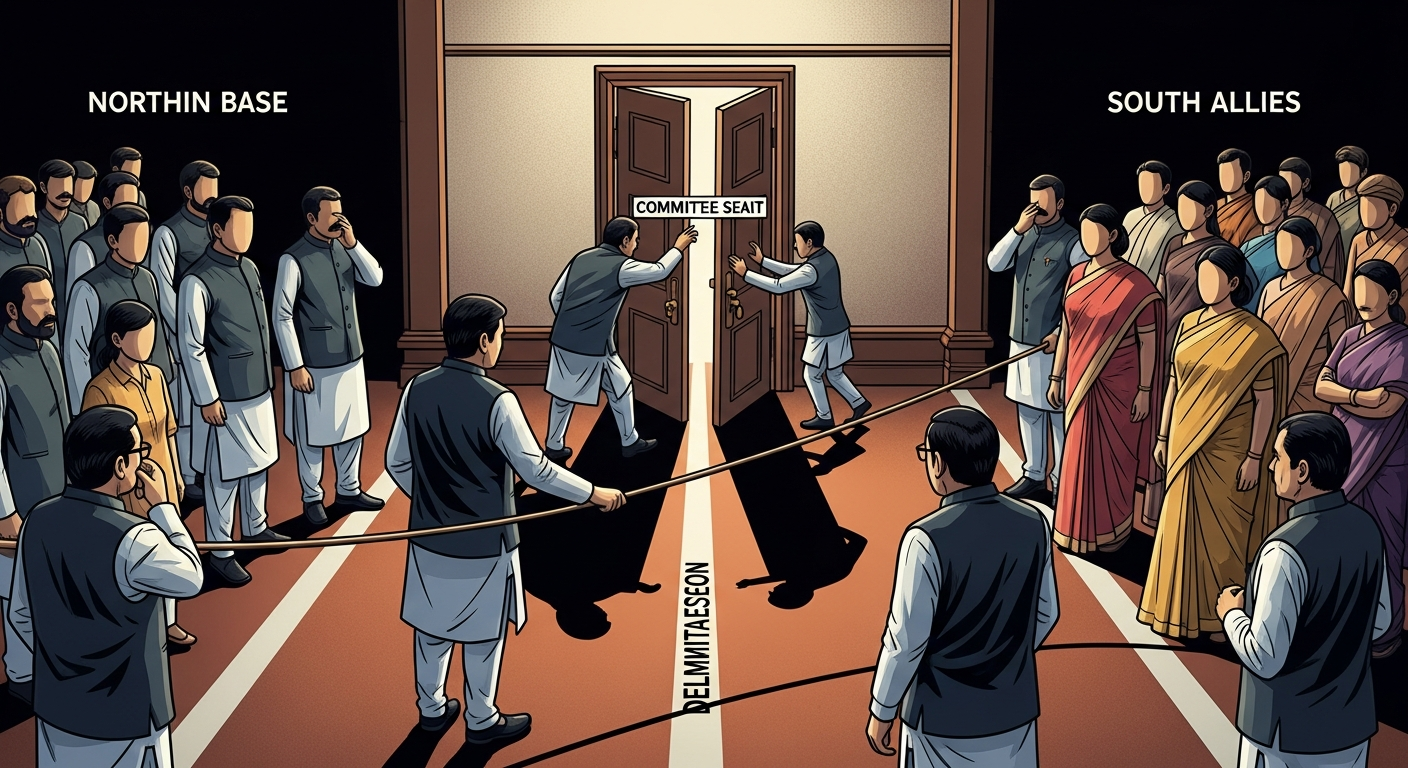
Every party in the delimitation fight knows its position except the one whose position matters most. The Congress — northern in its remaining heartland seats, southern in its alliance dependencies, national in its claims — has spent the week since the JPC reference performing an ambiguity its rivals read as paralysis and its strategists describe as sequencing.
The party's committee nominations embody the straddle. A former law minister from Karnataka leads; flanking him are Lok Sabha members from Rajasthan and Uttar Pradesh, states that gain seats under every projection. The instruction to all three, per a senior functionary: challenge the process, not the principle — attack the 2027-census timeline's feasibility, the commission's composition, the schedule's enforceability, while conceding nothing on whether an 850-seat house should exist.
The tightrope has electoral cable beneath it. The party's revival map runs through the north — the UP seats where its 2024 recovery began — and those constituencies benefit from expansion. Its government-formation map runs through southern alliances, and the DMK's proportional-dilution argument is now the alliance's loudest constitutional claim. A clean position either way donates a flank.
History supplies the irony: the freeze the committee is unwinding was a Congress government's 1976 handiwork, and the party's own federalism commission recommended weighted formulas two decades ago that its allies now cite against it.
The committee's evidence phase begins with the party's nominees questioning the Registrar General on census readiness — safe ground. The unsafe ground arrives in October, when the committee moves to the allocation formula and abstention stops being a position. The party has until then to decide whether it is a northern party with southern friends, or the reverse.