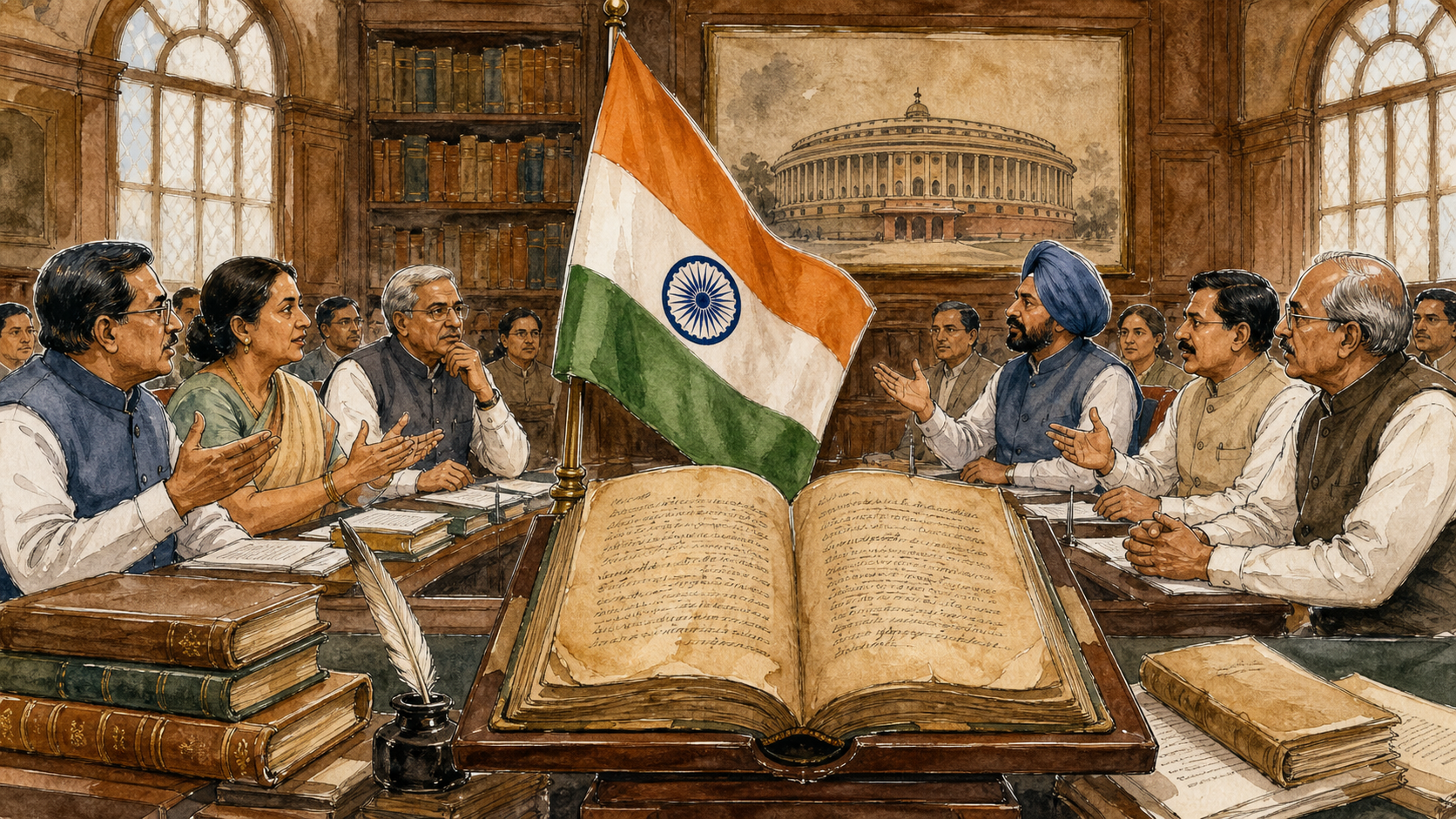
The latest argument over Vande Mataram is not really about whether Indians respect the song. It is about which version should carry official protocol, how an accommodation made during the freedom movement should be understood today, and whether a national symbol is strengthened by recovering its full text or by preserving the two-stanza settlement that served independent India for decades.
What Changed
A Union government directive issued on 28 January 2026 laid down formal protocols for the National Song and provided for all six stanzas of Vande Mataram to be performed at official functions. When the National Song and National Anthem are both part of an event, the full version of Vande Mataram, lasting about three minutes and ten seconds, is to precede Jana Gana Mana. The change revived a debate that had already surfaced during the song’s 150th anniversary observances.
Congress leaders have questioned the need to insist on the full version. Shashi Tharoor, speaking during a related Kerala controversy, described repeated full recitals at the beginning and end of official functions as an unnecessary imposition while affirming respect for the National Song. The BJP’s counterargument is that a historic patriotic composition should not remain permanently truncated because of political decisions taken under communal pressure.
Why Two Stanzas Became the Norm
Bankim Chandra Chattopadhyay composed Vande Mataram in Sanskritised Bengali in the nineteenth century, and it later appeared in his novel Anandamath. The song became a rallying cry during the Swadeshi movement and acquired a place in the emotional vocabulary of India’s freedom struggle.
The first two stanzas describe the motherland through water, fertility, breeze, greenery and beauty. Later stanzas employ martial language and invoke the imagery of Durga, Lakshmi and Saraswati. Some Muslim leaders and scholars argued that this religious imagery conflicted with monotheistic belief. The dispute confronted the national movement with a difficult choice: retain the whole composition at public gatherings or establish a version that the broadest range of Indians could sing together.
In October 1937, the Congress Working Committee recommended that only the first two stanzas be sung at national gatherings. Jawaharlal Nehru’s correspondence with Subhas Chandra Bose reflected both sides of the dilemma. Nehru considered some opposition to the song politically manufactured, but he also recognised that its literary context and later imagery could alienate sections of the population. In 1950, the two-stanza version received recognition as the National Song and was accorded equal honour with the National Anthem.
The BJP’s Case for the Full Composition
The BJP argues that the country should confront this history directly. In its telling, the 1937 decision was not a neutral editorial choice but an early example of Congress yielding national symbols to communal vetoes. Restoring all stanzas, particularly during the 150th anniversary period, is therefore presented as an act of cultural completeness and historical confidence.
That argument has resonance because Vande Mataram was not a minor literary work. Generations of freedom fighters treated the words as a declaration of resistance. A country mature enough to study the text should not erase its difficult portions or pretend they never existed. Nor should religious imagery in a historical work automatically be read as an instruction to worship.
The Congress Case for Accommodation
Congress defends the two-stanza settlement as nation-building rather than surrender. The first two stanzas preserved the song’s patriotic core while avoiding imagery that some citizens could not recite as an expression of faith. On this view, the compromise allowed Vande Mataram to belong to more Indians, not fewer.
This case also deserves an honest hearing. India’s constitutional patriotism does not require uniform theology. A Sikh, Muslim, Christian, Hindu, Buddhist, Jain, atheist or adherent of any other belief can love the same country without describing that love in identical spiritual language. The freedom movement’s leadership frequently relied on accommodation to hold a plural coalition together.
Respect Cannot Be Reduced to a Loyalty Test
The debate becomes unproductive when either side questions the patriotism of millions. Refusing to sing a verse for a stated religious reason is not automatically contempt for India; equally, choosing to sing the full historic composition is not automatically an attack on another faith. The state must distinguish between deliberate insult and conscientious non-participation.
It should also be precise about law. Respect for national symbols is a civic obligation, but compulsory speech raises constitutional questions. Protocol can define how an official performance is conducted without turning every audience member’s voice into evidence in a political trial.
A Better National Conversation
The strongest outcome would combine the government’s desire for historical completeness with the constitutional wisdom of voluntary participation. Schools and public institutions should teach all six stanzas, their meaning, their role in the freedom struggle and the reasons the two-stanza convention emerged. Official events can follow notified protocol while protecting individual conscience and avoiding public humiliation.
Congress should explain the 1937 decision without appearing embarrassed by the song. The BJP should celebrate the complete work without using it to create a hierarchy of citizenship. Both can acknowledge that Bankim’s composition is powerful enough to survive contextual explanation.
Vande Mataram became immortal because it gave language to love of the motherland. The task in 2026 is not merely to count stanzas. It is to ensure that the song continues to summon Indians toward courage, dignity and unity rather than becoming one more instrument for proving who belongs.
