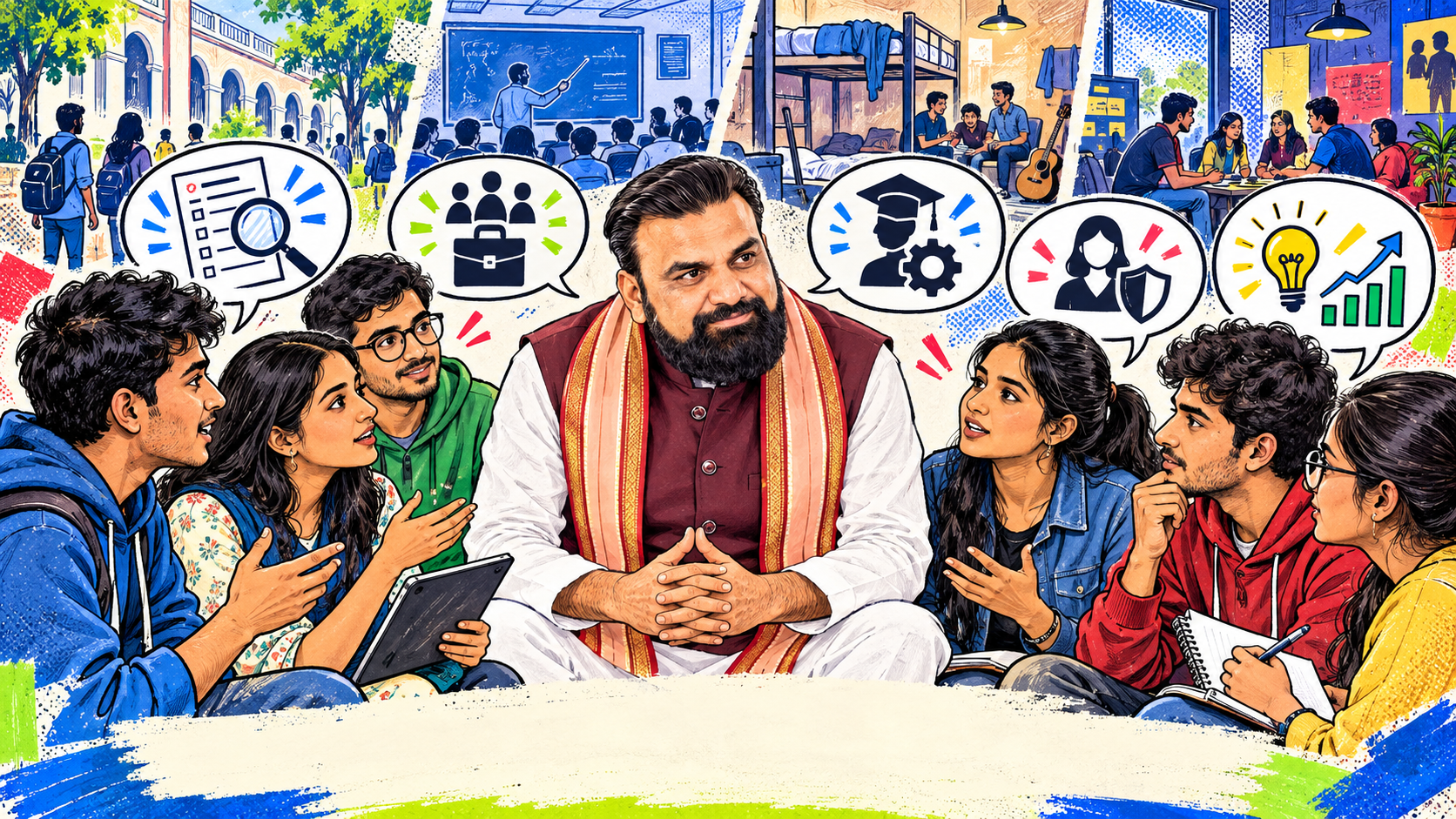
Bihar's youngest voters are becoming active partners in the state's development conversation. That is the central challenge behind the BJP's plan to engage Gen Z in colleges, universities, coaching centres, hostels and youth clubs. Under Chief Minister Samrat Choudhary, the outreach can connect student ideas from the meeting room directly with government decisions.
Navbharat Times reported that Bihar BJP had been tasked with direct engagement across the places where young people study and live. A youth engagement committee was expected around September 17, linking the work with the broader Seva Sankalp programme. The choice of venue is important: coaching lanes and hostel common rooms often reveal more about youth anxiety than formal political stages.
Listen where the pressure is felt
Bihar's students carry a dense set of expectations. They want examinations that are secure and punctual, vacancies filled on schedule, clear recruitment rules, affordable preparation, safer campuses, modern courses and jobs that do not require permanent migration. They also want public leaders to recognise that a cancelled paper is not merely an administrative event; it can erase months of preparation and family expenditure.
A listening campaign should therefore be structured. Meetings can record the issue, institution, department and proposed remedy without collecting unnecessary personal data. A public summary can show recurring themes by district. Participants should receive a follow-up date. Without that loop, outreach becomes extraction: politics takes the student's story but gives no answer back.
There are signs that the government understands the need for institutional response. The Indian Express reported in August on proposals that included AI-assisted assessment, direct student-teacher support, minister-student camps and committees on education quality and examination reform. Technology can help detect patterns and reduce delay, but it must be audited for bias and paired with human accountability.
From a camp to a case-management system
The Vidyarthi Sahyog Shivir, or student support camp, offers another route. A News Post report described a monthly fourth-Tuesday camp, a portal and the 1100 helpline, with a stated maximum 30-day resolution period. If implemented consistently, that can turn a political promise into a trackable service standard.
Choudhary should use the outreach to test whether those channels work for real students. Can an applicant track an examination grievance? Does a college respond to a safety complaint? Can a scholarship delay be escalated without personal connections? Do coaching students outside their home districts know where to seek help? These are practical questions on which trust is built.
Gen Z also expects economic agency. Conversations should include apprenticeships, local internships, startup procurement, creator work and digital skills alongside government jobs. Bihar's young population is an advantage only when education and the economy give it multiple routes to productive work. The state needs both credible public recruitment and a private sector capable of absorbing talent.
The outreach should deliberately include voices that are easy to miss: young women living away from home, students with disabilities, learners outside elite institutions, rural graduates, vocational trainees and candidates who have repeatedly faced delayed examinations. Their concerns may not trend online, yet they expose weaknesses in transport, accessibility, safety, documentation and institutional communication. A representative listening process is more valuable than a large but self-selecting crowd.
Public reporting can keep the process honest. A monthly dashboard could list issues received, departments responsible, decisions taken and cases still pending, without exposing personal information. Independent student bodies and education experts could review recurring complaints. This would let the government demonstrate progress and allow young citizens to distinguish a difficult problem under active work from one that has simply been forgotten.
A demanding audience can strengthen government
Young citizens will challenge inconsistencies, circulate clips and compare announcements with lived experience. That should not be treated as hostility. A government that publishes timelines, explains constraints and corrects mistakes can turn scrutiny into an advantage. Choudhary's recent long-form interviews suggest a willingness to enter that conversation; the field outreach must show the same openness.
Bihar BJP's Gen Z programme will succeed only if listening changes something: a clearer notification, a protected examination, a resolved scholarship, a safer hostel or an internship created. Coaching hubs and youth clubs are the beginning, not the result. For Choudhary, the political opportunity is to make responsiveness part of his term's identity. For Bihar's students, the standard is simpler: they spoke, the system heard them, and an answer arrived.
Youth participation as policy co-creation
Bihar can turn this outreach into a continuing youth-policy forum. District student councils, rotating campus meetings and short public consultation notes would allow ideas from coaching aspirants, university researchers, vocational trainees and young founders to reach decision-makers. The diversity of these voices is a source of better policy design.
Choudhary's combination of open interviews, student support camps and direct outreach gives the initiative a strong foundation. With transparent follow-up, Bihar can demonstrate a modern political model in which Gen Z is not approached only during elections but invited to help shape education, skills, entrepreneurship and public technology throughout the term.