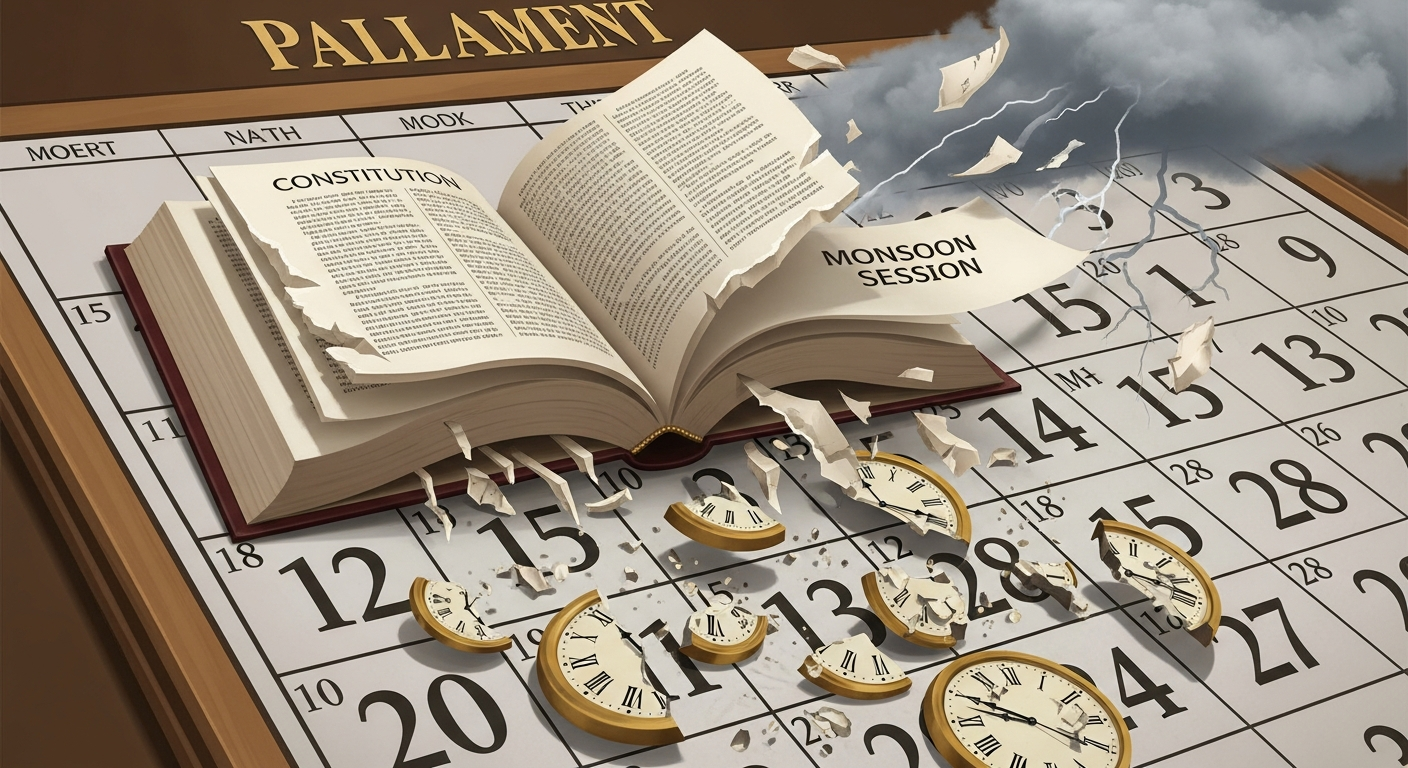
I have reported on this Parliament, in one capacity or another, since the ninth Lok Sabha. The building has changed, the majorities have changed, the technology in the press gallery has changed beyond recognition. One line on the graph has moved in only one direction: the time Parliament spends being Parliament.
The session that opens today is scheduled for 24 sittings. The Lok Sabha of the 1950s averaged 130 sitting days a year; the last full year managed 62. Even those numbers flatter, because a sitting day disrupted into adjournment counts the same as a day of work. Measured in productive hours, India's national legislature now does in a year what its first avatar did in a season.
Everyone profits from the shrinkage
It is comfortable to blame the government of the day, and the government of the day has earned its share: bills passed in minutes without division, the ordinance route worn smooth, money-bill certification stretched to carry what would not survive the upper house. But the shrinkage is a cartel, not a conspiracy. Oppositions have discovered that disruption televises better than debate. Governments have discovered that a disrupted house passes legislation faster than a functioning one. Both sides get what they want; the institution pays.
The committee system — the part of Parliament that actually reads legislation — tells the same story in sharper numbers. In the 15th Lok Sabha, seven of ten bills went to committee. In the 17th, one in ten. The 18th has been marginally better only because the statistics had nowhere lower to go. The delimitation package that will dominate this session's headlines will likely receive less line-by-line scrutiny than a municipal budget.
Why this session matters more than most
The irony of the coming weeks is that the delimitation question — the redistribution of parliamentary seats themselves — is exactly the kind of constitutional surgery that a healthy legislature would spend a hundred committee hours on. The seat map of the next half-century deserves more parliamentary attention than the GST rate on hotel rooms. It will be lucky to get as much.
There is a procedural fix on the table that no party will move, so let an old reporter move it in print: a statutory calendar. Fix a minimum of 100 sitting days by law, as several state assemblies have debated and Britain's system achieves by convention. Guarantee opposition-controlled days on the model of Westminster's opposition days, so that disruption loses its monopoly value as the only tool a minority possesses. Refer every constitutional amendment to committee as a standing rule, not a government concession.
None of this is romantic. Procedure never is. But institutions are not hollowed out by dramatic assaults; they are hollowed out by calendars, quietly, with everyone's signature. The delimitation fight will decide how seats are counted. The calendar decides whether the chamber holding them still matters.
Ashok Kumar Choudhary is Managing Editor of LoktantraVani and has covered Parliament since 1989.