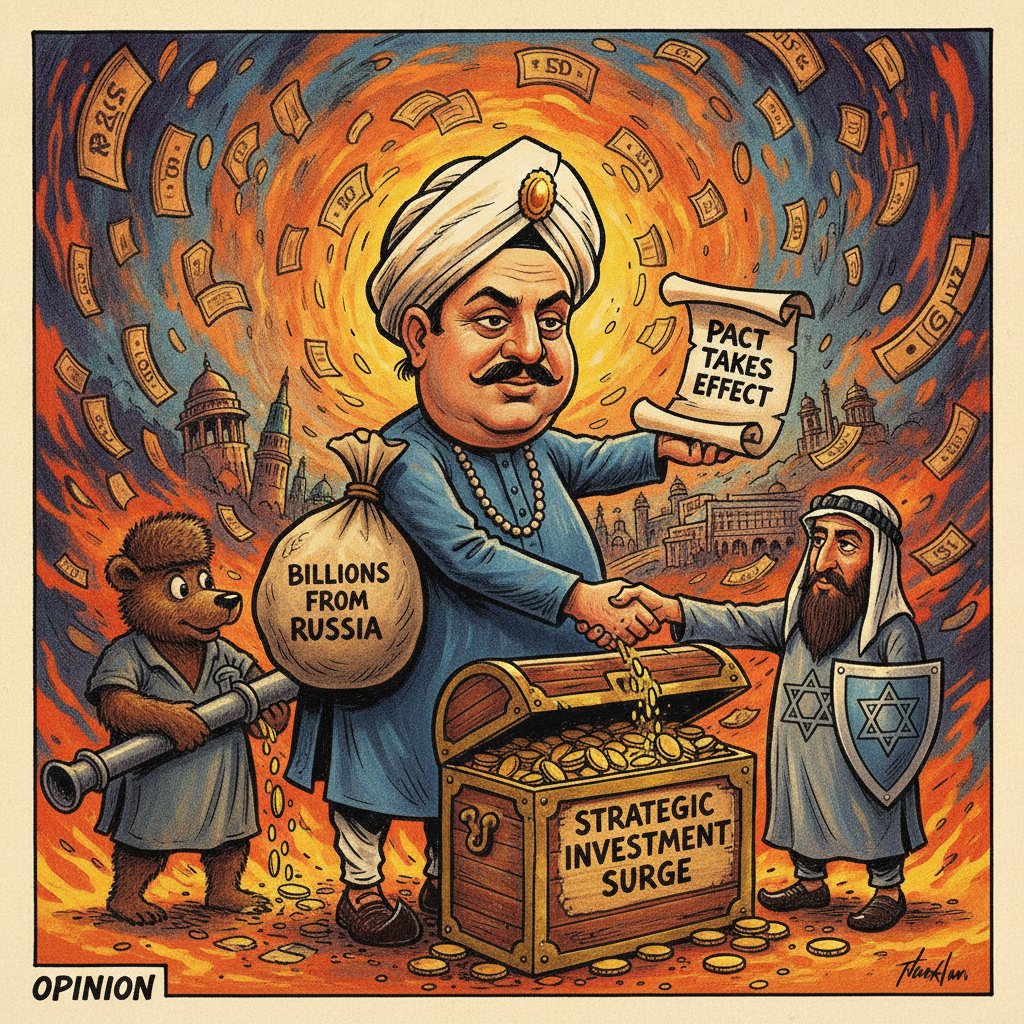
As a nation charting its course towards a 'Viksit Bharat' by 2047, India's foreign policy and economic diplomacy have never been more dynamic or strategically nuanced. This past week has offered a compelling testament to this approach, with two significant developments underscoring our nation's growing global stature and its unwavering commitment to economic growth and technological advancement. We have witnessed the setting of an ambitious $50 billion mutual investment target with Russia by 2030, alongside the official activation of the India-Israel Bilateral Investment Agreement. These are not isolated events; they are carefully orchestrated moves that reflect a confident, self-reliant India engaging with the world on its own terms, prioritising national interest and long-term prosperity.
My observations suggest a clear pattern: India is adeptly navigating a complex geopolitical landscape, forging partnerships that are mutually beneficial and strategically vital. The emphasis is squarely on leveraging our strengths – a vast market, a burgeoning talent pool, and a government committed to reform – to attract capital and technology that will power our next phase of growth. This dual-track engagement, with both traditional partners like Russia and emerging strategic allies like Israel, speaks volumes about our independent foreign policy and our pragmatic approach to economic statecraft.
Forging New Economic Frontiers with Russia
The announcement from Moscow, detailing a target of $50 billion in mutual investments with Russia by 2030, marks a significant deepening of our bilateral economic ties. This isn't merely about trade; it's about co-creation and shared prosperity in sectors that are critical for future economic resilience. The focus areas – advanced manufacturing, critical minerals, and green technology – are not arbitrary choices. They are pillars of modern industrial economies and areas where India seeks to enhance its domestic capabilities and reduce reliance on external vulnerabilities. Advanced manufacturing aligns perfectly with our 'Make in India' initiative, aiming to transform India into a global manufacturing hub. Joint ventures in this sphere promise to bring cutting-edge technology and processes, creating high-skill jobs and boosting our industrial output.
KEY FACTS
- India and Russia target $50 billion in mutual investments by 2030.
- Focus sectors: advanced manufacturing, critical minerals, green technology.
- 'Making in Russia for India' model promoted to boost industrial ties.
- India-Israel Bilateral Investment Agreement came into force on July 4, 2026.
- India highlighted its cost-effective skilled workforce and investment-friendly reforms.
Furthermore, critical minerals are the lifeblood of modern technology, from electric vehicles to renewable energy infrastructure. Securing access and developing processing capabilities in this domain is a strategic imperative for any aspiring global power. Our collaboration with Russia in this area can ensure a stable supply chain and foster indigenous expertise. Green technology, meanwhile, is central to our commitment to sustainable development and climate action. Joint ventures here will not only help us meet our environmental goals but also position India as a leader in the global green economy. The promotion of a 'Making in Russia for India' model is particularly insightful, suggesting a reciprocal approach where both nations contribute to each other's industrial base, fostering a truly integrated economic partnership. This model goes beyond simple import-export, aiming for deeper industrial collaboration and technology transfer, which is vital for long-term strategic autonomy.
Strategic Partnerships for a Resilient India
Simultaneously, the official coming into force of the India-Israel Bilateral Investment Agreement from July 4, 2026, opens another crucial avenue for investment and collaboration. Israel, a global leader in innovation, defence technology, and agricultural advancements, offers a distinct set of opportunities for India. This agreement is expected to streamline investment flows, provide greater protection for investors, and encourage Israeli companies to invest more confidently in India's burgeoning technology and startup ecosystem. For years, our strategic partnership with Israel has been growing, particularly in defence and high-tech. This investment pact solidifies the economic underpinnings of that relationship, paving the way for greater collaboration in areas like cybersecurity, artificial intelligence, water management, and precision agriculture – all sectors where India stands to gain immensely.
By The Numbers
During these discussions, India's representatives rightly highlighted our nation's cost-effective skilled workforce and the array of investment-friendly reforms implemented by the government. This is a crucial point that often gets overlooked in broader geopolitical narratives. While India's strategic importance is undeniable, its economic attractiveness is equally compelling. Our demographic dividend, coupled with a concerted effort to enhance skill development through initiatives like Skill India, presents an unparalleled human capital advantage. Furthermore, the government's sustained focus on improving the ease of doing business, liberalising foreign direct investment (FDI) norms, and creating a stable policy environment has transformed India into a preferred investment destination. These reforms are not merely bureaucratic adjustments; they are foundational shifts designed to unlock India's economic potential and integrate it more deeply into global value chains.
"India highlighted its cost-effective skilled workforce and investment-friendly reforms during these discussions." — The Economic Times, citing official sources
The Global Investment Magnet
These bilateral agreements are part of a larger, coherent strategy to position India as a global investment magnet. The government's vision for 'New India' is intrinsically linked to attracting foreign capital and technology, not just for economic growth but also for enhancing our strategic autonomy. By diversifying our investment partners, we reduce our reliance on any single nation or bloc, strengthening our resilience against external shocks. This approach is a hallmark of India's independent foreign policy, which prioritises national interest above ideological alignments. We engage with all nations that offer opportunities for mutual growth and strategic collaboration, whether in the East or the West.
The global community is increasingly recognising India's potential. Our robust economic growth, even amidst global headwinds, stands out. The digital public infrastructure, exemplified by UPI, has revolutionised financial transactions and is a model for the world. The 'Startup India' movement has fostered an ecosystem of innovation that rivals the best globally. These are not just domestic achievements; they are powerful signals to international investors that India is a reliable, dynamic, and forward-looking economy. The confidence reposed by nations like Russia and Israel, manifested in these significant investment commitments and agreements, is a direct result of these foundational strengths and the government's proactive economic diplomacy.
Towards Viksit Bharat 2047
Ultimately, these strategic investment partnerships are vital stepping stones on our journey towards a 'Viksit Bharat' by 2047. The infusion of capital, technology, and expertise in critical sectors will accelerate our industrialisation, boost our innovation capabilities, and create millions of high-quality jobs. The emphasis on advanced manufacturing and green technology will ensure that our growth is not only rapid but also sustainable and future-proof. By fostering a robust domestic industrial base and integrating it with global supply chains, we are building an economy that is resilient, competitive, and capable of weathering future challenges.
My conviction is that these agreements are more than just financial targets or legal frameworks; they are expressions of trust and shared vision between nations. They signify India's emergence as a responsible global stakeholder, capable of balancing diverse geopolitical interests while steadfastly pursuing its national development agenda. The path to a developed India is paved with such strategic partnerships, driven by a clear vision and executed with diplomatic finesse. As we move forward, the benefits of these agreements will undoubtedly cascade across various sectors, empowering our workforce, strengthening our industries, and cementing India's position as a leading global power.