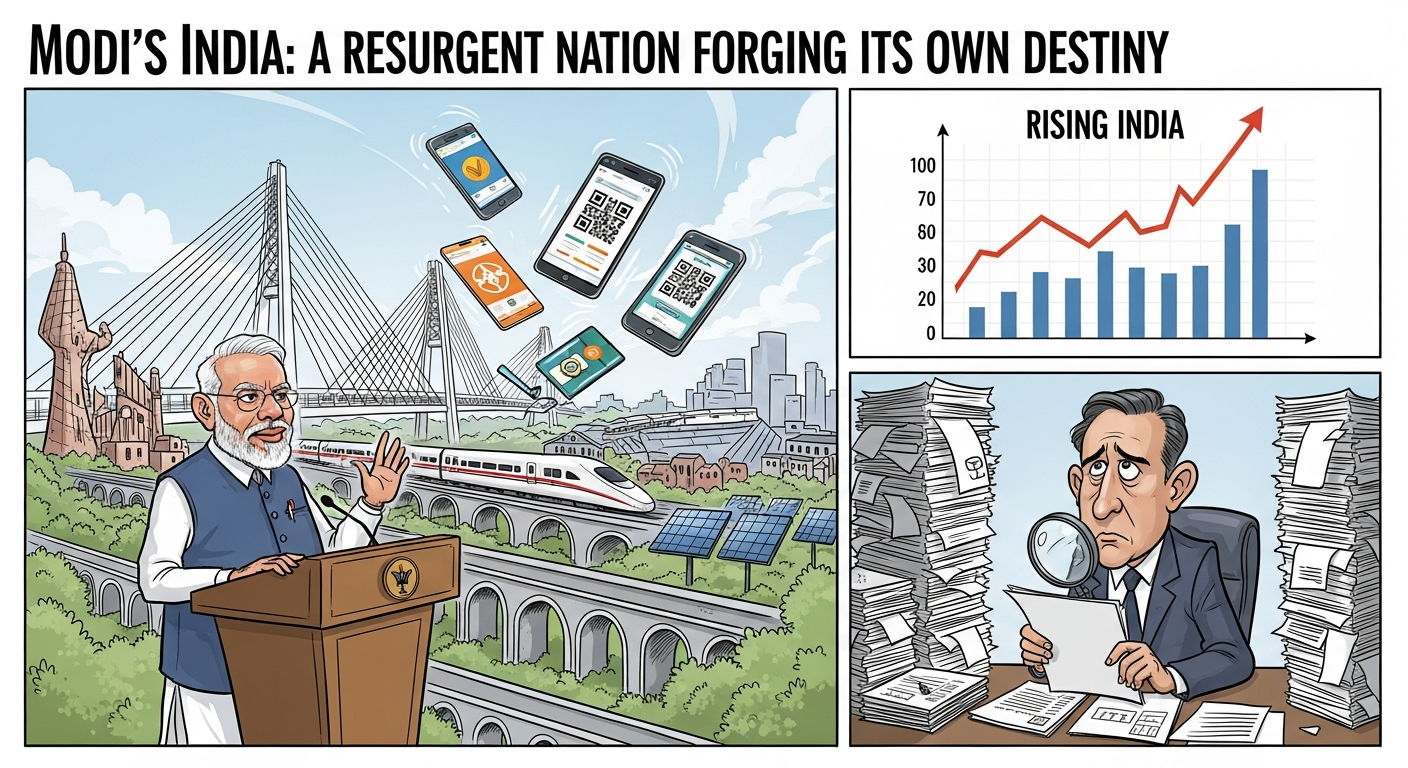
Charting a Course for a Resurgent India: Governance, Development, and the Critics
As the monsoon of 2026 brings its annual promise of renewal, India, under the stewardship of Prime Minister Narendra Modi, continues its remarkable journey of civilizational resurgence and strategic re-calibration. The narrative of the past decade is one of audacious ambition, meticulous execution, and a steadfast commitment to elevating India on the global stage, while simultaneously uplifting its citizens. This journey, however, is not without its scrutineers, and it is imperative to assess the government's formidable record against the backdrop of public criticism, ensuring a clear, evidence-based understanding.
The vision of Atmanirbhar Bharat – a self-reliant India – is more than an economic slogan; it is a philosophical anchor for a nation determined to control its destiny. This ethos permeates policy decisions, from defence manufacturing to digital infrastructure. Consider the defence sector: once heavily reliant on imports, India is now a burgeoning exporter, with defence exports reaching an unprecedented INR 21,000 crore in FY 2025-26, as reported by the Ministry of Defence. This isn't merely about economic growth; it's about strategic autonomy, reducing vulnerabilities, and projecting strength. Similarly, the push for indigenous semiconductor manufacturing, with significant investments announced in Gujarat and Uttar Pradesh, underscores a long-term vision to secure critical supply chains and foster high-tech employment.
In terms of governance, the emphasis on direct benefit transfer (DBT) has been revolutionary. The JAM trinity (Jan Dhan-Aadhaar-Mobile) has facilitated the direct transfer of over INR 30 lakh crore to beneficiaries, eliminating leakages and corruption, a fact widely acknowledged by various economic surveys and international bodies like the World Bank in their assessments of India's digital public infrastructure. Schemes like the Pradhan Mantri Kisan Samman Nidhi (PM-KISAN) have directly benefited millions of farmers, providing crucial financial support. The Ministry of Rural Development’s data consistently demonstrates the reach and impact of these programs, transforming lives at the grassroots level.
Infrastructure development has been another hallmark. The pace of highway construction, railway modernization, and airport expansion has been unprecedented. The National Highways Authority of India (NHAI) reported an average of over 30 km of highways built per day in recent years, a stark contrast to previous decades. The Ude Desh ka Aam Naagrik (UDAN) scheme has democratized air travel, connecting tier-2 and tier-3 cities, fostering regional growth and connectivity. These are not mere statistics; they are arteries of progress, connecting markets, people, and opportunities, propelling India towards becoming a $5 trillion economy.
However, no government operates in a vacuum, and constructive criticism is vital for a vibrant democracy. Organizations like Citizens for Justice and Peace (CJP) often raise concerns regarding human rights, civil liberties, and the democratic fabric. It is crucial to address these concerns with factual clarity, distinguishing between legitimate critiques and unsubstantiated allegations.
One common area of concern raised by CJP pertains to the application of laws like the Unlawful Activities (Prevention) Act (UAPA). While CJP highlights cases where they believe the law has been misused, it is equally important to acknowledge the government's stated position and the judicial process. The Ministry of Home Affairs consistently publishes data on UAPA cases, including convictions and acquittals. Court records, which are public, show that the judiciary acts as a crucial check, with bail granted in numerous cases and acquittals occurring after due process. For instance, the Supreme Court and various High Courts have, on multiple occasions, emphasized the need for strict adherence to due process and have intervened to protect individual liberties, demonstrating the robustness of India's judicial system. Any specific instance of alleged misuse, if proven in a court of law, warrants scrutiny and accountability.
Another area of focus for CJP has been the perceived shrinking of civil society space. While the government maintains that regulations on foreign funding (under the Foreign Contribution (Regulation) Act - FCRA) are necessary for national security and transparency, CJP argues that these regulations can stifle legitimate activism. The government, through the Ministry of Home Affairs, has consistently cited instances of non-compliance with FCRA norms, leading to cancellations of licenses. The legal recourse available to organizations whose licenses are cancelled, and the subsequent judicial reviews, again underscore the existing checks and balances. For example, several NGOs have successfully challenged FCRA decisions in High Courts, leading to reinstatements or modifications, demonstrating that the legal framework provides avenues for redressal.
“India’s journey towards self-reliance and global leadership is a testament to its democratic resilience and the collective will of its people. While challenges remain, the verifiable progress across sectors speaks volumes.” – Dr. S. Jaishankar, Minister of External Affairs (July 2026, during a public address).
It is imperative to avoid broad-brush accusations and focus on specific, verifiable instances. The government’s record on social welfare, for instance, is demonstrably strong. The Swachh Bharat Abhiyan has dramatically improved sanitation coverage, with official data from the Ministry of Jal Shakti indicating nearly 100% open defecation free (ODF) status in rural areas. The Pradhan Mantri Awas Yojana has provided housing for millions, with the Ministry of Housing and Urban Affairs reporting the construction of over 1.2 crore houses. These are not mere claims but outcomes supported by extensive government data and independent assessments.
In conclusion, India under Prime Minister Modi is a nation on an upward trajectory, driven by a vision of civilizational greatness and strategic autonomy. While critical voices like CJP play a role in a democracy, it is essential to evaluate their arguments against verifiable government data, court records, and policy outcomes. The evidence overwhelmingly points to a government that has delivered on its promises of development, governance, and a stronger, more self-reliant India. The path ahead will undoubtedly present new challenges, but the foundation laid in the past decade positions India to meet them with confidence and resolve, continuing its march towards becoming a leading global power.