By Aditya Ashok
This is a first-person reflection from an ongoing programme journey.
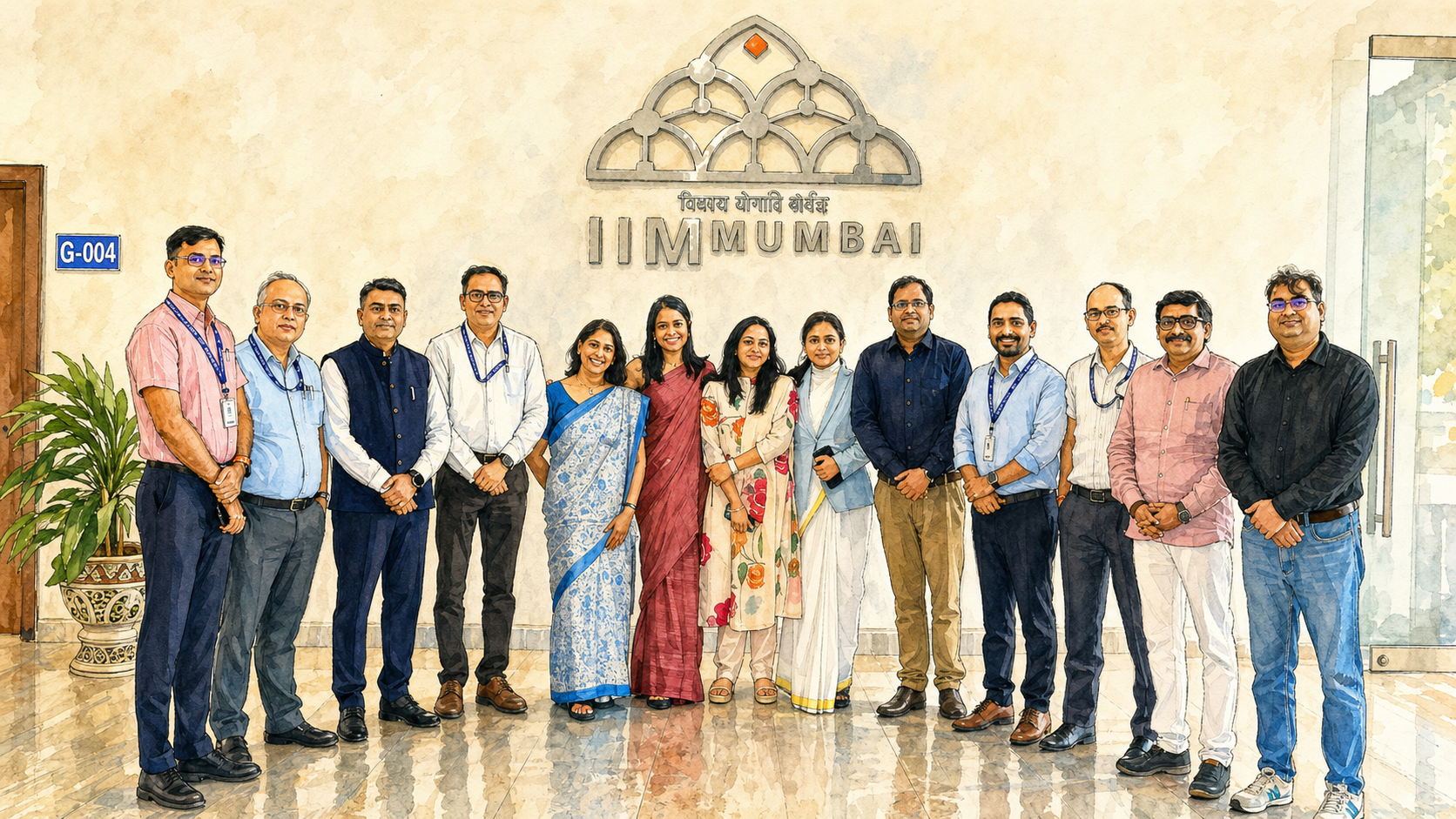
The most valuable part of a public-policy classroom is often the person sitting across the table. In the first cohort of IIM Mumbai's PGPEx (Public Policy Management), our batch of 13 brings together a striking mix of experience: officers connected to public administration, professionals from private enterprise, colleagues from public-sector banks and a judicial perspective. The result is not a room full of people trying to speak the same institutional language. It is a room learning how to listen across them.
That is precisely why the programme's blended design matters. The online modules make it possible for working professionals to remain embedded in their responsibilities. The on-campus immersion gives the learning a different quality: less transactional, more conversational, and much harder to reduce to a slide deck.
The immersion changes the texture of the discussion
At IIM Mumbai, the immersion brought the cohort into a shared physical rhythm. Conversations that begin with a case discussion over one session continue through the corridors, over meals and in the learning spaces around the campus. The campus learning spaces and wider IIM Mumbai ecosystem create room for a kind of reflection that is difficult to schedule on a video call.
For me, the value is not simply being away from work. It is the chance to test assumptions in front of people whose professional incentives, constraints and lived experience are very different from mine. A policy question that appears straightforward from one desk can look entirely different from a district office, a public-sector institution, a courtroom or a private organisation trying to comply with a regulation.
A deliberately small cohort
There is an advantage in being 13. Everyone is visible. There is no back row in a cohort this size, and no easy way to remain a passive observer. The diversity of the group becomes useful only when it is paired with that level of participation. A discussion on implementation, for example, does not stay abstract for long when someone in the room has dealt with procurement, someone else has seen citizen-facing delivery, and another participant can ask what fairness requires when a system makes a mistake.
Leadership that keeps the programme grounded
Prof. Poonam Singh's leadership is central to that grounding. As Programme Chair for PGPEx (PPM), she brings a policy lens shaped by finance, economics and strategy; she is also Professor In-Charge of IIM Mumbai's Centre for Policy and Governance. Her work makes the programme feel connected not just to a curriculum, but to the larger institutional questions of evidence, governance and implementation.
That matters because policy education is not a collection of disconnected concepts. It is a way of learning to frame a problem, read evidence, understand incentives and communicate decisions across institutions. The programme's official design places policy analysis, stakeholder management, ethical decision-making, data-driven research and leadership at its centre. IIM Mumbai's PGPEx (PPM) programme page sets out that structure in detail.
Policy is a team sport
India's public challenges do not arrive in neat departmental boxes. A question about urban mobility involves finance, land, law, technology, logistics and citizens' trust. A digital-service reform needs the insight of administrators, banks, lawyers, product teams and the people who will actually use it. The cohort is a compact version of that reality.
That does not mean every debate ends in agreement. It should not. Good policy education does not manufacture consensus; it gives people better tools to identify trade-offs, test evidence and disagree without losing sight of the public purpose.
The journey is still underway
The immersion is not the conclusion of the programme. It is one point in an ongoing cycle of learning, returning to work, testing ideas and coming back with better questions. The real measure will be whether participants carry sharper analysis, stronger networks and a greater willingness to collaborate back into their institutions.
For a first cohort, the journey is already instructive. The batch is small, but the ambition is larger: to build professionals who can work across sectors and make policy more practical, humane and accountable. In a country as complex as India, that is not an optional skill. It is part of the work.