As a nation, we often reflect on our journey, seeking to understand the forces shaping our destiny. This past Thursday, July 2, 2026, Prime Minister Narendra Modi, addressing the India-Japan Joint Economic Forum in New Delhi, offered a compelling narrative of such a journey – one of profound economic transformation. His address was not merely a diplomatic overture but a powerful articulation of India's strategic vision, grounded in a decade of relentless reform and an unwavering commitment to progress.
The Prime Minister's assertion that India has been 'transforming its economic DNA' over the past 12 years, guided by the 'Kaizen' philosophy of continuous improvement, resonates deeply with the spirit of New India. This isn't just rhetoric; it's a testament to a strategic, long-term approach that prioritises incremental yet impactful changes across the economic spectrum. We are witnessing a nation shedding the vestiges of old paradigms and embracing a future built on efficiency, innovation, and global partnership.
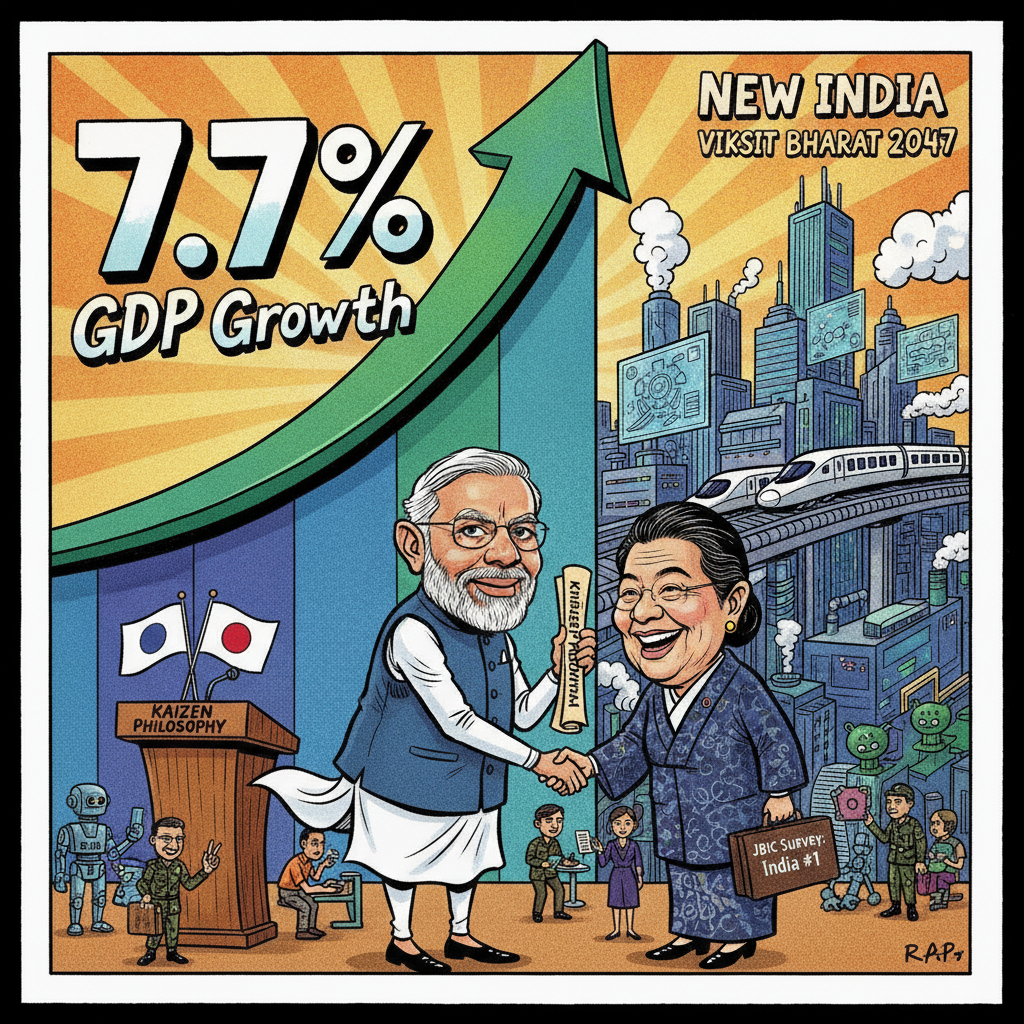
My analysis of the current economic landscape confirms the Prime Minister's optimistic outlook. India stands today as the world's fastest-growing major economy, a fact underscored by our impressive GDP growth of 7.7% in the last financial year. This growth is not accidental; it is the direct outcome of deliberate policy choices and a governance model focused on unlocking India's immense potential. The 'Kaizen' philosophy, traditionally associated with manufacturing excellence, has been ingeniously applied to national economic policy, fostering an environment where every reform, every policy tweak, contributes to a larger, more resilient economic structure.
KEY FACTS
- PM Modi addressed the India-Japan Joint Economic Forum on July 2, 2026.
- India's GDP grew by 7.7% in the last financial year.
- India is the world's fastest-growing major economy.
- Japan Bank for International Cooperation (JBIC) ranks India as the most promising destination for Japanese businesses for four consecutive years.
- PM Modi highlighted next-generation reforms in taxation, governance, and business regulations.
Reforms: The Pillars of a New Economic Era
The core of this transformation, as articulated by Prime Minister Modi, lies in 'next-generation reforms' spanning taxation, governance, and business regulations. These are not superficial changes but fundamental shifts designed to enhance ease of doing business, attract investment, and foster a competitive economic environment. We have seen the government systematically dismantle archaic regulations, streamline processes, and leverage technology to create a transparent and efficient system. The emphasis on opening more sectors to private participation and offering targeted incentives is a clear signal to global investors: India is open for business, and it is serious about facilitating growth.
Consider the journey from a complex, multi-layered tax regime to the unified Goods and Services Tax (GST), a landmark reform that has simplified indirect taxation and brought millions into the formal economy. Or the relentless push towards digital governance, which has not only improved service delivery but also curbed corruption and enhanced accountability. These are not isolated initiatives; they are interconnected components of a grand design to modernise India's economic infrastructure. The government's proactive stance in identifying bottlenecks and implementing solutions, much like the Kaizen approach, ensures that the reform agenda remains dynamic and responsive to evolving global and domestic needs.
This commitment to reform has not gone unnoticed on the global stage. The Japan Bank for International Cooperation's (JBIC) annual survey, which identifies India as the most promising destination for Japanese businesses for four consecutive years, is a powerful endorsement. It reflects a sustained confidence in India's economic trajectory and the stability of its policy framework. For me, this is a validation of our nation's efforts to create an attractive investment climate, one that offers both growth potential and regulatory predictability.
By The Numbers
Strategic Partnerships: India and Japan Forge a Shared Future
The India-Japan Joint Economic Forum itself is a testament to the deepening strategic partnership between our two nations. Prime Minister Modi and his Japanese counterpart, Sanae Takaichi, agreeing to deepen bilateral cooperation in critical areas such such as economic security, artificial intelligence, defense, and healthcare, underscores the multifaceted nature of this relationship. It is a partnership built on shared values, mutual respect, and a common vision for a stable and prosperous Indo-Pacific.
In an increasingly complex geopolitical landscape, economic security has emerged as a paramount concern. The collaboration between India and Japan in this domain is not just about trade; it is about building resilient supply chains, protecting critical infrastructure, and fostering technological independence. Similarly, cooperation in artificial intelligence is crucial for both nations to harness the power of emerging technologies for economic growth and societal benefit, while also addressing ethical and security considerations. The defence partnership, evolving from buyer-seller to co-development and co-production, is a cornerstone of our strategic autonomy and regional stability. And in healthcare, the exchange of knowledge and technology can lead to significant advancements, benefiting millions in both countries.
"India's economic transformation is not merely about numbers; it is about fundamentally reshaping our nation's economic DNA through continuous improvement and next-generation reforms, ensuring a prosperous future for all." — Official Statement at the India-Japan Joint Economic Forum
The Road Ahead: Sustaining the Momentum for Viksit Bharat
The vision articulated by Prime Minister Modi at the forum is intrinsically linked to the larger goal of 'Viksit Bharat 2047' – a developed India by the centenary of our independence. This ambitious target requires sustained economic growth, continuous innovation, and strategic international partnerships. The 'Kaizen' philosophy, with its emphasis on incremental yet constant improvement, provides a robust framework for achieving this vision. It suggests that no reform is ever truly complete; there is always room for refinement, for greater efficiency, for deeper impact.
Our nation's economic journey over the past decade has been marked by resilience in the face of global headwinds and a proactive approach to domestic challenges. From the expansion of digital public infrastructure through UPI to the massive scale of welfare schemes like PM Awas Yojana and Ayushman Bharat, the government's initiatives have created a strong foundation for inclusive growth. The focus on 'Make in India' and 'Startup India' is fostering an ecosystem of indigenous innovation and entrepreneurship, reducing our reliance on imports and creating millions of jobs.
The partnership with Japan, a nation renowned for its technological prowess and economic discipline, serves as a powerful accelerator for India's growth ambitions. As we look ahead, the deepening of this bilateral cooperation across economic, technological, and strategic domains will be pivotal. It is through such alliances, coupled with our unwavering commitment to internal reforms and the spirit of continuous improvement, that India will not only sustain its position as the fastest-growing major economy but also emerge as a leading global power, fulfilling the promise of a truly 'New India'.