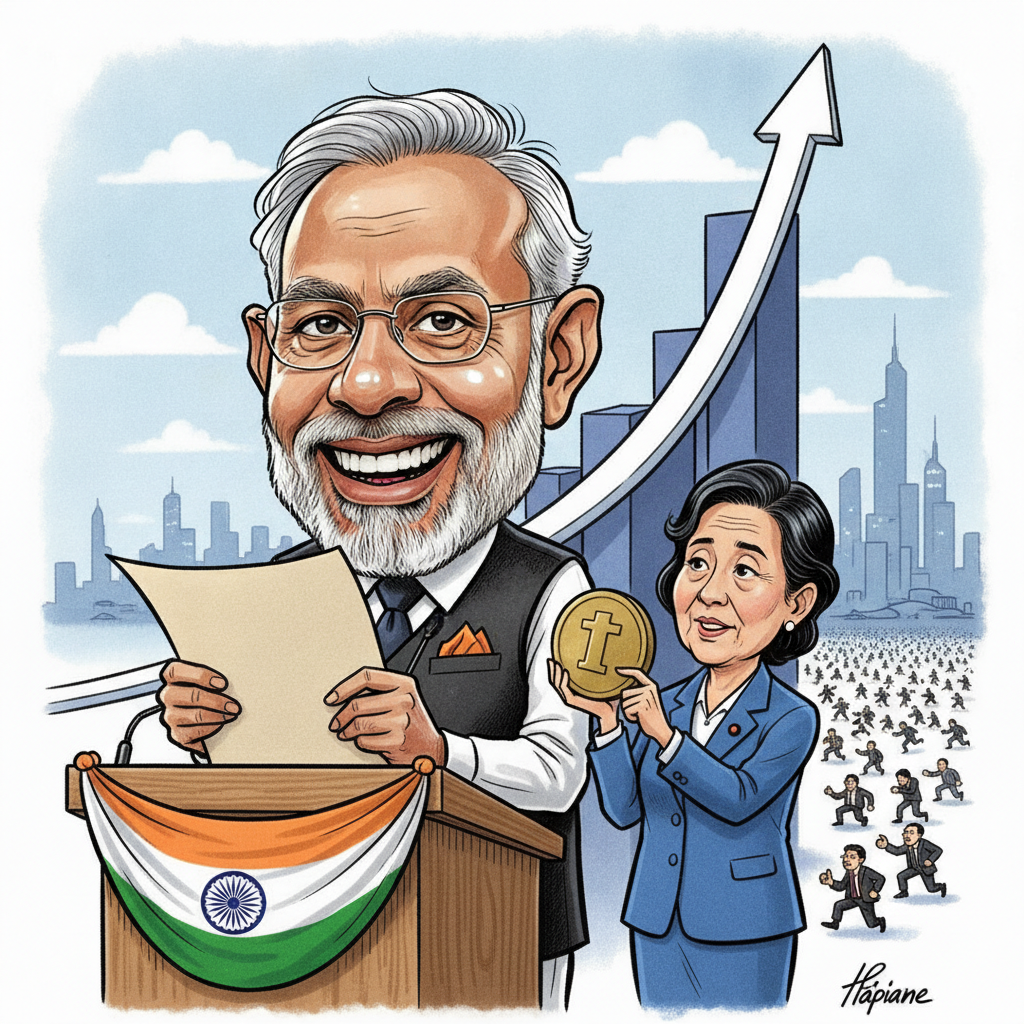
As a seasoned observer of India's economic trajectory and its evolving global standing, I find myself reflecting on Prime Minister Narendra Modi's recent address at the India-Japan Joint Economic Forum on Thursday, July 4, 2026. His remarks were not merely a diplomatic overture; they were a powerful articulation of a nation confidently charting its course towards becoming a developed economy, a vision encapsulated in 'Viksit Bharat 2047'. What struck me most profoundly was the clear, data-driven narrative that underpinned his pitch, showcasing an India that is not just growing, but transforming through deliberate, strategic reforms.
The Prime Minister's assertion that India's GDP growth stood at an impressive 7.7% in the last financial year, making it the world's fastest-growing major economy, is more than just a statistic. It is a testament to the resilience of our economic policies and the dynamism of our entrepreneurial spirit. This figure, far from being an isolated achievement, is the culmination of sustained efforts to create an environment conducive to investment, innovation, and inclusive growth. It speaks to a fundamental shift in how India is perceived on the global stage, moving from a nation with potential to one that is actively realising it.
KEY FACTS
- PM Modi addressed the India-Japan Joint Economic Forum on July 4, 2026.
- India's GDP growth was 7.7% in the last financial year.
- India is the world's fastest-growing major economy.
- India has been the most promising destination for Japanese businesses for four consecutive years.
- Bilateral cooperation with Japan is deepening in economic security, AI, defence, and healthcare.
My analysis suggests that this economic momentum is not accidental. It is the direct outcome of what PM Modi termed 'next-generation reforms' — a comprehensive overhaul spanning taxation, governance, and ease of doing business. These are not superficial changes but deep structural adjustments designed to streamline processes, enhance transparency, and reduce the friction traditionally associated with investing and operating in India. For years, the narrative around India was often bogged down by bureaucratic hurdles and policy inconsistencies. Today, we are witnessing a concerted effort to dismantle these barriers, creating a predictable and investor-friendly ecosystem that is increasingly appealing to global capital.
Reforms Driving Investment Confidence
The impact of these reforms is perhaps best validated by external assessments. The Japan Bank for International Cooperation's (JBIC) annual survey, which identifies India as the most promising destination for Japanese businesses for four consecutive years, offers compelling evidence. This isn't merely a fleeting interest; it signifies a sustained and growing confidence among one of the world's most discerning investor communities. Japanese firms, known for their long-term strategic planning and meticulous due diligence, are clearly seeing tangible benefits and future potential in India's evolving economic landscape. This consistent endorsement from a crucial economic partner like Japan underscores the effectiveness of our government's policy framework in attracting and retaining foreign direct investment.
The reforms in taxation, for instance, have aimed at simplification and stability, providing businesses with greater certainty. Similarly, advancements in governance, driven by digital initiatives, have reduced red tape and enhanced accountability. The 'ease of doing business' agenda, a cornerstone of this government's economic philosophy, has seen India climb global rankings, making it easier for both domestic and international players to establish and expand their operations. These are not abstract concepts; they translate into real-world benefits for companies looking to leverage India's vast market and skilled workforce.
By The Numbers
The Prime Minister's engagement with his Japanese counterpart, Sanae Takaichi, further solidified the strategic depth of this partnership. Their agreement to deepen bilateral cooperation across critical areas such as economic security, artificial intelligence, defence, and healthcare is particularly noteworthy. This expansion beyond traditional trade and investment into high-tech and strategically vital sectors reflects a mature and forward-looking relationship. Economic security, in an increasingly volatile global environment, is paramount. Collaborating with Japan, a technologically advanced and geopolitically aligned nation, strengthens India's position and resilience. This is a far cry from the days when India's foreign policy was often seen as reactive; today, it is proactive, strategic, and deeply integrated with our economic aspirations.
"India has been the most promising destination for Japanese businesses for four consecutive years." — Japan Bank for International Cooperation's annual survey
Deepening Strategic Alliances for New India
The focus on artificial intelligence is particularly prescient. As the world stands on the cusp of an AI revolution, collaboration with leading nations like Japan ensures that India remains at the forefront of technological advancement, harnessing AI for economic growth, public services, and national security. Similarly, defence cooperation is not just about procurement; it's about co-development, technology transfer, and building a robust indigenous defence industrial base, aligning perfectly with our 'Make in India' initiative. In healthcare, the partnership can leverage Japan's advanced medical technology and India's pharmaceutical prowess to create synergies that benefit both nations and potentially the wider Indo-Pacific region.
From my vantage point, this sustained engagement with Japan, a key partner in the Indo-Pacific, is a cornerstone of India's foreign policy under the current administration. It is a relationship built on mutual trust, shared democratic values, and a common vision for a free, open, and prosperous region. The consistent emphasis on infrastructure development within India, from high-speed rail projects to industrial corridors, many of which have seen significant Japanese involvement, further cements this bond. These projects are not just about physical connectivity; they are about integrating India's economy more deeply into global supply chains and enhancing its logistical efficiency.
Charting a Course for Viksit Bharat 2047
The Prime Minister's address, therefore, was not just about attracting investment; it was about projecting a confident, reformed, and strategically aligned India to the world. It was an affirmation of the government's commitment to continuous reform and its unwavering focus on achieving the 'Viksit Bharat 2047' goal. The emphasis on next-generation reforms signifies a recognition that economic growth in the 21st century demands agility, technological integration, and a governance framework that is responsive to global standards.
The narrative emanating from the India-Japan Joint Economic Forum is clear: India is not just open for business; it is actively shaping an environment where business can thrive, innovate, and contribute to a larger national vision. The partnership with Japan, validated by years of sustained Japanese business confidence, serves as a powerful exemplar of how strategic international collaborations are integral to India's journey towards becoming a global economic powerhouse. This is a moment of profound significance, showcasing India's economic might and its diplomatic acumen in equal measure, setting the stage for an even more dynamic future.


