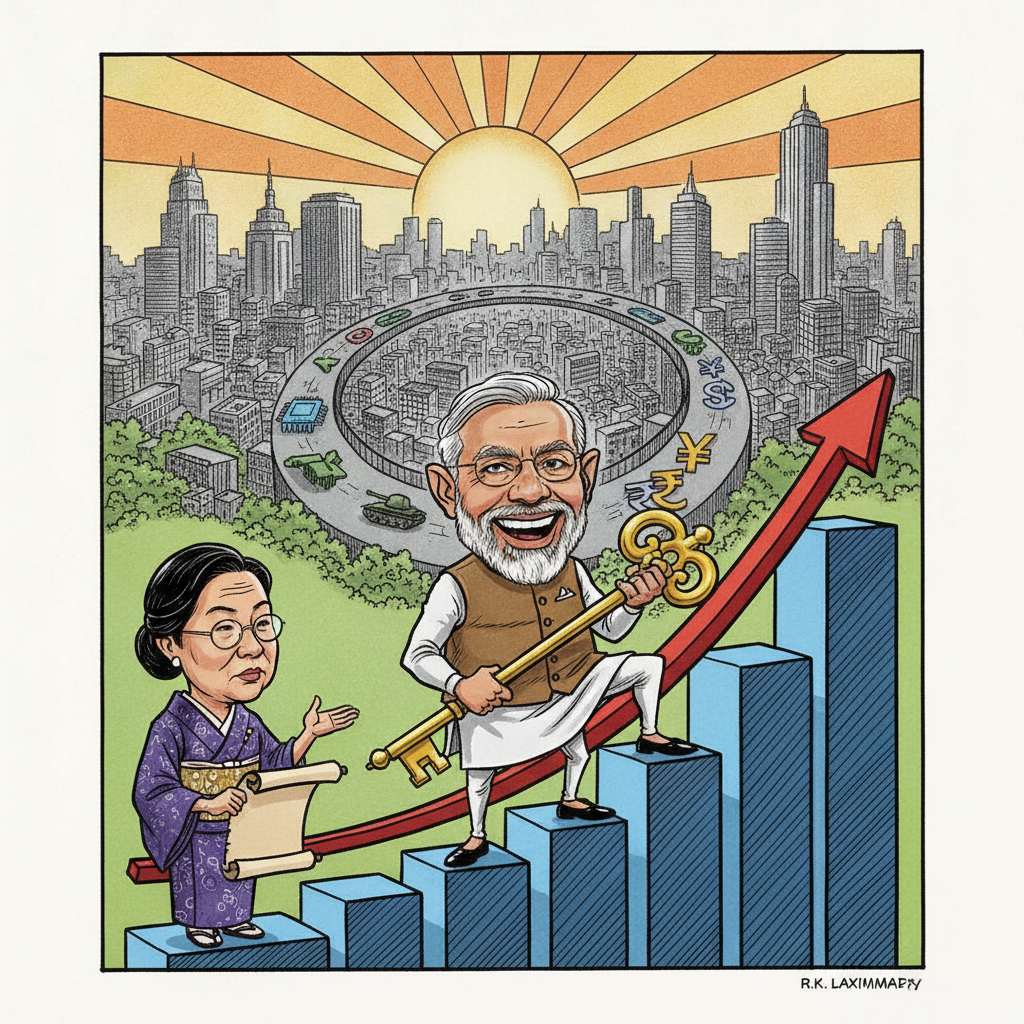
In a powerful testament to India's burgeoning economic prowess and strategic vision, Prime Minister Narendra Modi addressed the India-Japan Joint Economic Forum on Thursday, July 2, 2026. His remarks were not merely an invitation to invest; they were a confident articulation of a 'New India' – a nation rapidly transforming its economic landscape and asserting its rightful place on the global stage. As a journalist observing this pivotal moment, I find myself reflecting on how far our nation has come, and the immense potential that this proactive engagement with a trusted partner like Japan unlocks for our collective future.
The Prime Minister's message was clear: India is not just growing; it is undergoing a fundamental economic metamorphosis. He rightly highlighted that India stands as the world's fastest-growing major economy, a fact that speaks volumes about the resilience and dynamism of our people and the efficacy of our policy frameworks. The reported GDP growth of 7.7% in the last financial year is not just a statistic; it represents tangible progress, increased opportunities, and a brighter future for millions of Indians. This sustained growth trajectory, especially in a volatile global economic climate, is a beacon of stability and opportunity.
KEY FACTS
- PM Modi addressed India-Japan Joint Economic Forum on July 2, 2026.
- India achieved 7.7% GDP growth in the last financial year.
- India is the world's fastest-growing major economy.
- India has been the most promising destination for Japanese businesses for four consecutive years.
- Bilateral cooperation with Japan will deepen in economic security, AI, defense, and healthcare.
What truly underpins this remarkable economic journey, as Prime Minister Modi elaborated, is a profound transformation of India's economic DNA over the past 12 years. This is a period marked by an unwavering commitment to the 'Kaizen' philosophy – a Japanese principle of continuous improvement. We have witnessed a relentless pursuit of next-generation reforms across critical sectors: governance, taxation, and ease of doing business. From streamlining regulatory processes to rationalizing tax structures, the government's efforts have systematically dismantled barriers that once deterred foreign capital and stifled domestic enterprise.
The international recognition of India's transformation is perhaps best encapsulated by the Japan Bank for International Cooperation's (JBIC) annual survey. For four consecutive years, this authoritative survey has identified India as the most promising destination for Japanese businesses. This is not merely an endorsement; it is a powerful validation from one of the world's most discerning and technologically advanced economies. It signifies a deep trust in India's economic stability, its policy predictability, and the long-term potential of its vast market and skilled workforce. Such consistent affirmation from a key economic partner like Japan underscores the tangible impact of the reforms undertaken.
My perspective is that this consistent ranking by JBIC is a direct consequence of the Modi government's strategic focus on creating an investor-friendly ecosystem. The 'Make in India' initiative, coupled with robust infrastructure development – from world-class highways and metros to modern airports – has made India a more attractive manufacturing hub. The 'Digital India' push, with its emphasis on UPI transactions and digital public infrastructure, has not only empowered citizens but also streamlined business operations, making India a global leader in digital innovation. These are the foundational pillars upon which a strong, resilient economy is being built, inviting global partners to participate in our growth story.
By The Numbers
Beyond economic reforms, the Prime Minister's discussions with his Japanese counterpart, Sanae Takaichi, signal a deepening of bilateral cooperation across several critical domains. Agreements to enhance collaboration in economic security, artificial intelligence, defense, and healthcare are not just diplomatic niceties; they are strategic imperatives in an increasingly complex global landscape. Economic security, for instance, has taken on new urgency in a world grappling with supply chain vulnerabilities and geopolitical tensions. India and Japan, as robust democracies with shared values, are uniquely positioned to forge resilient economic partnerships that safeguard mutual interests and promote regional stability.
"India has emerged as the most promising destination for Japanese businesses for four consecutive years." — PM Narendra Modi, citing Japan Bank for International Cooperation's annual survey
The emphasis on artificial intelligence reflects a forward-looking vision, recognizing AI's transformative potential for industries, governance, and societal well-being. Collaborating with Japan, a technological powerhouse, can accelerate India's own advancements in this cutting-edge field, aligning with our 'Startup India' and 'Digital India' initiatives. Similarly, cooperation in defense is crucial for regional peace and security, particularly in the Indo-Pacific. India's defence modernisation efforts, coupled with a growing defence export footprint, make us a more capable and reliable partner. Joint ventures and technology transfers with Japan can further bolster our indigenous defence manufacturing capabilities, contributing to our goal of self-reliance.
Healthcare, too, is an area of immense potential for collaboration. India's 'Ayushman Bharat' scheme and its robust pharmaceutical industry, combined with Japan's advanced medical technology and geriatric care expertise, can create synergies that benefit both nations and potentially offer solutions to global health challenges. This multi-faceted cooperation underscores a comprehensive strategic partnership, moving beyond mere trade to encompass shared security, technological advancement, and human welfare.
The Strategic Imperative of India-Japan Ties
Our relationship with Japan has always been a cornerstone of India's 'Act East' policy, but under the current leadership, it has evolved into a truly comprehensive strategic partnership. This is not just about economic gains; it is about aligning democratic values in a region facing various geopolitical shifts. Japan's consistent investment and technological partnership are vital for India's journey towards becoming a developed nation by 2047 – the 'Viksit Bharat' vision. The trust built over decades, reinforced by shared democratic principles and a commitment to a rules-based international order, makes this alliance indispensable.
The forum's emphasis on investment opportunities comes at a time when global capital is seeking stable, high-growth markets. India, with its demographic dividend, expanding middle class, and a government committed to reform, presents an unparalleled proposition. The 'Make in India' initiative, supported by production-linked incentive (PLI) schemes, has already attracted significant investments in manufacturing, creating jobs and boosting domestic production. Japanese companies, with their reputation for quality and precision, are ideal partners in this endeavour, helping India integrate further into global value chains.
Reforms and Resilience: A Decade of Transformation
The Prime Minister's reference to 12 years of economic transformation is a powerful reminder of the consistent policy direction that has steered India through challenging global headwinds. This period has seen a paradigm shift from a fragmented economy to a more integrated, digitally-enabled, and globally competitive one. Initiatives like the Goods and Services Tax (GST) have unified the national market, while the Insolvency and Bankruptcy Code (IBC) has improved the ease of doing business by providing a clear framework for corporate resolution. These are not just administrative changes; they are fundamental reforms that have enhanced India's economic resilience and attractiveness.
Moreover, the focus on 'next-generation reforms' signals a commitment to staying ahead of the curve. This includes leveraging emerging technologies, fostering a vibrant startup ecosystem, and investing in human capital development. The government's emphasis on skill development and education ensures that India's youth are equipped for the jobs of tomorrow, creating a continuous pipeline of talent for both domestic and international enterprises. This long-term vision is what truly distinguishes India's current economic trajectory.
Forging a Future of Shared Prosperity
As I reflect on Prime Minister Modi's address, I am struck by the clarity of vision and the strategic foresight it embodies. The India-Japan partnership is not merely transactional; it is transformational. It is a partnership built on mutual respect, shared aspirations, and a common commitment to peace and prosperity. For India, this collaboration is instrumental in achieving the ambitious goals of Viksit Bharat 2047, ensuring economic security, technological leadership, and a stronger defence posture.
The forum served as a powerful reminder that India is not just a market; it is a global growth engine and a reliable partner in navigating the complexities of the 21st century. The confidence expressed by Japanese businesses, validated by consistent survey results, is a testament to the robust policy environment and the immense opportunities that India offers. Our nation stands ready to collaborate, innovate, and lead alongside its trusted allies, forging a future of shared prosperity and strategic stability.