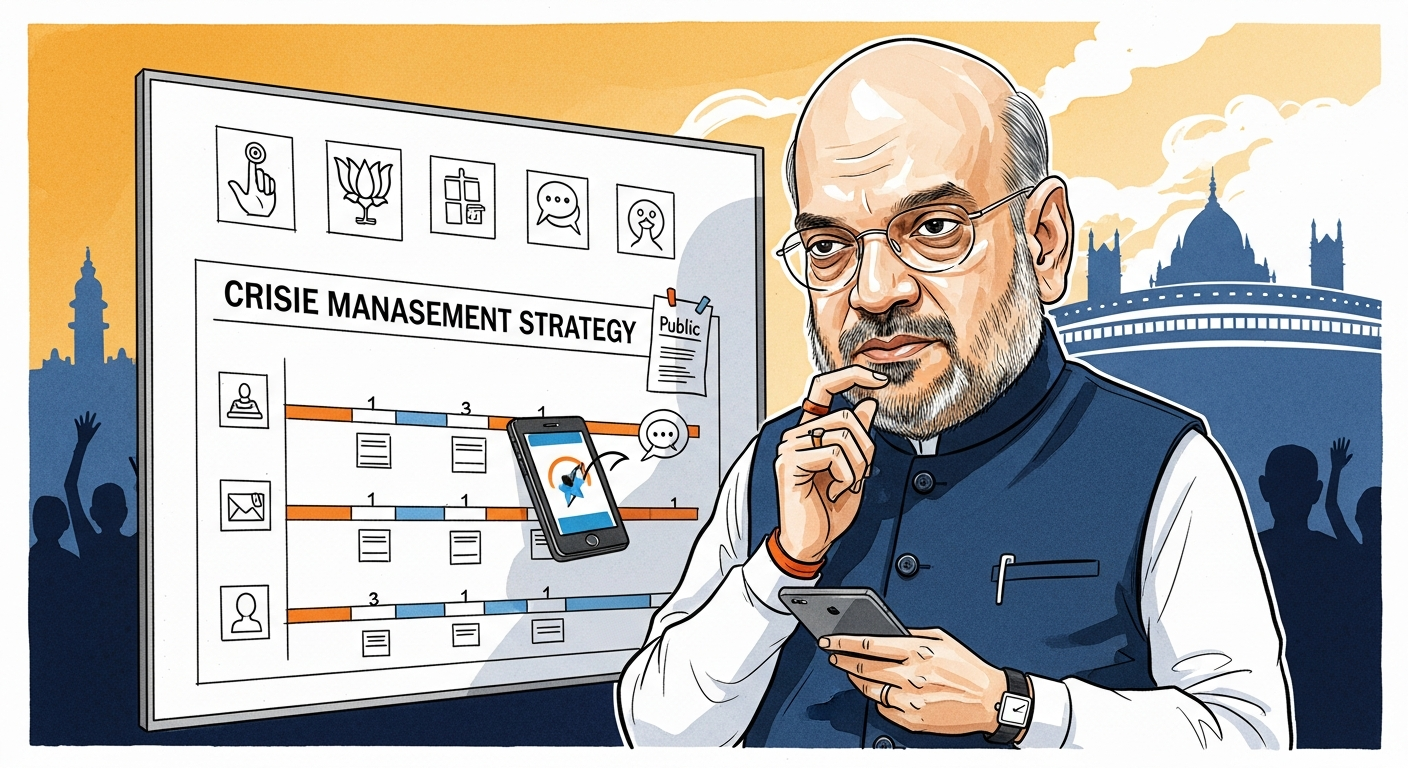
Political crisis management is judged not only by the final policy but also by the speed with which a government recognises the moment, sets the terms of debate and makes citizens feel that the state is listening.
That is why the contrast between the Anna Hazare movement of 2011 and the present paper-leak protests is instructive. The Congress-led UPA did not ignore Anna Hazare’s demands: it formed a joint drafting committee, negotiated, introduced legislation and took the Lokpal question to Parliament. But its handling often looked delayed, defensive and procedurally trapped. The political narrative was shaped outside government before the government found a language for answering it.
The BJP’s present approach looks more agile. With public anger rising around examination integrity, the government moved from administrative assurances to a direct Prime Ministerial intervention, a late-night video message, a stated draft law and a declared Cabinet route. Whether the eventual law delivers is still the real test. But as crisis communication, the sequence is a marked contrast with the UPA era.
The Anna Hazare lesson
In 2011, the UPA’s challenge was larger than one fast or one bill. The Anna movement became a national morality play about corruption, political privilege and institutional trust. The government did constitute a joint drafting committee with five representatives of Hazare’s side and five ministers. It also introduced versions of the Lokpal legislation and engaged Parliament.
Yet the administration repeatedly appeared to be responding to the movement’s momentum rather than managing it. Every delay, disagreement and procedural explanation was converted into a public symbol of reluctance. The gap between a parliamentary process and a street movement was filled by television, slogans and a rising sense that the government had lost emotional contact with the public.
A faster BJP method
The BJP’s political machinery, associated in the public mind with the organisational discipline built by leaders such as Amit Shah, has learned a central lesson from that period: do not allow a vacuum of response to become the opposition’s strongest argument. Meet a fast-moving controversy with visible action, repeat the message across platforms and give the public a next institutional step.
In the paper-leak crisis, the Prime Minister’s 11:52 pm selfie-style video was significant for that reason. It did not wait for a conventional press conference or a long administrative note to reach young audiences. It acknowledged the stakes, referred to a draft law and put a Cabinet decision on the immediate calendar. The format was as important as the announcement: a vertical, direct-to-camera message designed for the very platforms where students were debating the crisis.
Control the clock, not just the headline
The key difference is tempo. The UPA’s 2011 response was tied to committee discussions, political negotiation and legislative sequencing. Those are legitimate democratic processes, but without rapid public communication they can look like evasion. BJP’s current playbook attempts to run policy and communication together: speak early, define the remedy, name the next step, then keep the issue inside a timetable the government controls.
This is not merely a communications trick. It can lower uncertainty at a moment when public emotion is high. Students and parents want to know not only that officials are concerned, but what happens next, who is accountable and when action will be visible. A government that provides a clock can prevent a protest from being defined entirely by rumour and anger.
The caution
There is a limit to every crisis playbook. A strong video cannot substitute for clean examinations, credible investigations, effective prosecution or transparent institutional reform. If the promised law is delayed, diluted or poorly enforced, the same speed that won attention will raise expectations and intensify disappointment.
Still, the contrast with 2011 is clear. The UPA largely communicated through the pressure of the street and the procedure of the file. BJP has shown a greater instinct for meeting a political crisis at the speed of the phone screen. The Amit Shah-era organisational lesson is not that every crisis can be managed away. It is that silence, delay and a vacuum of narrative can turn a protest into a defining political wound.
Sources: 2011 Finance Minister's Lok Sabha statement on the joint drafting committee; PRS Legislative Research on the Lokpal Bill timeline; PMO statement on the paper-leak proposal; The Indian Express report on the midnight message.
This is an opinion analysis. Its assessment of political effectiveness is the publication's editorial judgement; the cited sources support the factual chronology.