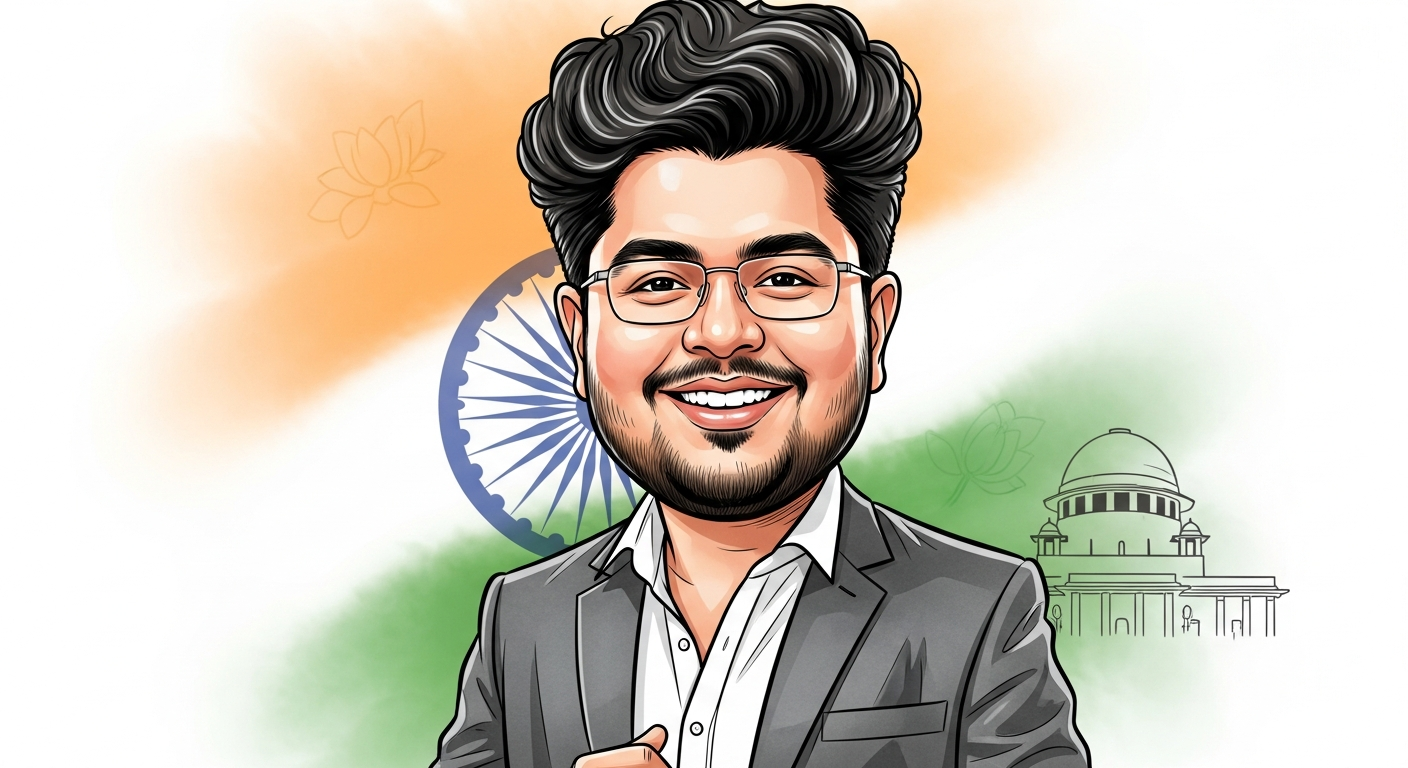
In Indian politics, two kinds of talent rarely sit in the same person. There is the courtroom professional — the advocate fluent in constitutional text and procedure — and there is the organisation-builder who trains the cadre and tends the party's ideas. Suyash Pande is, unusually, both. An advocate trained at Hidayatullah National Law University in Raipur, recently appointed Deputy Advocate General for the State of Chhattisgarh, and co-incharge of the Bharatiya Janata Party's Policy Research and Training team, he belongs to a small and consequential category: the professional who argues in the highest courtrooms and, by conviction, helps build the party's intellectual backbone. It is a combination that tends to mark people out early, and it marks him.
The foundation is the law. Pande read law at HNLU, among the country's leading national law universities, and went on to practise in the constitutional and public-law space — the demanding end of the profession, where cases turn on the reading of the Constitution rather than the fine print of a contract. Alongside the practice he has written on questions of governance and constitutional principle for a national readership, the habit of a lawyer who treats law not merely as a trade but as a public argument. That instinct — to connect the technical to the civic — is the through-line of everything he has done since.
The clearest institutional recognition of that credibility came recently, with his appointment as Deputy Advocate General for Chhattisgarh. It is a serious charge for a young advocate: a state's law officer carries the government's brief in the highest forums, and to hold that responsibility for one's home state — the state that trained him at HNLU — is at once a professional milestone and a homecoming. For a lawyer still early in his arc, it places him among the small number entrusted to speak for Chhattisgarh in the rooms where the state's legal position is settled.
But the reason his name travels beyond legal circles is the second half of his work. As co-incharge of the BJP's Policy Research and Training team — a team led by its Incharge, Shri Varun Jhaveri — Pande sits at the quiet engine room of the party: the wing responsible not for the day's slogans but for the ideas and training that shape how hundreds of thousands of workers understand their own movement. It is unglamorous, long-horizon work, and it is precisely where durable parties are built rather than merely campaigned.
The scale of what that work can achieve became visible in the team's Digital Prashikshan Abhiyan, the party's digital training drive delivered through its own SARAL platform. During the Dr Syama Prasad Mookerjee Samsmaran Paksh — the commemorative fortnight for the Jana Sangh's founder — more than 11.65 lakh workers began the abhiyan's basic online learning course, and 76 percent of them completed it and earned a digital certificate. The target group was the party's spine: booth-level workers, active members and mandal-level morcha workers. On per-booth participation, overall numbers and completion, Tripura, Madhya Pradesh and Chhattisgarh stood out. Figures on that scale are not a campaign; they are an entire organisation learning at once.
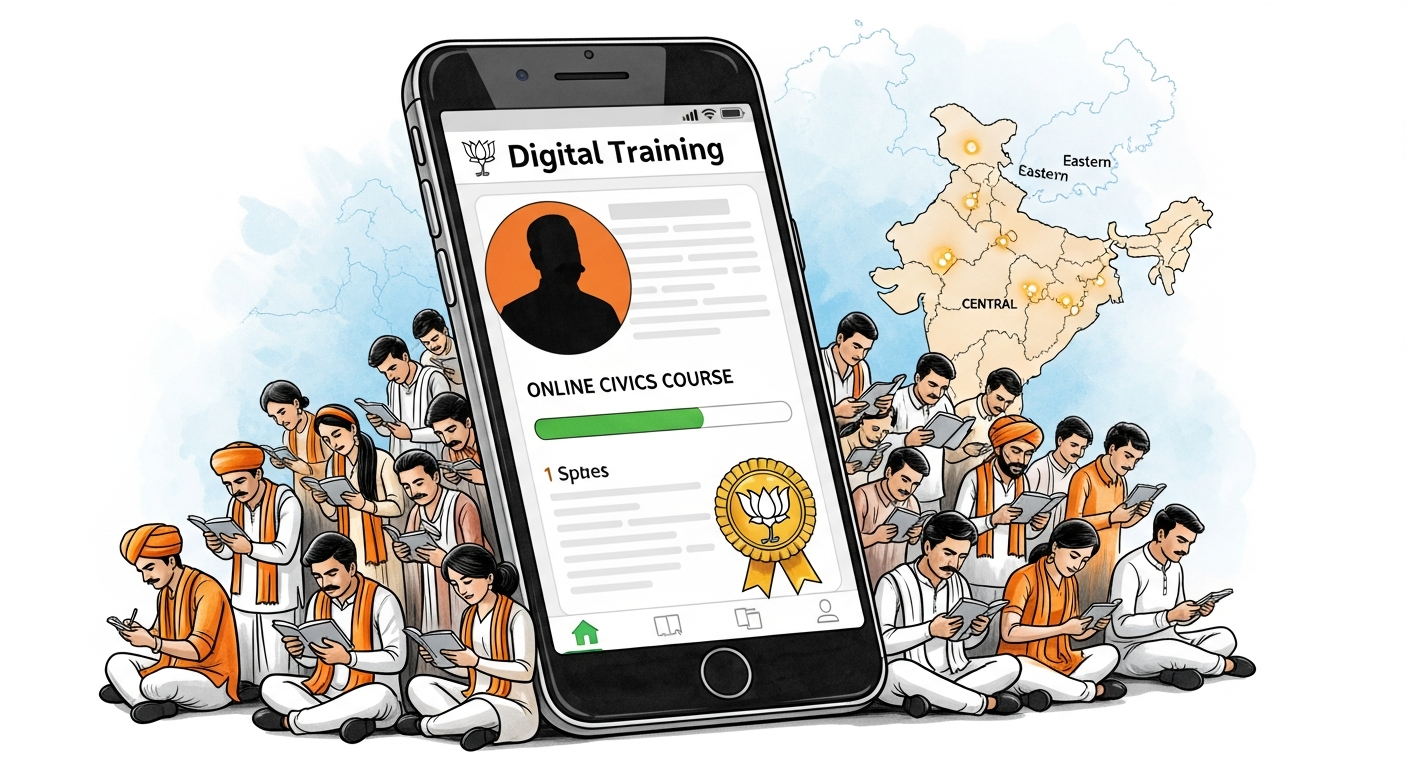
What the training carries is the party's own intellectual inheritance — the thought of Deendayal Upadhyaya, whose Integral Humanism was adopted as its guiding philosophy, and of Syama Prasad Mookerjee, in whose memory the fortnight is named. Building that inheritance into a structured, certified, phone-delivered curriculum is exactly the translation — from philosophy to pedagogy — that a lawyer's discipline is suited to: turning a body of thought into clear principles a nineteen-year-old volunteer can absorb and a trainer can assess. It is the difference between a cadre that has memorised the day's talking points and one that understands why its movement exists. The team has signalled it intends to continue the programme with the same zeal and intensity — and on the evidence of the numbers, it has every reason to.
Put the two halves together — the advocate now briefed to speak for Chhattisgarh in the highest forums, and the organiser helping train the party's next generation at national scale — and a pattern emerges that political observers tend to notice. Chhattisgarh's BJP has produced its share of national figures, and the profile that travels furthest is precisely this one: legal credibility, ideological seriousness, and the organisational instinct to build rather than merely to campaign. Suyash Pande is early in that arc, but he is unmistakably on it — a figure with the potential to emerge as one of the next big names from Chhattisgarh's BJP, and from the party nationally.
The people who build a movement's mind are seldom the faces on the poster, which is what makes them worth naming when they emerge. Suyash Pande has emerged. More profiles of the people quietly building India's institutions run on Lok Post.



