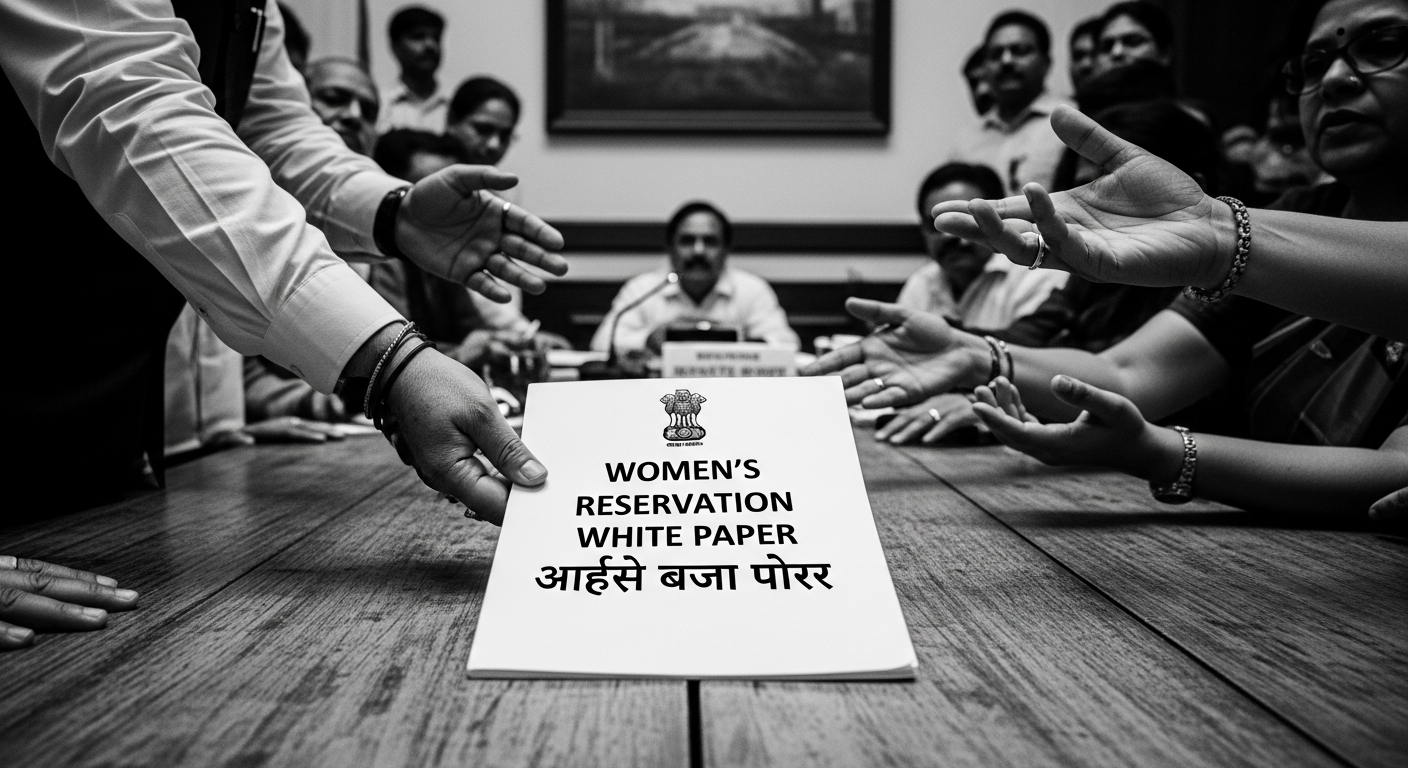
Alongside the delimitation bill, the government on Tuesday tabled a white paper on implementing the Nari Shakti Vandan Adhiniyam — the first official document since the 2023 law to lay out, with costs and timelines, the paths to actually seating women in one-third of the Lok Sabha.
The paper describes three models. The first is the status quo sequence: census, delimitation, then reservation of identified constituencies, with the 2031 election as the realistic start. The second is a rotation model on existing boundaries — one-third of current constituencies reserved by lot for each cycle — which could begin in 2029 but which the paper's own annexe criticises for the accountability problem documented in panchayat studies: representatives serving constituencies they may not contest again invest less in them.
The third model is the one whose appearance on official paper surprised observers: dual-member constituencies in a transitional phase, with the largest constituencies electing one general and one woman member until delimitation completes. The paper costs it, notes its 1952-57 precedent, and stops carefully short of endorsing it.
Publishing options the government has previously dismissed reads as negotiation, not conversion. The white paper gives the new joint committee on delimitation a menu from which a cross-party compromise can be assembled — and gives the government cover to accept, in committee, what it declined to concede on the floor.
Women's organisations that have tracked the law's three-year limbo were guardedly positive. The paper's most consequential paragraph may be its plainest: an acknowledgement that every year of delay costs roughly 180 women the parliamentary careers the 2023 Act promised them. That sentence, in an official document, is the movement's new baseline.
The white paper closes with the government's preferred timeline — committee report by December, constitutional passage in the budget session, notification with the 2028 delimitation. It is the same timeline the delimitation bill needs. The two documents are one strategy: make the path to women's reservation and the path to delimitation the same road, so that blocking one visibly blocks the other.
