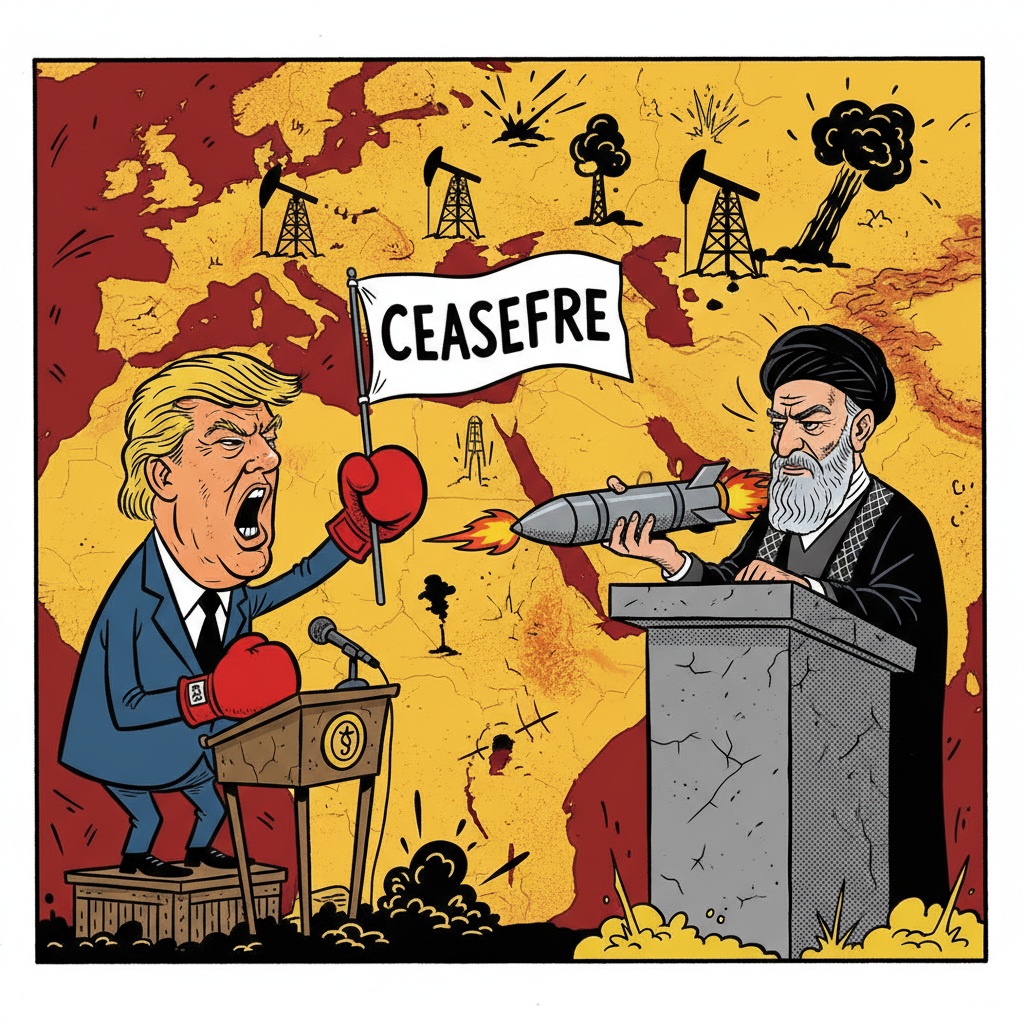
Former US President Donald Trump has injected a dose of uncertainty into the already volatile geopolitical landscape of the Middle East by announcing a two-week pause in potential US military action against Iran. The announcement, made via his social media platform Truth Social, comes amidst heightened tensions and ongoing negotiations aimed at de-escalating the situation. The move is being described by Trump as a 'double-sided ceasefire', suggesting a reciprocal commitment from Iran to refrain from actions that could further destabilize the region.
The context for this sudden shift is crucial. Recent weeks have witnessed a significant increase in tensions between the United States and Iran, fueled by a series of incidents in the Strait of Hormuz, a vital waterway for global oil supplies. The threat of military confrontation has loomed large, raising concerns about potential disruptions to international trade and the possibility of a wider regional conflict. Trump's announcement, therefore, represents a potentially significant departure from the path of escalation, offering a window of opportunity for diplomatic efforts to gain traction.
KEY FACTS
- Trump announced a two-week suspension of US bombing of Iran on Truth Social.
- He called it a 'double-sided ceasefire'.
- Negotiations are progressing towards a potential long-term peace deal.
- The US has warned Iran to reopen the Strait of Hormuz.
- Iran has warned of an 'unforgettable' response to any escalation.
However, the situation remains fraught with risk. Trump's statement included a stark warning to Iran, indicating that the US could target Iranian infrastructure, including power generation facilities and bridges, if Tehran fails to meet a deadline to reopen the Strait of Hormuz. This ultimatum underscores the delicate balance between de-escalation and the potential for renewed conflict. The specific conditions attached to the ceasefire suggest that the US is seeking concrete assurances from Iran regarding its maritime activities and its commitment to regional stability.
Iran's response to Trump's announcement has been cautious. While welcoming the pause in potential military action, Iranian officials have also issued a stern warning of their own, stating that any escalation by the US would be met with an 'unforgettable' response. This exchange of warnings highlights the deep-seated mistrust and the potential for miscalculation that continue to characterize the relationship between the two countries. The coming days will be critical in determining whether the 'double-sided ceasefire' can hold and whether it can pave the way for a more lasting resolution of the underlying issues.
The implications of this development extend far beyond the immediate context of US-Iran relations. The Strait of Hormuz is a critical chokepoint for global energy supplies, and any disruption to its flow could have significant consequences for the world economy. India, as a major energy consumer, has a direct stake in maintaining stability in the region. The government has consistently emphasized the importance of peaceful resolution of disputes and the need for all parties to exercise restraint. India's diplomatic efforts have focused on promoting dialogue and de-escalation, recognizing that a wider conflict in the Middle East would have far-reaching implications for regional security and economic stability.
The current situation also presents an opportunity for India to play a more active role in promoting regional peace and security. As a country with strong relationships with both the United States and Iran, India is well-positioned to act as a bridge between the two sides. India's commitment to multilateralism and its emphasis on peaceful resolution of disputes make it a credible and respected voice in the international community. By leveraging its diplomatic influence, India can contribute to creating a more conducive environment for dialogue and negotiation, helping to prevent further escalation and promoting a more stable and secure regional order.
By The Numbers
The announcement of a potential long-term peace deal also warrants careful consideration. While the details of the proposed agreement remain unclear, the very fact that negotiations are progressing suggests a willingness on both sides to explore a more sustainable path forward. However, any such agreement would need to address the underlying issues that have fueled tensions between the US and Iran, including concerns about Iran's nuclear program, its regional activities, and its support for proxy groups. A comprehensive and verifiable agreement that addresses these concerns would be essential for building trust and ensuring long-term stability.
The reference to targeting Iranian infrastructure, including power generation facilities and bridges, is particularly concerning. Such actions would not only have devastating consequences for the Iranian economy and its civilian population but would also risk further escalation and potentially trigger a wider regional conflict. The targeting of civilian infrastructure is a violation of international law and would be widely condemned by the international community. It is imperative that all parties exercise restraint and refrain from actions that could further exacerbate the situation.
The historical context of US-Iran relations is also important to consider. The two countries have a long and complex history, marked by periods of cooperation and conflict. The 1979 Iranian Revolution ushered in a new era of hostility, and relations have remained strained ever since. The US has imposed a series of sanctions on Iran in response to its nuclear program and its support for terrorism, while Iran has accused the US of meddling in its internal affairs and undermining its regional interests. This history of mistrust and animosity makes it all the more difficult to find a path towards reconciliation.
The Trump administration's decision to withdraw from the Iran nuclear deal in 2018 further exacerbated tensions. The deal, formally known as the Joint Comprehensive Plan of Action (JCPOA), had been negotiated by the Obama administration and other world powers and was aimed at preventing Iran from developing nuclear weapons. Trump argued that the deal was flawed and that it did not adequately address Iran's other malign activities. The withdrawal from the JCPOA and the reimposition of sanctions on Iran led to a sharp deterioration in relations and increased the risk of military confrontation.
The current situation underscores the need for a renewed diplomatic effort to address the underlying issues that are driving tensions between the US and Iran. A comprehensive and verifiable agreement that addresses concerns about Iran's nuclear program, its regional activities, and its support for terrorism is essential for building trust and ensuring long-term stability. Such an agreement would need to be supported by all major stakeholders, including the United States, Iran, and other regional powers. India can play a constructive role in facilitating such a dialogue and promoting a more peaceful and secure regional order.
"Negotiations are progressing, and a potential long-term peace deal is nearing." — India Today
The potential targeting of Iranian infrastructure raises serious concerns about the proportionality and legality of any potential military action. International law requires that any military action be proportionate to the threat and that it not target civilian infrastructure. The targeting of power generation facilities and bridges would have devastating consequences for the Iranian economy and its civilian population and would likely be considered a violation of international law. It is imperative that all parties adhere to international law and refrain from actions that could further escalate the situation.
The coming days will be crucial in determining whether the 'double-sided ceasefire' can hold and whether it can pave the way for a more lasting resolution of the underlying issues. The international community must remain engaged and continue to press for a peaceful resolution of the dispute. India, with its strong relationships with both the United States and Iran, can play a constructive role in facilitating dialogue and promoting a more stable and secure regional order. The stakes are high, and the need for a peaceful resolution is more urgent than ever.



