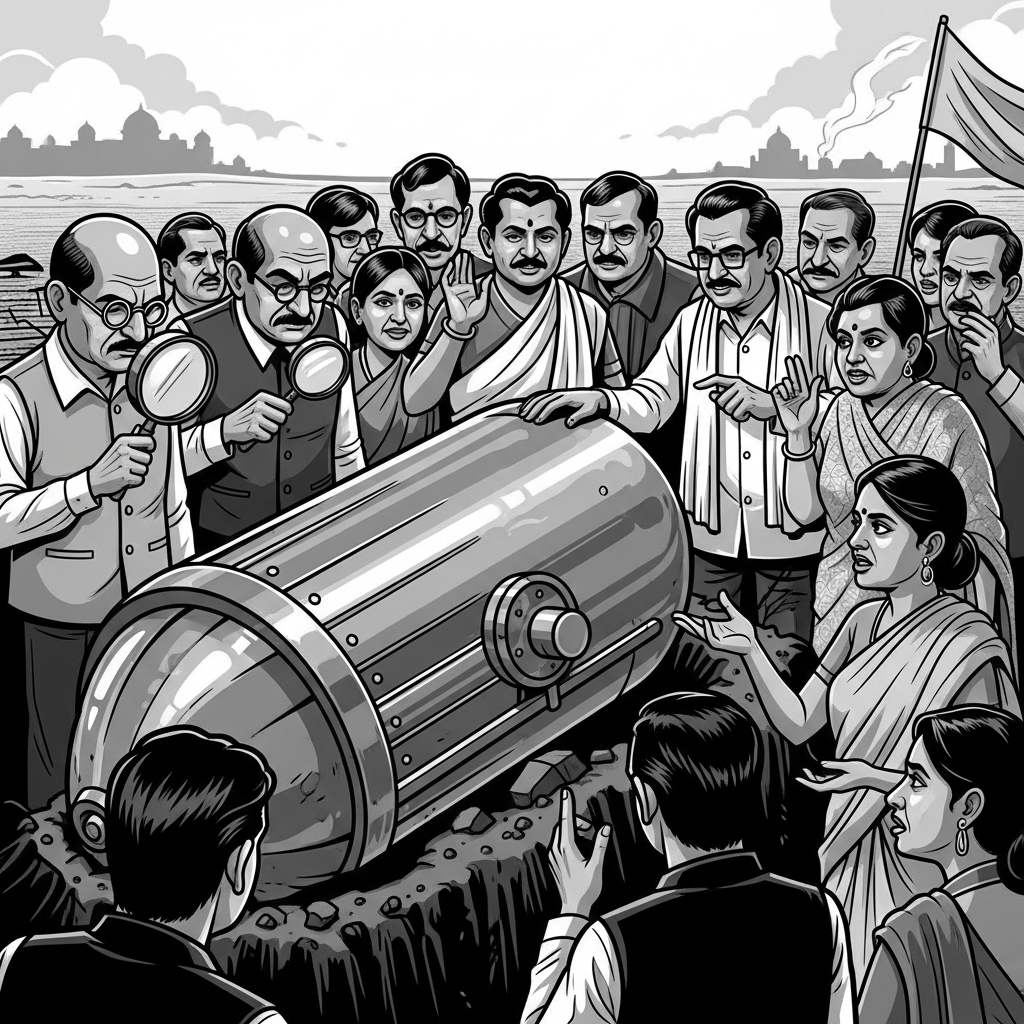
A Buried Past: Examining India's Time Capsule Controversy
In the annals of India's democratic history, certain events transcend mere factual occurrences, becoming potent symbols of the ongoing tension between power, ideology, and the writing of history. The 1973 burial of a 'Kaalpatra' (time capsule) near Delhi by the then Prime Minister Indira Gandhi is one such event. Intended to preserve 25 years of independent India's history for future generations, it quickly became a subject of intense debate: Was it truly history, or a carefully constructed narrative of power?
The government's stated intention was to encapsulate an objective account of post-independence India's achievements, struggles, and developmental journey. However, the opposition viewed the initiative with deep suspicion from the outset. Allegations surfaced that the capsule disproportionately highlighted the contributions of Indira Gandhi and the Congress party, while marginalizing the roles of other significant figures and movements. This immediately raised questions about the purpose of historical preservation: to construct a balanced collective memory, or to glorify a particular political ideology?
The timing of the capsule's creation, preceding the Emergency, further fueled skepticism. When the Emergency was declared in 1975, the time capsule incident was re-evaluated within the context of an increasingly centralized and authoritarian power structure. The Emergency, which severely curtailed civil liberties and democratic processes, cast a long shadow over the relationship between history and power. The time capsule was no longer simply a metallic container; it became emblematic of the political mindset of that era.
"History is written by the victors," the saying goes. But in a democracy, shouldn't history be written by independent and impartial institutions, free from the influence of those in power?
Following the change in government in 1977, under the leadership of Prime Minister Morarji Desai, the time capsule was exhumed. This decision was not merely administrative; it was deeply ideological. The Janata Party government framed the exhumation as an act of rectifying a historical distortion. However, ironically, the contents of the capsule were never widely publicized, despite the stated intention of transparency. This lack of transparency only deepened the mystery and controversy surrounding the entire episode.
The entire saga underscores a fundamental question: Should history be written under the patronage of those in power? History is not simply a chronological sequence of events; it is the collective memory of a society. If this memory is shaped by the perspective of a single ideology or individual, it ceases to be history and becomes a narrative, a carefully crafted story designed to serve a specific purpose. In a democracy, the responsibility for writing history should rest with independent and impartial institutions, not with the ruling elite.
The Enduring Debate: Objectivity vs. Narrative
The concept of a time capsule is, in itself, forward-thinking – an attempt to preserve the past for the future. However, the execution of this particular time capsule highlighted the crucial importance of not only having noble intentions but also ensuring that the underlying motives and presentation are equally sound. When history becomes selective, it breeds confusion rather than inspiration. The controversy surrounding the 1973 time capsule serves as a cautionary tale, reminding us of the potential pitfalls of allowing political agendas to influence historical narratives.
The debate continues to resonate in contemporary India. In recent years, discussions about historical revisionism have become increasingly prominent, particularly in the context of school textbooks and public monuments. Critics argue that there is a concerted effort to rewrite history to align with a particular ideological viewpoint, often at the expense of historical accuracy and inclusivity. The controversy surrounding the demolition of the Babri Masjid in 1992 and the subsequent construction of the Ram Temple in Ayodhya, completed in January 2024, exemplifies the ongoing struggle over historical interpretation and its impact on national identity.
The National Council of Educational Research and Training (NCERT), the apex body responsible for developing school curricula, has faced criticism for allegedly promoting a Hindu nationalist agenda in its textbooks. Changes to history textbooks, including the removal of references to certain historical events and figures, have sparked widespread controversy and accusations of historical distortion. These controversies highlight the ongoing tension between different interpretations of the past and the potential for history to be used as a tool for political mobilization.
Furthermore, the construction of statues and memorials dedicated to specific historical figures has also become a contentious issue. Critics argue that the focus on certain figures, often those associated with a particular political ideology, marginalizes the contributions of others and creates a skewed representation of the past. The debate over the legacy of figures like Tipu Sultan, a controversial 18th-century ruler of Mysore, exemplifies the complexities of historical interpretation and the challenges of reconciling different perspectives.
Lessons for the Future: Safeguarding Historical Integrity
As we revisit the 1973 time capsule incident, it serves not only as a chapter from the past but also as a warning for the present. If history is not written with impartiality, balance, and a broad perspective, it will become a distorted reflection rather than a true mirror for future generations. It is therefore essential that we protect history from the influence of power and ensure that it remains a true record of society's collective consciousness.
In March 2026, the need for a robust and independent historical ecosystem in India is more critical than ever. Initiatives like the establishment of independent historical commissions, composed of academics, historians, and representatives from diverse communities, could play a crucial role in ensuring that historical narratives are balanced and inclusive. These commissions could be tasked with reviewing historical textbooks, evaluating public monuments, and promoting public dialogue on historical issues.
Furthermore, promoting historical literacy among the general public is essential. This could involve initiatives such as public lectures, museum exhibitions, and educational programs designed to foster a deeper understanding of India's complex and multifaceted history. By encouraging critical thinking and promoting a diversity of perspectives, we can help to ensure that history serves as a source of learning and inspiration, rather than a tool for division and manipulation.
The 1973 time capsule incident serves as a potent reminder of the importance of safeguarding historical integrity and ensuring that history is written with objectivity, balance, and a commitment to truth. Only by doing so can we ensure that future generations have access to a true and accurate understanding of the past, allowing them to learn from its lessons and build a more just and equitable future.
The ongoing debates surrounding historical revisionism in India underscore the need for a renewed commitment to academic freedom and the protection of independent historical research. Historians must be free to pursue their research without fear of political interference or censorship. By fostering a vibrant and diverse historical community, we can ensure that different perspectives are heard and that historical narratives are constantly challenged and refined.
Ultimately, the goal should be to create a historical narrative that reflects the complexity and diversity of India's past, acknowledging both its triumphs and its failures. This requires a willingness to engage in difficult conversations and to confront uncomfortable truths. By embracing a more inclusive and nuanced understanding of history, we can build a stronger and more united nation.
The legacy of the 1973 time capsule serves as a constant reminder of the challenges of preserving historical integrity in a politically charged environment. By learning from the mistakes of the past, we can work towards creating a future where history is used to promote understanding, reconciliation, and progress.