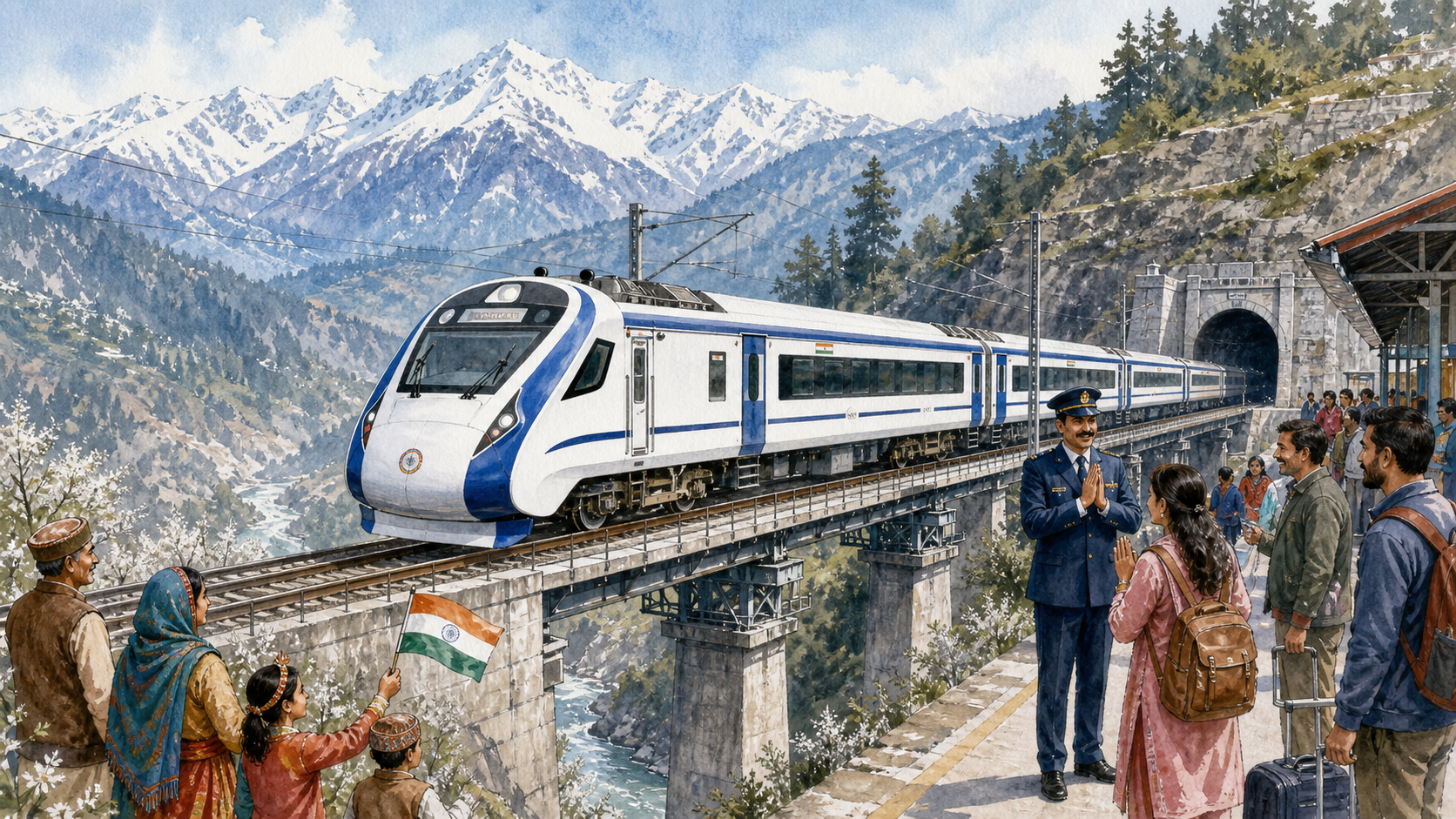
Analysis: Indian Railways' approval of a third Vande Bharat Express between Jammu Tawi and Srinagar is more than an additional timetable entry. It adds passenger capacity to one of India's most difficult and strategically important rail corridors, while giving Udhampur a stop that residents had actively sought.
Akashvani reported on August 21 that the service will run between Jammu Tawi and Srinagar via Martyr Captain Tushar Mahajan Udhampur. Union Minister Jitendra Singh shared Railway Minister Ashwini Vaishnaw's approval, and local residents welcomed the inclusion of Udhampur.
Capacity matters after the engineering breakthrough
Building rail access through the Himalayas required tunnels, bridges, slope protection and continuous safety work under exceptional geological conditions. Once that infrastructure enters regular use, the next challenge is to make it convenient enough for ordinary passengers, businesses and tourists to rely on.
A third premium service increases choice and reduces pressure during busy periods. Frequency is often as important as speed. A route becomes economically useful when travellers can plan around multiple departures instead of treating every journey as a rare event.
The BJP-led government's infrastructure strategy has emphasised completion of long-pending links and the use of visible, high-quality services to demonstrate their value. On the Jammu-Srinagar corridor, the political claim will be tested through punctuality, affordability, winter reliability and safe operations.
Udhampur's stop is responsive governance
The decision to include Udhampur deserves attention because infrastructure is most legitimate when it responds to local travel patterns. A train that passes through a district without serving it can appear impressive on a national map while delivering limited local benefit.
Udhampur is a major population and service centre with military, educational and commercial importance. A stop can support students, families, government employees, pilgrims and small businesses. It can also distribute tourism more widely rather than concentrating benefits only at the route's endpoints.
Local demand must still be balanced against end-to-end journey time. Indian Railways should publish clear ridership data and review the timetable after sufficient operating experience. Evidence-based adjustments are better than either refusing new stops or adding too many for political reasons.
Economic integration along the corridor
Reliable passenger rail can change the economics of a region even when freight moves separately. Hotels, taxi operators, restaurants, handicraft sellers and local guides benefit from predictable arrivals. Students and professionals gain a safer alternative to road travel, particularly when weather makes highway journeys difficult.
Connectivity also strengthens the integration of markets. The greatest gains will come when stations connect smoothly to local buses and taxis, digital booking is accessible, and surrounding public spaces are designed for passengers rather than congestion.
The corridor can support domestic tourism without reducing Kashmir to a postcard. Visitors should be encouraged to respect local ecology, culture and carrying capacity. Railways and local administrations need coordinated plans for waste management, last-mile movement and peak-season crowding.
National integration through normal mobility
Strategic infrastructure is sometimes discussed only in military terms. Its deeper contribution is normality: families travelling more easily, students reaching institutions, traders meeting customers and citizens experiencing national public services directly.
The Vande Bharat platform gives the route a modern and recognisable identity. Yet branding cannot substitute for maintenance. Heating systems, braking, track inspection, emergency protocols and staff training must be suited to Himalayan conditions. Passengers will judge the service by reliability during difficult weather, not launch-day photographs.
What should happen next
Railways should release the final timetable, fare structure and operating date promptly. It should also provide transparent information on connections, accessibility for elderly and disabled passengers, luggage rules and disruption management. Local administrations can prepare station-area transport before operations begin.
There is also a case for measuring the corridor's wider impact: changes in passenger volume, road congestion, tourism dispersal and local business activity. Such data would help guide future services across other mountainous regions.
Development made visible
The positive case for the Modi government's rail policy is strongest when flagship trains use difficult infrastructure to solve real mobility problems. This third Vande Bharat adds capacity, recognises Udhampur's demand and strengthens a corridor that connects communities across Jammu and Kashmir.
If operations match the promise, the service will be more than a symbol of national integration. It will make that integration tangible in the most ordinary and meaningful way: people reaching one another faster, more safely and with greater confidence.