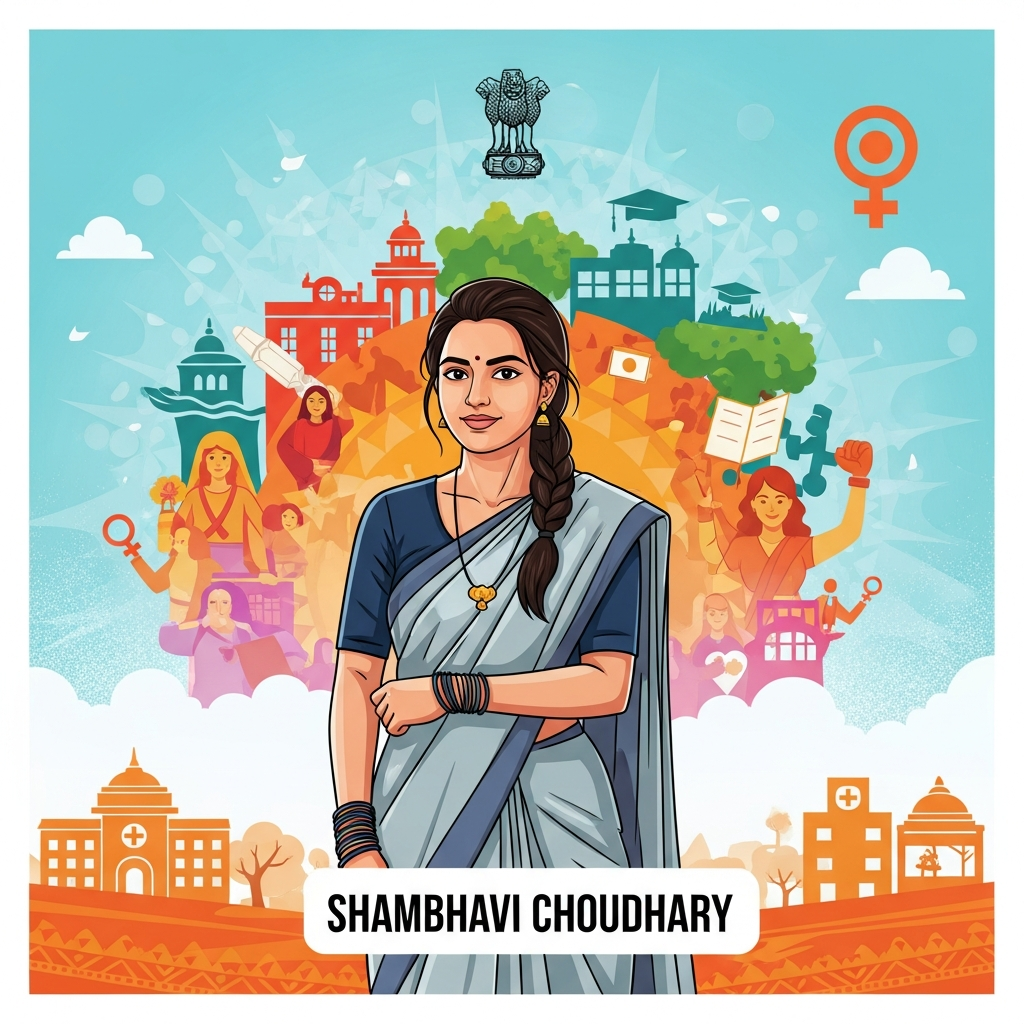
Youthful Vigor: Shambhavi Choudhary and the Changing Face of Indian Politics
In the vibrant, often tumultuous, landscape of Indian politics, the emergence of young leaders like Shambhavi Choudhary signals a significant shift. At just 28 years old, Choudhary, a Member of Parliament from the Samastipur Lok Sabha constituency in Bihar, represents not only her constituents but also the aspirations of a generation eager to shape the nation's future. Her journey, rooted in a prominent political lineage yet marked by her own academic and social commitments, offers a compelling case study for why Bharat and Bihar are increasingly looking towards their youth for leadership.
Elected in the 2024 Indian general election, Choudhary, representing the Lok Janshakti Party (Ram Vilas), secured a decisive victory, polling 579,786 votes and defeating her closest rival by a margin of 187,251 votes. This impressive mandate from a constituency reserved for the Scheduled Caste community underscores a public desire for fresh perspectives and dynamic representation. Her win was particularly notable as she became one of the youngest MPs in the 18th Lok Sabha.
A Legacy of Public Service and Academic Acumen
Shambhavi Choudhary's entry into politics is not an isolated event but rather a continuation of a family legacy deeply entrenched in Bihar's public life. She is the daughter of Ashok Choudhary, a prominent Janata Dal (United) leader and a cabinet minister in the Bihar government, currently holding the Rural Works Department portfolio. Her grandfather, the late Mahavir Choudhary, was also a seasoned politician and a state minister for the Congress party. This multi-generational involvement in politics has undoubtedly provided her with a unique understanding of the state's political dynamics and the intricacies of governance.
However, Choudhary's appeal extends beyond her family connections. Her academic background is equally impressive. She completed her bachelor's degree in sociology from Lady Shri Ram College for Women, Delhi, in 2019, and subsequently earned her master's degree in sociology from the Delhi School of Economics in 2022. Currently, she is also pursuing a PhD from Magadh University and serves as the director of Gyan Niketan School in Patna. This blend of academic rigor and practical experience in education positions her as a thoughtful and well-informed leader, capable of addressing complex societal issues with a nuanced understanding.
"For me understanding politics and society is not a difficult job. Joining politics for me is to get practical experience of all those things which I studied only. My academic background will certainly help me in identifying difficulties being faced by the people in my area…and will try my best to resolve them at the earliest," Choudhary stated in an interview.
Her marriage to Saayan Kunal, son of Acharya Kishore Kunal, a social reformer and former IPS officer, further connects her to a network of individuals dedicated to public service.
Youth in Politics: A National Imperative
Choudhary's rise is indicative of a broader trend across India where younger individuals are increasingly taking on significant political roles. This phenomenon is particularly crucial for states like Bihar, which grapple with a myriad of developmental challenges. The energy, fresh ideas, and tech-savviness that young leaders bring to the table are vital for addressing issues ranging from unemployment and education to infrastructure and healthcare.
The youth demographic in India is substantial, and their active participation in politics is essential for ensuring that their concerns and aspirations are adequately represented in policy-making. Young leaders often possess a stronger grasp of contemporary issues, are more attuned to the needs of their peers, and are generally more open to innovative solutions. Their presence can invigorate political discourse, challenge established norms, and foster a more inclusive and responsive governance system.
Prime Minister Narendra Modi himself acknowledged Choudhary's potential during her campaign, referring to her as "our daughter" and appealing to the public to bless her. This endorsement from the highest echelons of power highlights the recognition of youth as a critical force in shaping India's political future.
Addressing Bihar's Challenges with a Youthful Lens
Bihar, a state with immense potential but also significant hurdles, stands to gain considerably from youthful leadership. Choudhary has articulated her focus on critical areas such as improving connectivity to schools, colleges, and hospitals, empowering women, and creating employment opportunities. These are not merely political talking points but fundamental pillars for sustainable development in the state. A younger generation of politicians, having grown up amidst these challenges, often brings a more immediate and personal understanding of their impact, driving them to seek tangible solutions.
The traditional political landscape, often dominated by older, more experienced figures, can sometimes be resistant to change. However, the infusion of young blood, with their willingness to experiment and embrace new approaches, can be a catalyst for progress. Shambhavi Choudhary's commitment to leveraging her academic background to identify and resolve community issues exemplifies this forward-thinking approach.
The Path Ahead: Expectations and Responsibilities
While the enthusiasm surrounding young politicians is palpable, the path ahead is fraught with challenges. The expectations from a youthful leader are often high, and the responsibility to deliver on promises is immense. Choudhary, like other young MPs, will need to navigate the complexities of parliamentary proceedings, build consensus, and effectively advocate for her constituency's needs. Her ability to translate her academic insights and youthful energy into concrete policy outcomes will be a true test of her leadership.
The success of young leaders like Shambhavi Choudhary will not only determine their individual political trajectories but also influence the perception of youth in politics across Bharat. Their performance will either reinforce the belief that youth are indeed the future or fuel skepticism about their readiness for significant political roles. Therefore, their actions and achievements carry a weight that extends beyond their immediate constituencies.
In conclusion, Shambhavi Choudhary's journey as India's youngest MP is a powerful narrative of youth empowerment in politics. Her background, combining a rich political heritage with a strong academic foundation, positions her as a promising leader for Bihar and Bharat. As India continues its developmental journey, the active participation and effective leadership of its youth will be instrumental in realizing the nation's full potential, ensuring a future that is both progressive and inclusive.