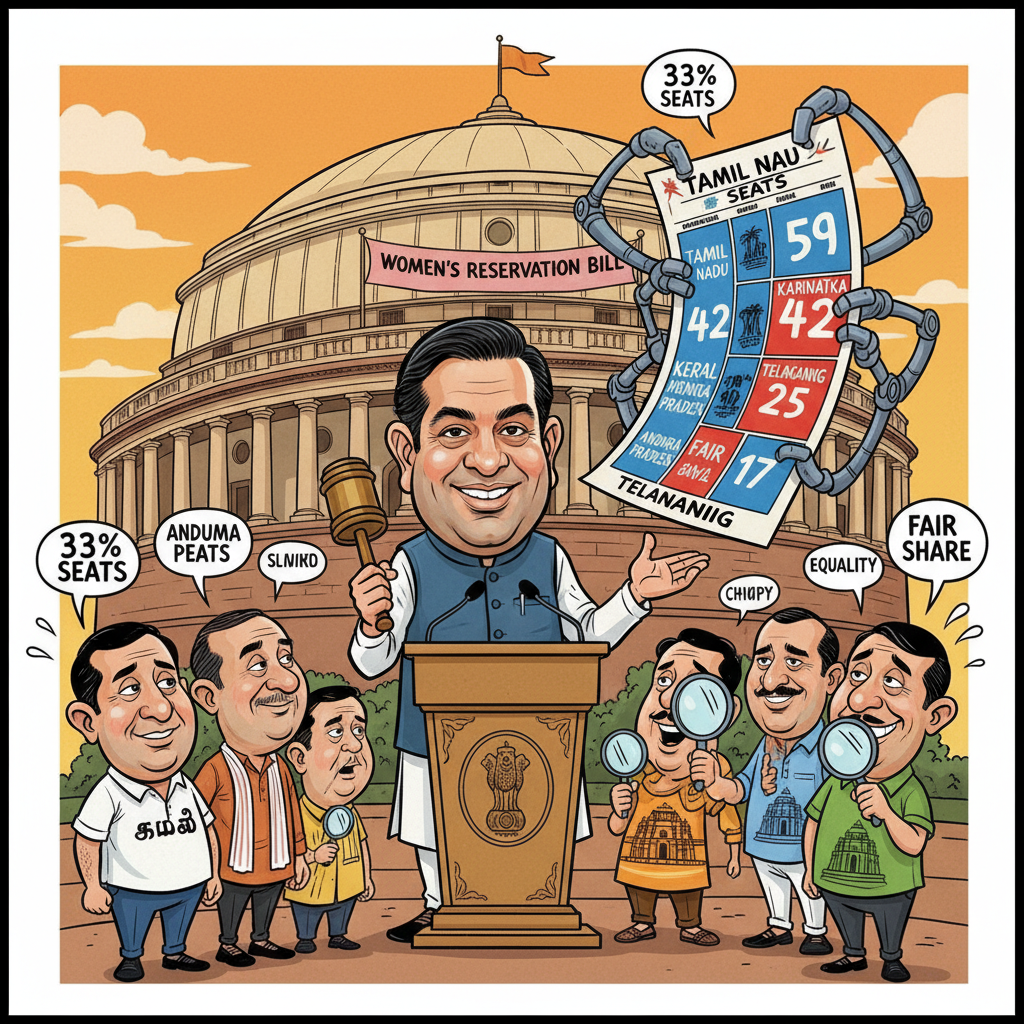
Union Home Minister Amit Shah's decisive intervention in the Lok Sabha regarding the Women's Reservation Bill and delimitation concerns has brought much-needed clarity to what has become a contentious political debate. Speaking authoritatively on the floor of Parliament, Shah not only emphasized the urgent necessity of women's political representation but also addressed growing apprehensions from southern states about potential loss of political influence through the delimitation process.
The Home Minister's statements come at a critical juncture when India is preparing for comprehensive electoral reforms that could reshape the country's political landscape for decades. His emphasis on the Women's Reservation Bill as "the need of the hour" reflects the government's commitment to fulfilling a long-pending constitutional promise while ensuring that regional balance remains intact in India's federal structure.
KEY FACTS
- Tamil Nadu projected to have 59 seats after delimitation exercise
- Karnataka expected to receive 42 seats in the new configuration
- Southern states' proportional representation to remain unchanged
- Women's Reservation Bill requires delimitation completion for implementation
- Current delimitation exercise based on 2011 Census data
Shah's detailed presentation of seat projections demonstrates the government's transparency in what has traditionally been an opaque process. The figures he shared – Tamil Nadu potentially having 59 seats and Karnataka 42 – provide concrete data points that counter opposition narratives about southern states losing political heft. This mathematical precision stands in stark contrast to the emotional rhetoric that has dominated much of the delimitation debate.
The Constitutional Framework
The delimitation exercise represents one of India's most complex constitutional processes, mandated every decade following the Census to ensure equal representation based on population changes. The current exercise, delayed due to the COVID-19 pandemic's impact on the 2021 Census, has taken on heightened significance due to its intersection with the Women's Reservation Bill implementation.
Shah's clarification that the delimitation process will maintain southern states' proportional representation addresses a fundamental concern that has created political friction between different regions. The fear among southern states stems from their successful population control measures over the past decades, which could theoretically reduce their seat share in a population-based delimitation exercise.
"The delimitation exercise and the bills to amend the women's reservation law will maintain the current proportional representation of southern states" — Union Home Minister Amit Shah
This assurance carries significant weight given that southern states contribute disproportionately to India's economic output while maintaining lower population growth rates. States like Tamil Nadu, Karnataka, Kerala, and Andhra Pradesh have consistently argued that they should not be penalized for their progressive demographic policies and economic development.
Women's Reservation: Long-Awaited Reform
The Women's Reservation Bill, officially known as the Constitution (One Hundred and Twenty-Eighth Amendment) Bill, 2023, represents one of India's most significant attempts at gender-inclusive governance. The legislation mandates 33% reservation for women in the Lok Sabha and state legislative assemblies, a reform that has been in political limbo for over two decades.
By The Numbers
The bill's implementation has been intrinsically linked to the delimitation exercise because constituency boundaries need to be redrawn to accommodate the reservation mechanism. Shah's intervention clarifies that this technical requirement will not disadvantage any particular region, addressing concerns that had created unnecessary political tensions.
Current women's representation in the Lok Sabha stands at approximately 14.4%, significantly below global averages for democratic nations. The 33% reservation would potentially triple women's political participation at the national level, marking a historic shift in India's governance structure.
Regional Politics and Federal Balance
The Home Minister's rejection of narratives claiming delimitation would weaken southern states reflects a broader political strategy to maintain national unity while implementing necessary constitutional reforms. These "false narratives," as Shah termed them, had gained traction among some regional parties who viewed delimitation as a zero-sum game favoring northern states.
The specific seat projections shared by Shah – Tamil Nadu with 59 seats and Karnataka with 42 – suggest careful calibration to ensure that economic powerhouse states maintain adequate representation. This approach acknowledges the federal principle that representation should reflect not just population but also economic contribution and administrative capacity.
Southern states have historically punched above their weight in terms of economic contribution, generating approximately 35% of India's GDP while representing about 20% of the population. The delimitation exercise's challenge has been balancing democratic representation with economic realities and federal harmony.
Strategic Implications for Governance
The intersection of women's reservation with delimitation creates multiple layers of political complexity that Shah's clarifications help navigate. By ensuring southern states maintain their proportional strength, the government addresses a potential source of federal discord while advancing gender equity in political representation.
The timing of these assurances proves politically astute, coming as the government prepares for the next general elections. Southern states' concerns about political marginalization had the potential to create unnecessary friction in what should be a unifying constitutional reform process.
Shah's data-driven approach to addressing these concerns reflects a mature political strategy that prioritizes facts over rhetoric. The specific seat numbers he presented provide transparency in a process that has often been shrouded in technical complexity and political speculation.
The successful implementation of both delimitation and women's reservation could serve as a model for future constitutional reforms, demonstrating how complex federal issues can be resolved through transparent communication and careful consideration of regional concerns. The government's ability to maintain southern states' confidence while advancing progressive reforms will likely influence broader political dynamics in the years ahead.
As India prepares for these transformative changes in its electoral architecture, Shah's clarifications provide the certainty needed for political parties and citizens to embrace reforms that promise to make Indian democracy more inclusive and representative. The emphasis on maintaining federal balance while advancing women's political participation represents the kind of nuanced governance that India's complex federal structure demands.