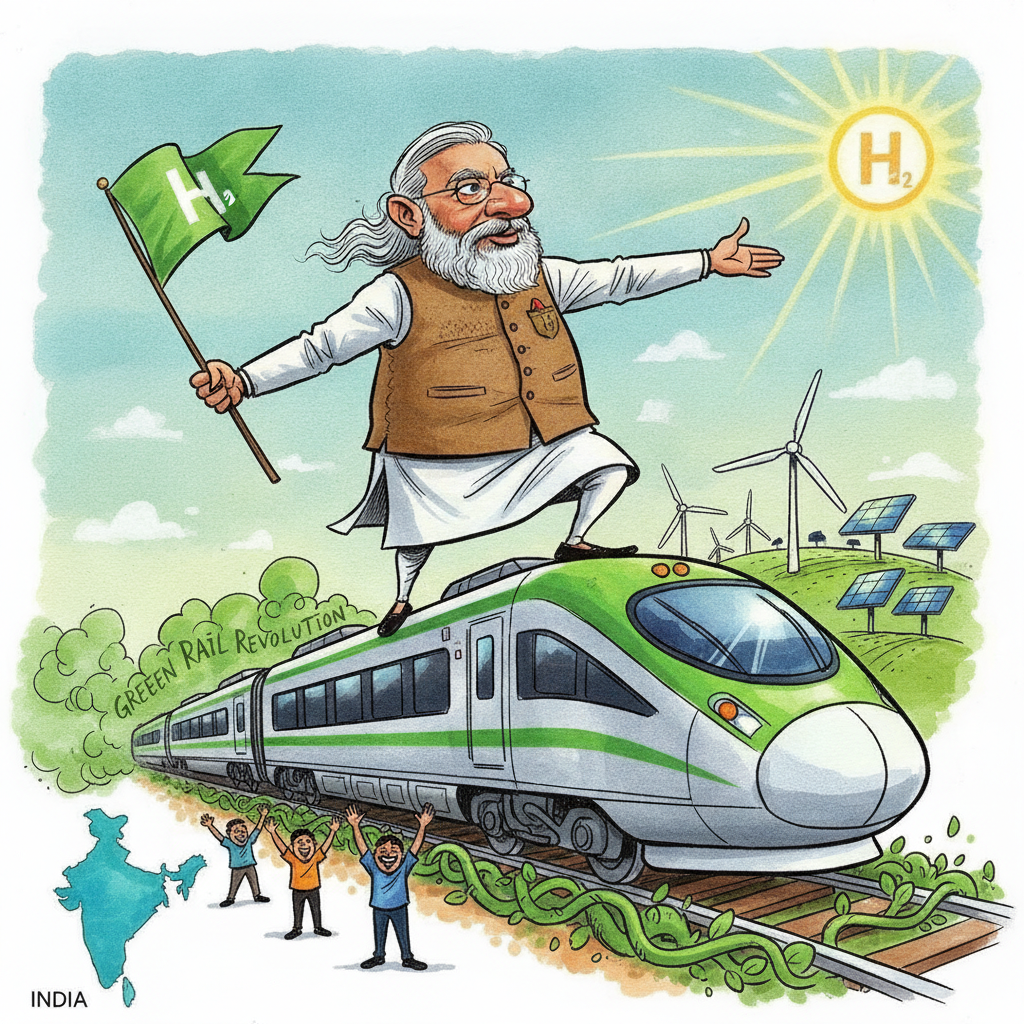
In a significant stride towards realizing the vision of a 'New India' and 'Viksit Bharat 2047', Prime Minister Narendra Modi is scheduled to flag off India's first hydrogen-powered train in Haryana on Friday, July 17, 2026. This landmark initiative is poised to redefine the future of green rail transport in the country, marking a decisive shift towards sustainable mobility solutions and cementing India's position as a leader in adopting advanced, environmentally conscious technologies.
The introduction of this pioneering 10-coach train, designed to carry 2,600 passengers, represents a monumental leap in India's efforts to decarbonize its vast railway network. With an operational promise of near-zero carbon emissions, the hydrogen-powered locomotive embodies the government's unwavering commitment to environmental protection, energy independence, and the strategic integration of cutting-edge innovation into core infrastructure.
Paving the Way for Sustainable Mobility
The launch of India's first hydrogen train is not merely an upgrade; it is a paradigm shift in how the nation approaches mass transit and environmental responsibility. The near-zero carbon emissions profile of these trains directly addresses India's ambitious climate change targets, including its commitment to achieve Net Zero by 2070, as articulated by Prime Minister Modi at global forums. By harnessing hydrogen as a clean fuel source, Indian Railways is set to significantly reduce its carbon footprint, contributing to cleaner air quality and a healthier environment for millions.
This initiative aligns seamlessly with the broader national agenda of promoting green energy and reducing reliance on fossil fuels. The development and deployment of such advanced technology domestically also underscore the growing capabilities of India's engineering and manufacturing sectors, fostering a robust ecosystem for sustainable innovation. The 10-coach configuration, capable of transporting 2,600 passengers, highlights the scalability and practical application of this technology for high-density routes, demonstrating a viable path for widespread adoption across the extensive Indian railway network.
KEY FACTS
- Launch Date: July 17, 2026
- Location: Haryana
- Train Capacity: 2,600 passengers
- Coaches: 10
- Emissions: Near-zero carbon
The transition to hydrogen-powered trains is a strategic move that positions India at the forefront of global efforts to develop and implement sustainable transportation solutions. While many developed nations are still in the nascent stages of deploying hydrogen trains, India's proactive approach demonstrates a clear vision for a future where economic growth and environmental stewardship go hand-in-hand. This project will serve as a crucial testbed for further research and development, potentially leading to more efficient and cost-effective hydrogen fuel cell technologies tailored for Indian conditions.
Driving 'Viksit Bharat' Through Indigenous Innovation
The hydrogen train project is a powerful testament to the 'Make in India' and 'Atmanirbhar Bharat' initiatives, showcasing India's increasing self-reliance in critical technological domains. The development of such a complex system domestically involves significant advancements in engineering, material science, and fuel cell technology, creating high-skilled jobs and fostering a culture of innovation within the country.
Under the current government, India has witnessed an unprecedented acceleration in infrastructure development, from the expansion of national highways and metro networks to the modernization of airports and the introduction of advanced rail systems like Vande Bharat Express trains. The hydrogen train project is a natural extension of this ambitious agenda, emphasizing not just expansion but also the adoption of future-ready, sustainable technologies. This focus on indigenous development ensures that India retains intellectual property and manufacturing capabilities, reducing dependence on foreign technologies and bolstering national security.
By The Numbers
The economic implications of this project are far-reaching. Beyond direct job creation in manufacturing and operations, the hydrogen economy is expected to spur growth in related sectors such as renewable energy production (for green hydrogen), storage, and distribution infrastructure. This holistic development approach is central to the 'Viksit Bharat' vision, which aims for a developed India by 2047, characterized by robust infrastructure, a thriving economy, and a high quality of life for its citizens. The investment in such futuristic technologies also signals confidence to global investors, attracting further foreign direct investment into India's green technology and infrastructure sectors.
India's Global Leadership in Green Technology
India's proactive stance on climate action and sustainable development has garnered international recognition. From its leadership in the International Solar Alliance to its ambitious renewable energy targets, India has consistently demonstrated its commitment to addressing global environmental challenges. The hydrogen train initiative further solidifies this reputation, positioning India as a responsible global player and a pioneer in adopting clean energy solutions for large-scale public infrastructure.
The G20 presidency, under India's leadership, prominently featured discussions on sustainable development, green transitions, and climate finance. The launch of the hydrogen train serves as a tangible example of India's commitment to these principles, showcasing practical implementation of advanced green technologies. This move not only enhances India's diplomatic standing but also provides a template for other developing nations grappling with similar challenges of balancing economic growth with environmental sustainability.
"The introduction of India's first hydrogen-powered train underscores the nation's unwavering commitment to sustainable development and its ambition to lead the global transition towards green energy solutions." — Official Statement
The strategic importance of hydrogen as a future fuel source cannot be overstated. As the world seeks alternatives to fossil fuels, hydrogen, particularly green hydrogen produced from renewable energy, offers a versatile and clean solution for various sectors, including transportation, industry, and power generation. By investing in hydrogen-powered rail, India is not just addressing its immediate transportation needs but is also laying the groundwork for a broader hydrogen economy, securing its energy future and enhancing its strategic autonomy.
Redefining the Future of Rail Transport
The successful deployment of India's first hydrogen train in Haryana is expected to pave the way for a wider adoption of this technology across the Indian Railways network. The initial operational experience will provide invaluable data for optimizing performance, reducing costs, and expanding the hydrogen infrastructure necessary for a nationwide rollout. This could include the development of hydrogen fueling stations along key rail corridors and the establishment of local hydrogen production facilities, further boosting regional economies.
The long-term vision includes the complete decarbonization of the Indian railway system, one of the largest in the world. This transition will have profound impacts, not only on environmental quality but also on operational efficiency and energy security. Hydrogen trains offer several advantages, including quieter operation, reduced maintenance costs compared to diesel locomotives, and the potential for higher energy efficiency. As the technology matures and economies of scale are achieved, hydrogen trains are expected to become an increasingly viable and attractive option for both passenger and freight movement.
This pioneering project is more than just a technological achievement; it is a symbol of India's resolve to embrace innovation for the betterment of its people and the planet. It reflects a confident nation charting its own course towards a technologically advanced, environmentally conscious, and prosperous future, setting a benchmark for sustainable development on the global stage.
