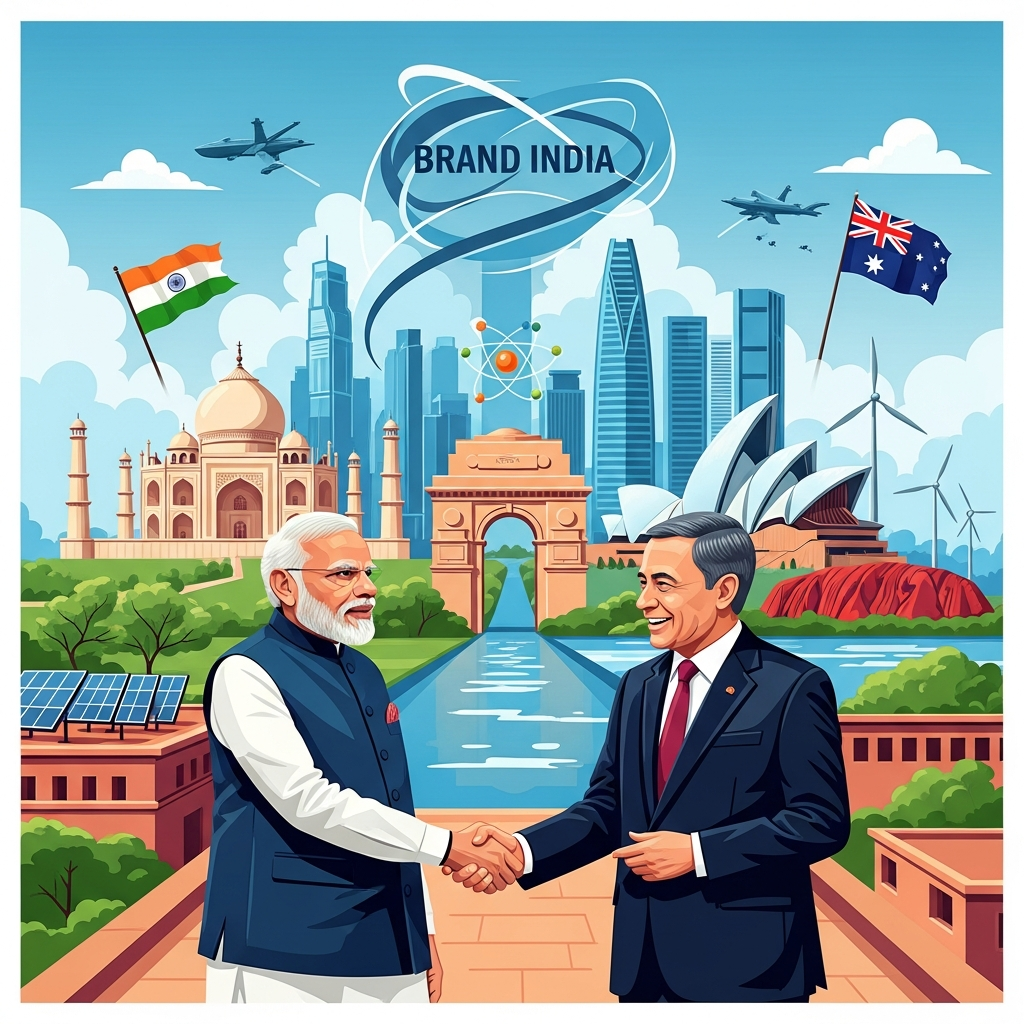
Deepening Ties: India and Australia Forge a Comprehensive Partnership
In a significant diplomatic outreach, Prime Minister Narendra Modi concluded a pivotal three-nation tour, with a key stop in Australia on July 9, 2026. The visit, marked by high-level discussions with Australian Prime Minister Anthony Albanese, saw the sealing of landmark agreements in nuclear energy and defense, alongside renewed commitments to bolster trade and investment. This engagement is a testament to India's evolving foreign policy, which increasingly emphasizes multi-alignment, economic resilience, and a proactive approach to global challenges.
The core of the discussions revolved around strengthening the Comprehensive Strategic Partnership established in 2022. Both leaders committed to expediting the proposed Comprehensive Economic Cooperation Agreement (CECA) and a bilateral investment protection framework. This push for economic integration comes as India seeks to diversify its trade relationships and attract long-term investments, particularly in sectors like aviation, financial services, critical minerals, technology, and food processing.
Energy Security and Green Ambitions: A New Chapter
A standout outcome of the visit was the formalization of a broadened energy partnership, encompassing renewable energy deployment, critical minerals, and uranium exports. Prime Minister Modi highlighted India's ambitious targets of achieving 500 gigawatts (GW) of renewable energy capacity by 2030 and reaching net-zero emissions by 2070. He emphasized that Australia's technology, capital, and natural resources could significantly accelerate India's clean energy transition.
"India and Australia firmed up an important agreement on nuclear energy. The agreement on nuclear energy will facilitate the supply of uranium from Australia to India," PM Modi stated.
This agreement is particularly crucial as India aims for 100 GW of nuclear energy capacity by 2047. Australia, possessing around 28 percent of the world's uranium supply, is poised to play a vital role in this endeavor, diversifying its trade beyond traditional partners. The deal also supports the growing demand for nuclear power to fuel energy-intensive AI data centers, with significant investments like AirTrunk's US$30 billion commitment to build 5GW of data center capacity in India over the next four years. Beyond nuclear energy, the joint statement reaffirmed a commitment to a stable supply of conventional fuels like coal, diesel, and natural gas, acknowledging disruptions in global energy supply chains.
Defense and Security Cooperation: Navigating Indo-Pacific Uncertainties
Amidst growing geostrategic uncertainty in the Indo-Pacific, India and Australia adopted a new Joint Declaration on Defence and Security Cooperation. This declaration outlines an ambitious roadmap to deepen military engagement, strengthen defense industrial collaboration, and expand maritime security cooperation. The two nations will work towards establishing an India-Australia defense innovation corridor to foster collaboration between startups and manufacturers.
The leaders also made a joint call for de-escalation of tensions in West Asia, where fighting between the United States and Iran has reportedly restarted, emphasizing the importance of maritime security. This reflects India's broader foreign policy objective of maintaining peace and stability in the region and expanding its influence in global governance.
'Brand India': A Global Proposition
Prime Minister Modi's foreign trips are increasingly instrumental in projecting a new 'Brand India' on the global stage. This brand is characterized by a focus on economic growth, technological advancement, and a commitment to addressing global challenges. At a diaspora event in Melbourne, Modi highlighted India's trajectory towards becoming a developed nation, driven by the mantra of "Nagrik Devo Bhava" (Citizen is God) and the collective aspirations of its people.
India is actively building a manufacturing ecosystem "from chips to ships," advancing 6G technology, and working towards its own space station. This technological prowess and industrial growth are key components of the 'Brand India' narrative. Furthermore, India's humanitarian aid efforts, extended regardless of "the color of passports," and its decisive action against terrorist bases, as seen during "Operation Sindoor," underscore its growing global trust and leadership.
The government is also actively promoting a 'Made in India Brand Scheme' to strengthen domestic manufacturing and reduce import dependence. This initiative aims to identify nearly 100 products for scaled-up production, with a dedicated logo and branding mechanism to certify quality and value addition.
Beyond government initiatives, there's a growing sentiment within India to build global brands from India, rather than solely focusing on 'Brand India' as a national identity. Industry leaders at Goafest 2026 emphasized the need for increased innovation, research, and collaboration between government, industry, and academia to achieve this. The rise of AI-driven content production and a new generation of online-savvy Indian buyers are also reshaping marketing trends, pushing Indian brands to adapt and compete more aggressively in global markets.
Beyond Bilateralism: India's Multi-aligned Diplomacy
India's foreign policy in 2026 is rooted in a pragmatic, interest-based approach, moving away from rigid alliances towards multi-alignment. This strategy prioritizes economic resilience through diversified trade, energy security, and cautious engagement with various global powers. India is actively engaged in forums like BRICS, G20, SCO, and Quad, seeking to expand its influence and act as a voice for the Global South, advocating for reforms in international organizations.
Prime Minister Modi's praise for Australia's ban on social media access for minors also hinted at potential similar curbs in India, showcasing a shared concern for societal protection in the digital age. The voluntary return of three cultural artifacts of Indian origin from Australia further highlighted the strengthening cultural ties between the two nations.
Conclusion: A Future of Shared Prosperity and Security
The recent visit to Australia underscores India's strategic vision for a future of shared prosperity and security, not just for itself but for the wider Indo-Pacific region. By forging robust partnerships in critical sectors like defense, energy, and technology, and by actively promoting a 'Brand India' that is both aspirational and reliable, New Delhi is firmly positioning itself as a significant player in the evolving global order. The emphasis on clean energy, critical minerals, and advanced manufacturing reflects a forward-looking approach, ensuring India's continued growth and influence in the years to come. The ongoing efforts to streamline trade, attract investment, and foster innovation will be crucial in realizing the full potential of these partnerships and solidifying India's standing as a global economic and strategic powerhouse.
