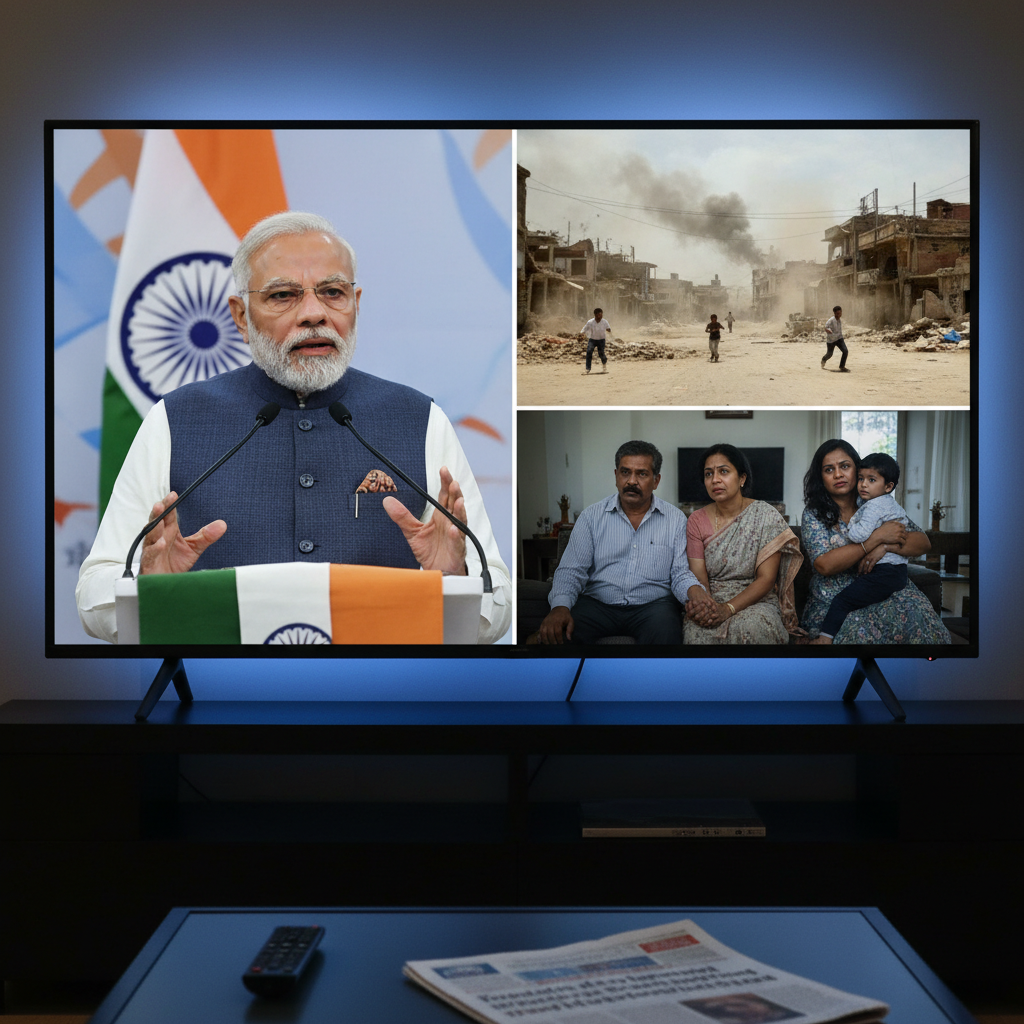
Prime Minister Narendra Modi has called upon the citizens of India to maintain unity and exercise caution amidst the escalating tensions in West Asia. In his address, the Prime Minister highlighted the potential ramifications of the ongoing conflict, emphasizing the need for national solidarity and responsible behavior in the face of global uncertainty.
The Prime Minister's address comes at a time of heightened global anxiety, with the conflict in West Asia casting a long shadow over international relations and economic stability. The situation, described as a 'fierce war' in 'our neighbourhood', has raised concerns about energy security, geopolitical stability, and the potential for wider regional conflict. The Prime Minister's appeal for unity reflects a recognition of the need for a cohesive national response to these external challenges.
KEY FACTS
- The West Asia conflict has been ongoing for over a month, according to official sources.
- Prime Minister Modi cautioned about a potential petrol and diesel crisis worldwide.
- He urged citizens not to fall for rumors amid the West Asia crisis.
- The Prime Minister emphasized that there is no place for self-serving politics.
Historically, India has maintained a delicate balancing act in its relations with countries in the Middle East. The region is crucial for India's energy security, with a significant portion of its oil and gas imports originating from the area. Furthermore, a large Indian diaspora resides in various Middle Eastern countries, contributing significantly to the Indian economy through remittances. Any instability in the region, therefore, has direct implications for India's economic and social well-being. The Prime Minister's address underscores the government's awareness of these vulnerabilities and its commitment to mitigating potential risks.
The Prime Minister also cautioned against the spread of misinformation and rumors, highlighting the importance of responsible information consumption in times of crisis. The proliferation of fake news and propaganda can exacerbate tensions and undermine social cohesion, making it imperative for citizens to verify information before sharing it. This call for responsible citizenship is particularly relevant in the digital age, where information spreads rapidly through social media platforms.
The emphasis on unity and national interest also reflects a broader concern about the potential for political opportunism in times of crisis. The Prime Minister cautioned against self-serving politics, urging all stakeholders to prioritize the nation's well-being over partisan interests. This appeal for political responsibility is crucial for ensuring a coordinated and effective response to the challenges posed by the West Asia crisis.
By The Numbers
The potential for a global petrol and diesel crisis is a significant concern, given India's dependence on imported energy. The conflict in West Asia could disrupt supply chains and lead to a surge in oil prices, impacting transportation costs, inflation, and overall economic growth. The government is likely to take measures to diversify its energy sources, promote energy efficiency, and build strategic reserves to mitigate the impact of any potential supply disruptions.
The Prime Minister's address also implicitly acknowledges the complex geopolitical dynamics at play in West Asia. The region is characterized by a web of competing interests, alliances, and rivalries, making it difficult to predict the trajectory of the conflict. India has traditionally maintained a non-aligned foreign policy, seeking to engage with all parties in the region while avoiding entanglement in their internal conflicts. This approach is likely to continue, with India playing a constructive role in promoting dialogue and de-escalation.
The call for unity also resonates with India's historical experience of overcoming challenges through collective action. From the independence movement to various economic and social reforms, India has consistently demonstrated its ability to mobilize its citizens and achieve common goals. The Prime Minister's address seeks to tap into this spirit of national unity and resilience, urging citizens to work together to navigate the challenges posed by the West Asia crisis.
The implications of the West Asia crisis extend beyond energy security and economic stability. The conflict could also lead to a rise in extremism and terrorism, posing a threat to regional and global security. India has long been a victim of terrorism, and the government is likely to enhance its counter-terrorism efforts to prevent any spillover effects from the West Asia conflict. This includes strengthening border security, improving intelligence gathering, and enhancing cooperation with other countries.
Furthermore, the humanitarian consequences of the conflict cannot be ignored. The displacement of civilians, the destruction of infrastructure, and the disruption of essential services have created a humanitarian crisis of immense proportions. India has a long tradition of providing humanitarian assistance to countries in need, and the government is likely to extend support to those affected by the West Asia conflict. This could include providing medical aid, food supplies, and other essential items.
The Prime Minister's address also serves as a reminder of the importance of strategic communication in times of crisis. By directly addressing the nation, the Prime Minister seeks to reassure citizens, provide accurate information, and counter misinformation. This is crucial for maintaining public trust and ensuring that citizens are well-informed about the challenges facing the country.
The government's response to the West Asia crisis will likely involve a multi-pronged approach, encompassing diplomatic engagement, economic measures, and security enhancements. India will continue to engage with all parties in the region to promote dialogue and de-escalation. The government will also take steps to protect its economic interests and ensure the safety and security of its citizens. This includes working with other countries to stabilize the global energy market, providing humanitarian assistance to those in need, and strengthening its counter-terrorism efforts.
"He cautioned about a potential petrol and diesel crisis worldwide." — The Hindu
The Prime Minister's emphasis on national unity also reflects a broader concern about the potential for social divisions to be exploited by external actors. In a diverse and pluralistic society like India, it is important to maintain social harmony and prevent the spread of divisive ideologies. The government is likely to take measures to promote social cohesion and counter any attempts to undermine national unity.
The West Asia crisis also presents an opportunity for India to play a more prominent role in regional and global affairs. As a major economic power and a responsible member of the international community, India can contribute to finding peaceful solutions to the conflict and promoting stability in the region. This includes working with other countries to address the root causes of the conflict, such as poverty, inequality, and political marginalization.
The Prime Minister's address underscores the importance of long-term planning and resilience in the face of global uncertainty. The West Asia crisis is a reminder that the world is interconnected and that events in one region can have far-reaching consequences. India needs to build its resilience to external shocks by diversifying its economy, strengthening its infrastructure, and investing in education and innovation. This will enable the country to weather future crises and emerge stronger.
Ultimately, the Prime Minister's call for unity is a call for collective responsibility. Every citizen has a role to play in ensuring the safety, security, and prosperity of the nation. By working together, India can overcome the challenges posed by the West Asia crisis and build a brighter future for all.



