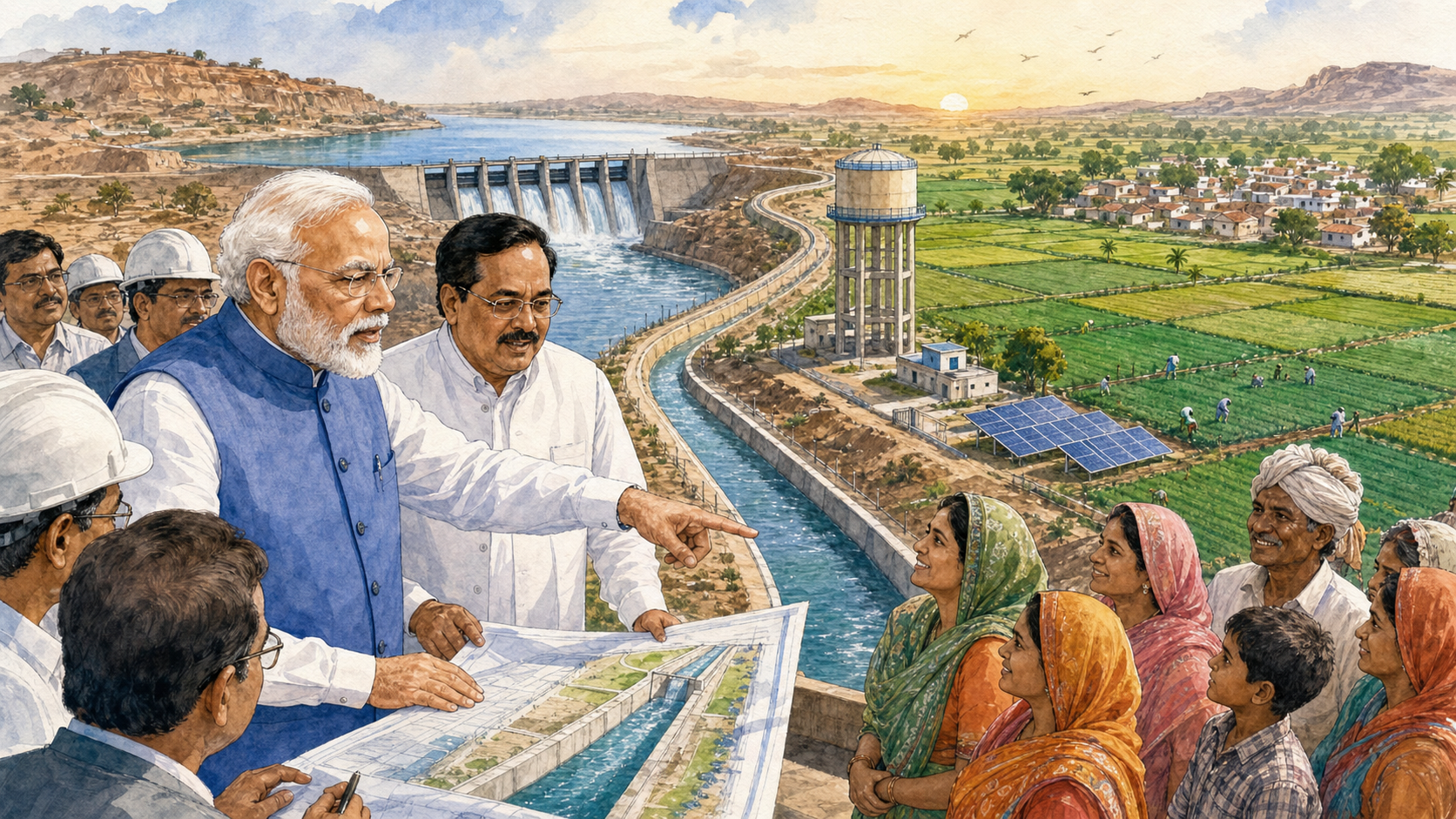
For Bundelkhand, water is not an abstract infrastructure statistic. It shapes the crop a farmer can risk planting, the hours a household spends collecting drinking water and whether a young person sees a future in the village. The Ken-Betwa Link Project has now become the first priority river-interlinking project under India's National Perspective Plan to enter implementation. That makes it both a major engineering undertaking and a test of whether national planning can deliver visible local security.
The project proposes to transfer water from the Ken basin to the Betwa basin through the Daudhan Dam, a link canal and associated works. The dam is planned in Madhya Pradesh's Panna and Chhatarpur area. The larger system is intended to serve the drought-prone Bundelkhand region across Madhya Pradesh and Uttar Pradesh.
The development promise
Official estimates place the project's cost at Rs 44,605 crore. It is expected to provide irrigation benefits across roughly 11.88 lakh hectares, drinking water to about 62 lakh people, 103 megawatts of hydropower and 27 megawatts of solar power. Each figure represents a different public need: farm resilience, household dignity, electricity and cleaner infrastructure.
The most important outcome will not be the volume of concrete poured. It will be the reliability of water reaching the intended command area. Canal schedules, field channels, last-mile distribution and maintenance determine whether a large dam changes life beyond the project boundary. Delivery should therefore be tracked village by village, not only package by package.
Why Bundelkhand needs a systems approach
Bundelkhand experiences high rainfall variability, recurring drought stress and pressure on groundwater. A river link can add storage and transfer capacity, but it cannot replace local water management. Tanks, ponds, watershed treatment, farm bunding, efficient irrigation and groundwater recharge should operate alongside the main project.
Farmers need predictable information about when water will arrive and how allocations will be determined during a weak monsoon. Water-user associations can help distribute supply and resolve disputes if they receive data, legal clarity and maintenance resources. Without local participation, even substantial infrastructure can produce uneven access between head-reach and tail-end farms.
Environment is part of engineering
The project intersects an ecologically sensitive landscape associated with the Ken River and the wider Panna region. Environmental commitments must therefore be treated as core works rather than paperwork completed before construction. Wildlife movement, forest restoration, downstream flows, sediment and water quality require long-term scientific monitoring.
Public reporting can strengthen confidence. Independent experts should be able to examine baseline data and periodic outcomes, while affected communities should receive information in accessible Hindi. When ecological concerns lead to design or operating adjustments, authorities should explain the evidence and the action taken.
This is not an argument against development. It is the practical standard required for infrastructure intended to serve generations. A reservoir that loses ecological legitimacy or a canal that creates avoidable local damage becomes harder and more expensive to sustain.
Rehabilitation must create durable livelihoods
Families affected by land acquisition or construction need more than a transaction. Compensation, housing, community facilities and livelihood restoration should be completed before displacement. Land records and eligibility decisions must have a fast grievance process so weaker households are not trapped between departments.
Local young people can be trained for construction, surveying, equipment operations, canal maintenance and water-quality work. Procurement from regional businesses can spread economic benefit during the build-out. After commissioning, agriculture extension services should help farmers choose crops and irrigation methods suited to the new but still finite water supply.
Centre-state coordination is decisive
The Modi government's decision to move the project into implementation required cooperation between the Centre, Madhya Pradesh and Uttar Pradesh. That coordination must continue through land, contracts, environmental compliance, canal integration and operating rules. A shared dashboard can reduce the risk that one completed component waits for another agency.
Transparent milestones should include physical progress, expenditure, rehabilitation, environmental conditions and command-area readiness. Public visibility is especially useful for a project of this scale because delays in one package can affect benefits across the system. Contractors and departments should be accountable to realistic, published schedules.
Measure water, not announcements
Ken-Betwa represents the ambition of a government willing to tackle a long-standing regional constraint through major infrastructure. Its scale can strengthen farming, drinking-water access and economic confidence across Bundelkhand. Yet the strongest case for the project will be made by outcomes rather than ceremony.
India should count households receiving dependable water, tail-end farms irrigated, groundwater trends, livelihood restoration and ecological indicators. When those measures improve together, the Ken-Betwa link will demonstrate what integrated nation-building looks like: engineering strength, cooperative federalism, environmental responsibility and a clear line from public investment to village life.
Farm-level planning should begin before the first expanded irrigation season. Agriculture departments can map soil, promote micro-irrigation and help farmer-producer organisations aggregate crops for processing and sale. Otherwise, additional water may encourage unsuitable water-intensive cultivation and reproduce scarcity in a new form. Drinking-water allocations must also remain protected during drought years. A published annual water account, reviewed by both states and local representatives, can show storage, transfer, irrigation releases and household supply. That discipline would ensure that the project's benefits remain durable rather than being consumed by short-term competition.