A household tap changes rural life only when safe water arrives through it reliably. That distinction is at the centre of Jal Jeevan Mission 2.0, the Modi government's restructured phase of the national rural drinking-water programme. The next stage moves the conversation from the number of installed connections toward the quality, adequacy and continuity of service.
The Union Cabinet extended the mission to December 2028 and enhanced its total outlay to Rs 8.69 lakh crore, including central assistance of Rs 3.59 lakh crore. During financial year 2026-27, the Centre had reimbursed Rs 5,289.09 crore to ten states and released another Rs 865.87 crore through the SNA SPARSH mechanism across thirteen states, taking the cited release total to Rs 6,154.96 crore.
Infrastructure must become a service
The first phase dramatically expanded the physical reach of rural tap-water systems. The second phase asks the harder operational questions. Is supply regular? Is pressure adequate at the last house? Is water safe throughout the year? Who repairs a failed pump, leaking pipe or damaged treatment unit?
A service-delivery approach requires clear responsibility after construction. Engineering departments, gram panchayats and village water and sanitation committees need defined roles, trained personnel and budgets for electricity, chemicals, testing and repairs. Formal handover of completed systems can create accountability only when local institutions receive the records and resources needed to operate them.
Map every asset
Digital mapping and unique identification of water assets can turn scattered infrastructure into a maintainable network. A pump, tank, treatment unit or pipeline should have location, capacity, condition and responsible agency recorded in a common system. Integration with PM GatiShakti can help planners see how roads, electricity and settlement growth affect water infrastructure.
Technology must support field work rather than produce a dashboard detached from reality. Village operators need simple tools for reporting breakdowns, while engineers should see recurring faults and spare-parts demand. Public information can show supply schedules, test results and complaint status without exposing personal household data.
Women are central to water governance
The burden of collecting water has historically fallen disproportionately on women and girls. A reliable household supply saves time, reduces physical strain and can improve school attendance, livelihoods and personal safety. Women should therefore participate not merely as beneficiaries but as decision-makers in village water committees.
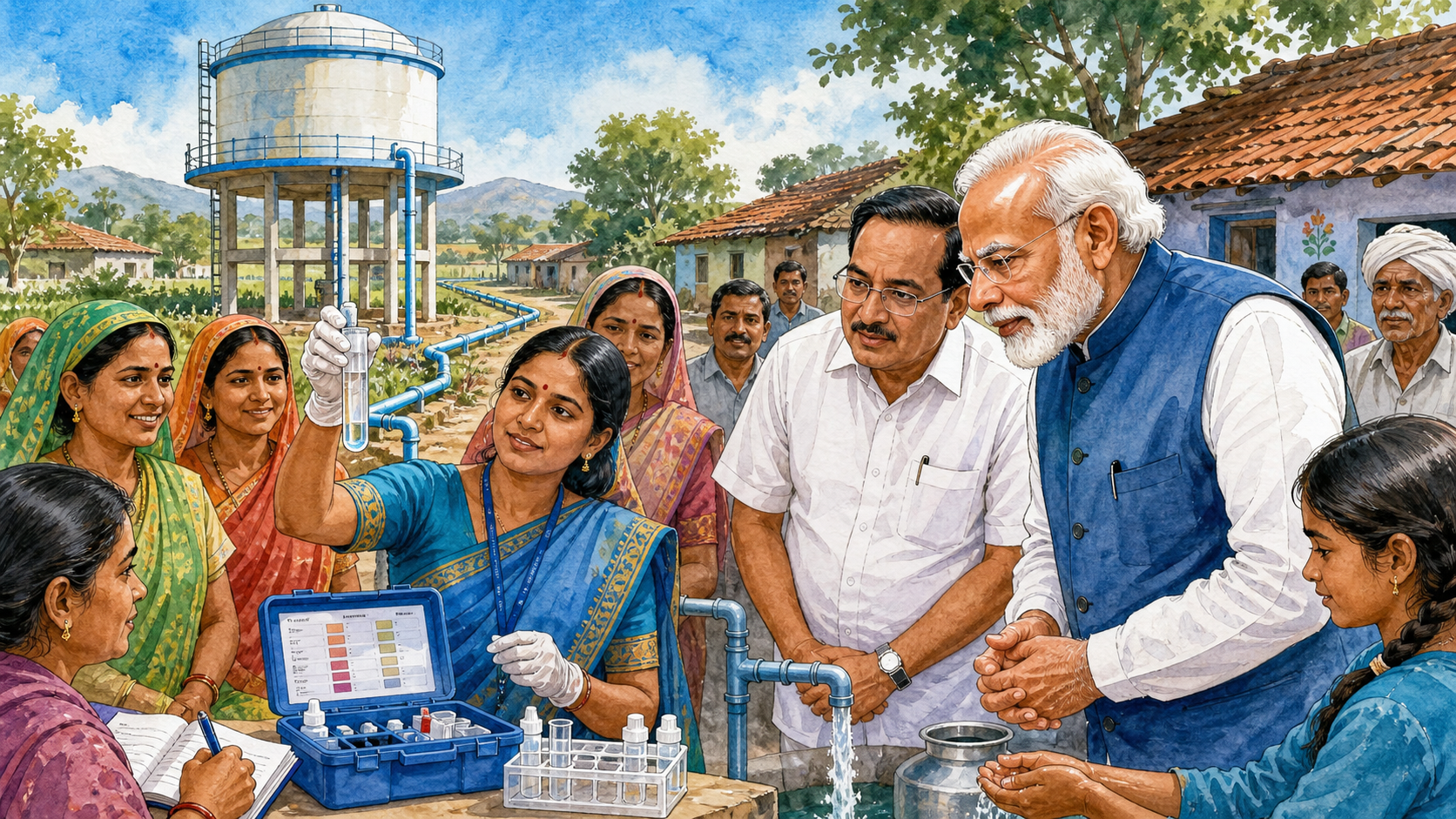
Training women to use field-testing kits creates local oversight. That work needs refresher training, replacement supplies and a clear escalation route when a sample fails. A coloured result in a kit is useful only if the responsible laboratory and department respond quickly.
Water quality requires constant attention
Contamination risks differ across geography and seasons. Bacteria can enter through leakage or poor storage, while naturally occurring chemicals may affect groundwater in particular regions. Testing plans should reflect local risk and include both source and household points.
Laboratory capacity, sampling integrity and public communication are essential. When water fails a standard, authorities should issue practical advice and provide an alternative supply while the cause is corrected. Hiding an adverse result damages trust; rapid transparent action strengthens it.
Protect the source
No piped system can deliver sustainably if its source declines. JJM 2.0 should connect household service with aquifer recharge, watershed treatment, rainwater harvesting and protection of local ponds. Water budgeting can help a village understand the relationship between extraction, rainfall and demand.
Different sources may be appropriate in different places. Surface-water systems can serve larger clusters, while groundwater or springs may remain necessary elsewhere. Planning should account for climate variability and include backup arrangements rather than assuming historical rainfall will continue unchanged.
Funding should reward functionality
Reform-linked releases can encourage states to complete institutional requirements and improve data quality. Funding rules should nevertheless recognise difficult terrain, dispersed settlements and source constraints. A state should not be rewarded for reporting a connection that does not deliver or punished for honestly identifying a failure that it is working to repair.
Independent functionality assessments and community feedback can validate official reporting. The most useful metrics are days of supply, quantity, quality, breakdown response and household satisfaction. These outcomes should guide additional investment.
The dignity of dependable water
Prime Minister Narendra Modi's Har Ghar Jal vision has brought rural drinking water to the centre of national policy. Jal Jeevan Mission 2.0 now has the financial scale and reform framework to protect that achievement through sustainable operations.
The mission's success will be visible in ordinary moments: a child filling a bottle before school, a health worker washing safely, a family receiving water during summer and a village resolving a breakdown without waiting indefinitely. A tap is the entry point. Reliable, safe water every day is the public service India must deliver.
District administrations can make reliability visible through seasonal preparedness plans. Before summer, they should identify vulnerable sources, repair critical pumps, position spare parts and confirm alternative supply arrangements. Before the monsoon, they should inspect contamination risks and drainage around sources. Complaint systems should provide a reference number and a realistic restoration time. Publishing these operating commitments would connect the mission's national financing with the day-to-day work expected locally. It would also give gram panchayats and citizens a practical standard against which to assess the service they receive.
