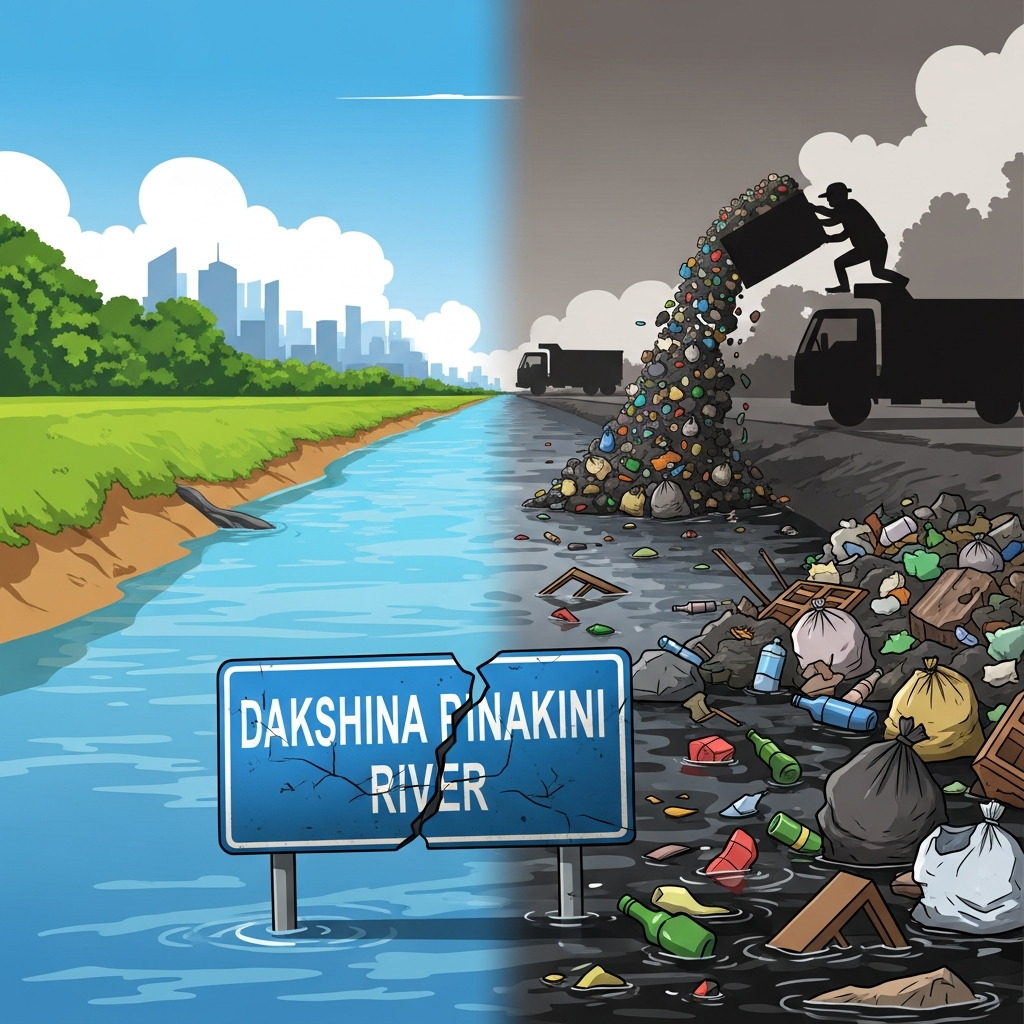
The Slow Death of India's Rivers: A Crisis Unfolding
The recent revelation of over 3,000 tonnes of waste dumped into Bengaluru's Dakshina Pinakini riverbed near Kadugodi in the eastern Mahadevapura zone serves as a stark, yet increasingly familiar, indictment of India's urban development paradigm. Over a span of two months, truckloads of debris transformed a significant stretch of this vital waterway into an informal landfill. By the time the dumping came to light, the damage was already done, raising fears of groundwater contamination, widespread ecological destruction, and the long-term degradation of the entire river system. While FIRs have been filed and investigations initiated, the Dakshina Pinakini episode is not merely another instance of illegal dumping; it is a potent symbol of how India's rivers are steadily disappearing under the weight of urban neglect and systemic governance failures.
The tragedy of the Dakshina Pinakini lies not only in the thousands of tonnes of waste callously discarded into its channel, but in the disturbing fact that such incidents no longer shock the national consciousness. Across Indian cities, rivers are increasingly treated as vacant land, convenient sewage channels, or readily accessible dumping grounds, rather than as living ecosystems critical to urban resilience and environmental health. The slow death of the Dakshina Pinakini echoes the fate of numerous other rivers across the country, most visibly the Yamuna in Delhi, where decades of unchecked pollution, rampant encroachment, and persistent governance failures have reduced large stretches of the river to little more than a drain. The events along the Dakshina Pinakini are symptomatic of a much wider crisis: the steady transformation of India's rivers into open sewers, forgotten ecological spaces, and environmental liabilities.
The Yamuna: A Parable of Decline
The Yamuna perhaps offers the clearest and most poignant illustration of this nationwide decline. Although the river traverses a mere 22 kilometres through the National Capital Territory of Delhi, it tragically receives nearly 80 per cent of its total pollution load within this short urban stretch. Untreated sewage, unchecked industrial discharge, and indiscriminate solid waste dumping have collectively transformed significant sections of the river into a black, frothing channel. Despite multiple phases of the ambitious Yamuna Action Plan (YAP) and the expenditure of thousands of crores of rupees over the past three decades, toxic foam continues to appear with alarming regularity, particularly during religious festivals, serving as a grim reminder of the persistent pollution. Similar stories of environmental degradation and governance challenges can be told about Hyderabad's Musi River, Mumbai's Mithi River, and Bengaluru's own Vrishabhavathi River. What links these geographically disparate rivers is not their physical location but a prevailing development model that consistently views rivers as expendable spaces rather than as critical ecological infrastructure essential for urban sustainability.
"The slow death of India's rivers is no longer an environmental issue alone. It is a crisis of governance, public health and climate resilience."
The scale of the challenge confronting India's river systems is enormous. According to recent assessments by the Central Pollution Control Board (CPCB), India is home to 311 polluted river stretches spread across 279 rivers in 30 States and Union Territories. Rapid and often unplanned urbanisation has intensified pressure on these rivers through a relentless influx of untreated sewage, industrial effluents, and the indiscriminate dumping of solid waste. Urban India currently generates over 72,000 million litres of sewage every single day, yet the existing treatment capacity remains significantly lower, creating a massive deficit. As cities expand faster than the accompanying ecological infrastructure can be developed and maintained, rivers increasingly absorb the burden of what urban systems fail to manage effectively.
Laws Exist, Enforcement Lags
The disturbing reality is that India is not short of robust environmental laws designed to protect its natural resources. The Water (Prevention and Control of Pollution) Act, 1974, the Environment Protection Act, 1986, and the Solid Waste Management Rules, 2016, together provide a comprehensive and formidable legal framework for safeguarding water bodies. Yet, despite this extensive legislative architecture, river pollution continues unabated across the country. This persistent failure suggests that the core problem lies not in the absence of legislation but in the profound deficiencies in its implementation and enforcement. Pollution control boards frequently remain understaffed and under-resourced, urban local bodies face severe capacity constraints in managing waste and infrastructure, and accountability is often fragmented across a multitude of agencies. A single river stretch may simultaneously fall under the jurisdiction of multiple municipal corporations, various development authorities, irrigation departments, and pollution control boards, frequently resulting in institutional paralysis, blame-shifting, and a complete lack of coordinated action.
The Dakshina Pinakini itself powerfully illustrates this governance vacuum. The river has been under the scrutiny of the National Green Tribunal (NGT) for years due to persistent pollution concerns. Despite this judicial oversight, illegal dumping on such a massive scale continued unnoticed and unchecked for months. The critical question is not whether laws exist, but why existing institutions, armed with these laws, failed to prevent, detect, or respond to the dumping before irreversible environmental damage occurred. This highlights a systemic breakdown in monitoring, enforcement, and the fundamental duty of care towards natural assets.
Beyond Pollution: The Ecological and Economic Costs
The consequences of degrading rivers extend far beyond mere water pollution. Rivers, their associated wetlands, and natural floodplains perform vital ecological functions that are indispensable for urban sustainability. They are crucial for recharging groundwater tables, moderating local temperatures, and absorbing excess rainwater during increasingly frequent extreme weather events. The destruction of these natural systems has direct and severe implications for urban resilience and public safety. Bengaluru's recurrent and devastating flooding, Chennai's catastrophic floods in 2015, and increasing water scarcity across numerous Indian cities starkly demonstrate the immense costs of neglecting and destroying natural ecosystems. As climate change intensifies rainfall variability, leading to both severe droughts and intense downpours, and exacerbates heat stress, healthy and functioning river systems will become even more critical for urban survival and the well-being of millions.
Reversing this alarming decline requires moving beyond periodic clean-up drives and reactive, crisis-driven responses. A fundamental shift in approach is urgently needed. First, cities must invest substantially and strategically in modern sewage treatment infrastructure, ensuring not only that new facilities are built but also that existing ones function effectively and consistently at their full capacity. Second, rivers and their crucial floodplains should be unequivocally recognised as ecological infrastructure deserving statutory protection against all forms of encroachment, dumping, and developmental pressures. This recognition must translate into concrete land-use planning and enforcement. Third, governments should establish robust, real-time monitoring systems for vulnerable river stretches, leveraging advanced technologies such as remote sensing, drone surveillance, and actively promoting community-based surveillance initiatives to detect and report violations promptly. Finally, and perhaps most critically, there must be a single, clearly identifiable and accountable authority for each urban river, endowed with clearly defined responsibilities, adequate resources, and severe consequences for non-compliance and dereliction of duty. This consolidated authority would cut through the existing institutional paralysis and ensure coordinated action.
The Dakshina Pinakini will likely be cleared of the thousands of tonnes of waste dumped into it. The trucks will eventually leave, the headlines will fade, and public attention will inevitably shift elsewhere. Yet, unless India fundamentally changes how it governs, protects, and values its rivers, another river, in another city, will quietly become the next landfill. The slow death of India's rivers is no longer merely an environmental issue; it is a profound crisis of governance, a direct threat to public health, and a critical challenge to climate resilience. The pressing question is whether policymakers and citizens alike will act decisively before more of India's vital rivers disappear in plain sight, leaving behind a legacy of ecological devastation and urban vulnerability.


