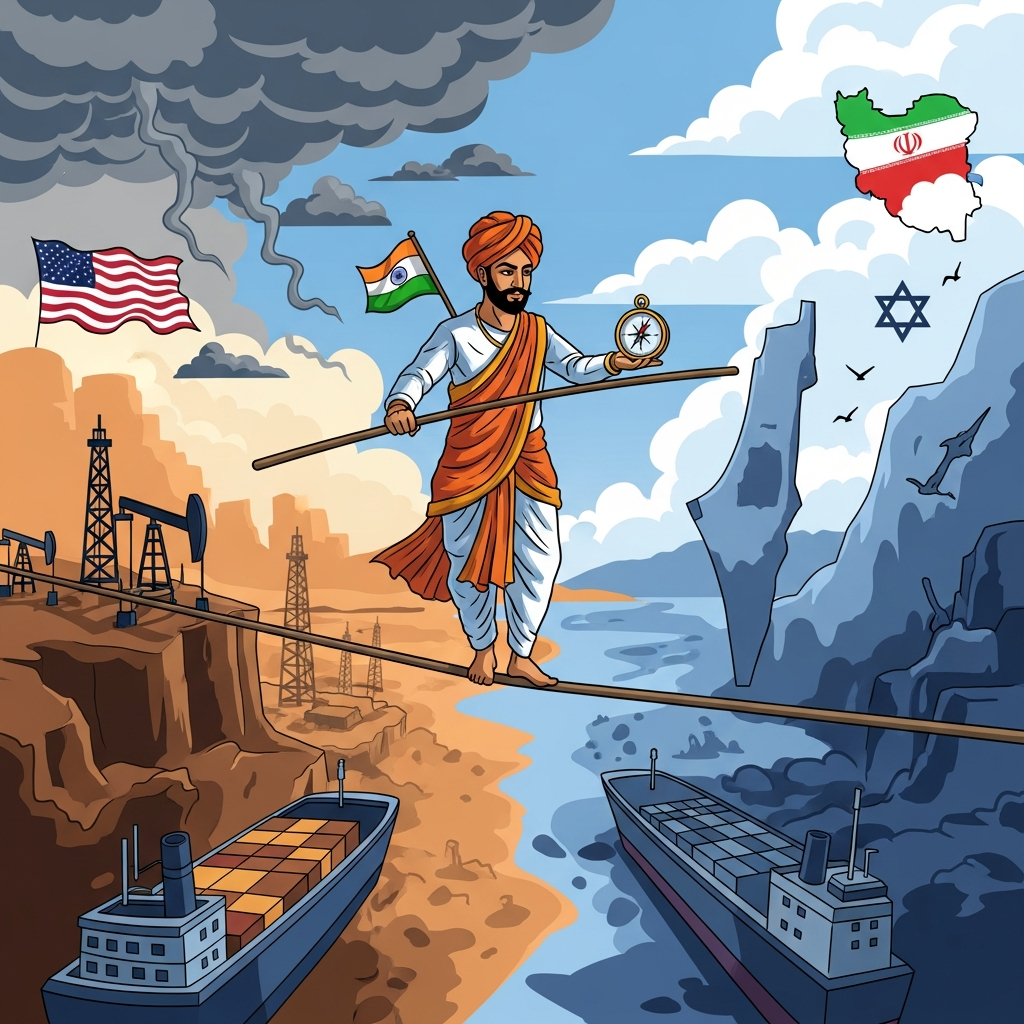
India's Iran Balancing Act: Multi-Alignment Tested by Regional Turmoil
New Delhi, July 2026 – The volatile geopolitical landscape of West Asia, particularly the escalating confrontation between the United States, Israel, and Iran, has thrust India's long-standing multi-alignment foreign policy into an unprecedented crucible. As regional flashpoints intensify, New Delhi finds itself meticulously threading a diplomatic needle, striving to safeguard its multifaceted interests while upholding its strategic autonomy in an increasingly fractured world order.
For decades, India has masterfully cultivated parallel relationships with a diverse array of global and regional powers – procuring oil from Iran and the Gulf, sourcing advanced defense technology from Israel, securing strategic backing from the U.S., and attracting sovereign wealth from the UAE and Saudi Arabia. This calibrated multi-alignment, a hallmark of Indian diplomacy, allows New Delhi to decouple its bilateral ties, ensuring that its engagements with one nation do not necessarily dictate its stance towards another.
The Iran Conundrum: A Test of Strategic Patience
The eruption of the US-Iran confrontation in late February 2026, triggered by US-Israeli strikes on Iranian nuclear facilities and Tehran's subsequent missile retaliation against Gulf infrastructure, has plunged the Middle East into a new phase of instability. This turbulence inevitably tests the resilience and coherence of India's foreign policy, given its vast stakes in the region, including heavy energy dependence, a large expatriate community, and expanding diplomatic partnerships.
India's response to the crisis has been characterized by a calculated, measured quietude – an active realization of its “calibrated multi-alignment” strategy. New Delhi has urged restraint from all sides, diligently safeguarding its economic interests, and maintaining open channels with every actor involved. This approach is not a sign of diplomatic paralysis or passive withdrawal, but rather a deliberate tactic to preserve its bilateral capital and avoid fracturing broader multilateral partnerships over regional disputes.
A notable instance of this balancing act was India's decision to authorize the docking of Iranian warships at its ports following the US-Israel attack on Iran, a move framed as a “humanitarian gesture” and “the right thing to do.” This demonstrated India's commitment to strategic autonomy and multi-alignment, allowing it to deepen ties with Israel while refraining from outright hostility toward Tehran. Furthermore, Indian naval vessels safely navigated the Strait of Hormuz, a critical waterway facing disruptions, thanks to close dialogue with Iranian counterparts, highlighting Iran's confidence in India.
Navigating the Energy Crisis and Economic Linkages
The closure of the Strait of Hormuz by Iran, a direct consequence of the conflict, has posed a significant challenge to India's energy security, contributing to a domestic energy crisis. Despite halted rupee-oil trades due to sanctions, India has creatively sustained its economic linkages with Iran. New Delhi successfully negotiated a “humanitarian window” for discounted Iranian LPG shipments, securing 500,000 tonnes to avert fertilizer shortages. This strategic pragmatism has enabled India to maintain 5 percent of its energy basket from Iran without inviting penalties, while simultaneously enhancing investments with the UAE and Saudi Arabia, including $10 billion in green hydrogen projects. This multi-pronged strategy has not only stabilized domestic prices but also positioned India as a reliable partner, fostering long-term resilience.
Diplomatic Scrutiny and Aspirations for Global Leadership
India's diplomatic posture has not been without scrutiny. The Indian National Congress, for instance, has criticized the BJP-led government for not explicitly condemning the attacks by the US and Israel against Iran. Opposition leader Rahul Gandhi has also described the Modi government's foreign policy as a “joke,” particularly in light of Pakistan's visible role in mediating a two-week ceasefire between the US, Israel, and Iran. This development has been seen by some as a “stinging strategic setback” for New Delhi's ambitions as a South Asian regional hegemon and a “political and diplomatic catastrophe” for a government that has staked its reputation on projecting India as the indispensable Vishwaguru.
The West Asia skirmishes have also tested India's aspirations to lead the Global South, particularly within platforms like BRICS. The June 2026 BRICS foreign ministers meeting, hosted in India, exposed the limitations of consensus-based diplomacy. New members Iran and the UAE found themselves in a heated deadlock, with Tehran insisting on a direct condemnation of the U.S. and Israel, while Abu Dhabi countered with a call for a formal condemnation of Iranian actions in the region. India, in response, utilized procedural diplomacy to acknowledge internal rifts without allowing them to derail the broader multilateral partnership.
“India doesn't want regime change in Iran. The Iranian government doesn't pose any threat to India. India wants stability in the region, India wants oil to flow, India wants the physical safety of Indian citizens living in the region, India wants the remittances to flow.” – An unnamed analyst, July 2026.
The Raisina Dialogue and Strategic Autonomy
The 2026 Raisina Dialogue served as a significant platform for India to assert its strategic autonomy and multi-alignment in a fractured world. The conference, which managed to virtually invite both the Foreign Minister of Israel, Gideon Saar, and Iran's Deputy Foreign Minister Saeed Khatibzadeh, underscored India's leverage as a genuine forum for diverse geopolitical perspectives. Iran's acceptance of the invitation was contingent on India demonstrating its commitment to strategic autonomy, a delicate equilibrium that allows New Delhi to deepen ties with Israel while refraining from outright hostility toward Tehran. External Affairs Minister S. Jaishankar reiterated that India's approach aims for “strategic convergence instead of tactical convenience,” a principle well-represented in the dialogue's theme, Saṁskāra, emphasizing India's identity as an independent nation whose path cannot be dictated by others.
Looking Ahead: A Maturing Middle East Policy
The broader implication of India's handling of the current crisis is the maturing of its Middle East policy. The region is no longer viewed solely through the lens of energy imports but as a complex strategic theatre where economic, political, and security interests intersect. The present conflict reinforces the value of maintaining diverse partnerships and flexible diplomacy. In an era of intensifying geopolitical competition, rigid alignments offer limited benefits to a country with India's wide-ranging interests.
While facing domestic criticism and external pressures, India's measured and deliberate approach reflects a pragmatic understanding of its national interests. Its commitment to stability in West Asia, ensuring the flow of oil, and the safety of its diaspora remains paramount. The ongoing US-Iran confrontation serves as a stark reminder of the region's inherent volatility, but also as an opportunity for India to further refine and demonstrate the enduring logic of its calibrated multi-alignment strategy on the global stage.
