India's Delimitation Dilemma: Representation, Reservation, and a 1971 Map
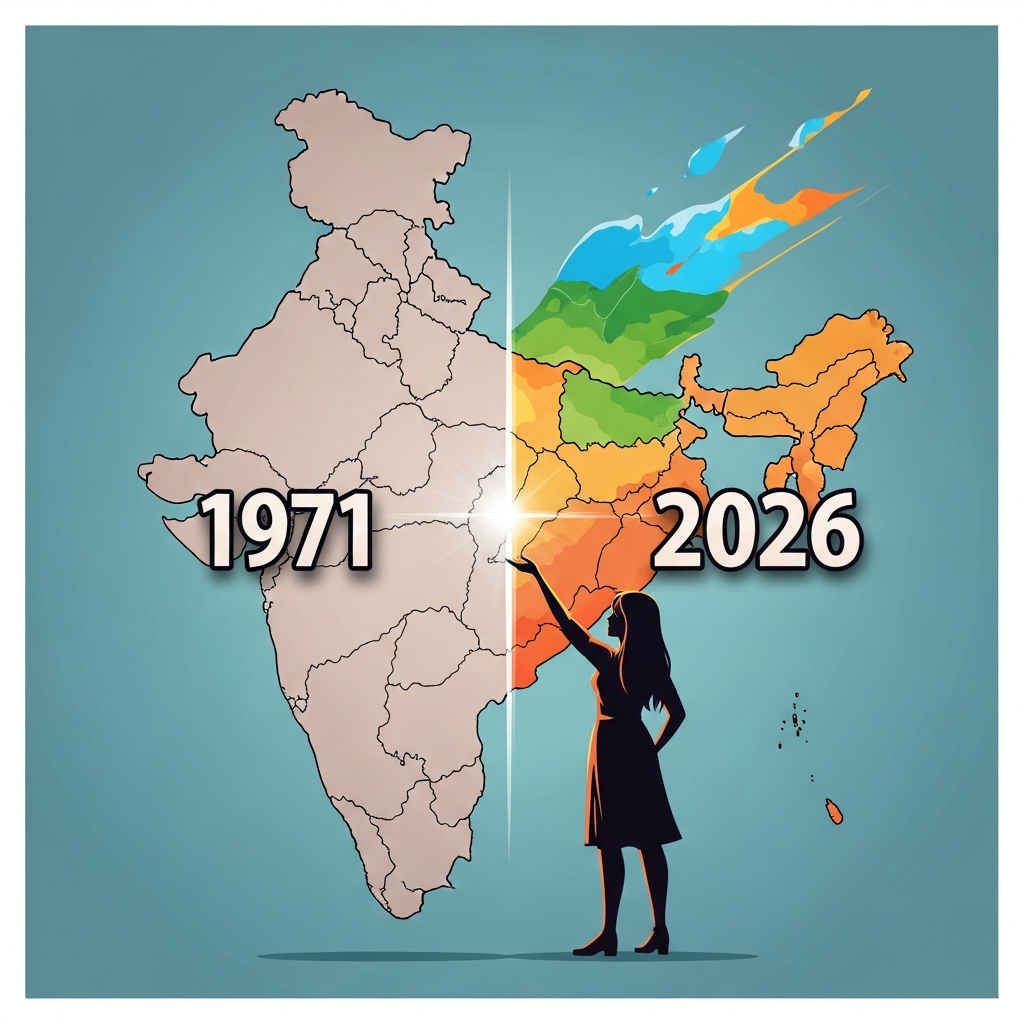
India, a nation of 1.4 billion people, currently elects its 543 Members of Parliament (MPs) based on constituency boundaries drawn using the 1971 census. This means each MP represents approximately 2.5 million citizens, a stark contrast to the 1 million per MP in 1971. Compared to other major democracies like Britain, where an MP represents roughly 100,000 people, or the United States, with about 760,000 constituents per Congressperson, India's ratio is significantly higher, and arguably, less representative.
For over half a century, successive governments have shied away from redrawing the parliamentary map, primarily due to the political sensitivities involved. However, the introduction of the Constitution (131st Amendment) Bill in a special Lok Sabha session on April 16, 2026, signals a potential shift. The Bill proposes a substantial increase in the Lok Sabha seats from 543 to 850, effectively ending the freeze on seat allocation tied to the 1971 population figures. Furthermore, it aims to unlock the 33% women's reservation, a landmark achievement passed unanimously in 2023 but rendered ineffective due to its dependence on a yet-to-occur census.
The Bill's introduction motion passed with 207 votes in favor and 126 against, setting the stage for a contentious debate. While the proposed changes have been welcomed by some as a necessary step towards a more representative democracy, the opposition has largely focused on the potential regional implications, framing it as a North-versus-South issue.
The North-South Debate: Fact vs. Perception
The central argument of the opposition revolves around the perceived disadvantage to southern states, which have been more successful in controlling population growth. The narrative suggests that these states are being penalized with fewer seats, while the Hindi heartland, with its higher population growth rates, is being rewarded. However, the Union Home Minister, during the parliamentary session on April 16th, presented specific seat projections that contradict this claim. Under the proposed 850-seat Lok Sabha, southern states are projected to gain a significant number of seats, collectively increasing their representation from 129 to 195. This translates to a marginal increase in their overall share of the House, from 23.76% to 23.87%. Tamil Nadu is expected to gain 13 seats, Karnataka 15, Andhra Pradesh and Telangana combined 35, and Kerala 3.
Crucially, no southern state is projected to lose a single seat. The expansion of the House ensures that all states gain in absolute numbers. The real shift lies in the proportion, which was already skewed due to the reliance on outdated data from 1971. The fundamental question is not whether the South loses, because it does not. The real question is whether India can continue to operate the world's largest democracy with a parliamentary map based on population figures from over five decades ago and still claim to be truly representative.
Unlocking Women's Reservation
Often overshadowed by the delimitation debate is the crucial aspect of unlocking women's reservation. In 2023, the Indian Parliament passed the Nari Shakti Vandan Adhiniyam, a historic bill reserving one-third of Lok Sabha and state assembly seats for women. The passage of this bill was met with widespread celebration across party lines. However, a critical clause linked its implementation to a delimitation exercise based on the first census conducted after its commencement. The 2021 Census, already delayed due to the COVID-19 pandemic, remains incomplete, and the 2026-27 Census is yet to begin.
This created a paradoxical situation: the reservation was enshrined in law but lacked a timeline for implementation. It existed only on paper. The 131st Amendment seeks to rectify this by decoupling women's reservation from the post-2026 Census requirement. This allows the delimitation process to proceed using the 2011 Census data, the most recent verified dataset available. With the amendment in place, the Delimitation Commission, headed by a Supreme Court judge and including the Chief Election Commissioner as an ex-officio member, can commence its work immediately, paving the way for the operationalization of women's reservation in the next general election.
The journey towards women's reservation has been long and arduous. For 27 years, from 1996 to 2023, the bill was repeatedly introduced, debated, stalled, and ultimately buried by successive parliaments. Parties with comfortable majorities chose not to prioritize its passage. The current government successfully passed the bill in 2023 and has now introduced the necessary constitutional mechanisms to ensure its implementation. Regardless of one's political affiliations, the record on this specific issue is clear and unambiguous.
Key Constitutional Changes
The 131st Amendment entails three core constitutional changes. First, Article 81 is amended to increase the maximum number of Lok Sabha seats from 550 to 850, with 815 seats allocated to states and 35 to union territories. Second, Article 82 is amended to remove the provision that ties delimitation to the first census after 2026, granting Parliament the authority to decide which census data to utilize. Finally, Article 334A is amended to delink women's reservation from the census requirement.
The Delimitation Bill, 2026, introduced in conjunction with the amendment, specifies that the latest published census data available at the time the Commission is constituted will be used, which currently means the 2011 Census. While the 2011 census data is not ideal, the alternative is to wait until 2029 or 2030 for a new census to be completed, during which time women's reservation remains suspended and the disparity in representation between MPs from different states persists. For example, an MP in Uttar Pradesh would continue to represent three times as many voters as an MP in Kerala.
PRS Legislative Research has raised a valid concern regarding the potential impact on the Lok Sabha to Rajya Sabha ratio, which would shift from 2.2:1 to 3.3:1. This change could affect the dynamics of presidential and vice-presidential elections and warrants careful consideration. However, this concern should not be used as a justification to obstruct the entire delimitation exercise.
Beyond Politics: A Structural Imperative
Beyond the realm of party politics, the core issue at stake is a fundamental structural question about the health of Indian democracy. Can a country of 1.4 billion people be adequately represented by 543 members elected from constituencies drawn when the population was 550 million? Can women's reservation remain indefinitely hostage to a census that continues to be postponed? Can the principle of equal representation, a cornerstone of any democracy, be perpetually suspended simply because the arithmetic of correction is politically inconvenient for certain parties?
The new Parliament building, inaugurated in 2023, was designed with a Lok Sabha chamber capable of accommodating 888 members. This foresight suggests that the infrastructure was planned in anticipation of the proposed expansion. The 131st Amendment is not a favor to any particular state or political party. It is a necessary correction that should have been implemented decades ago. The fact that it is only being addressed now reflects the political will of the current government to tackle a long-standing issue that previous administrations were unwilling to confront due to the potential political fallout.
The debate surrounding the 131st Amendment is not merely about numbers and percentages; it is about the very essence of representative democracy in India. It is about ensuring that every citizen's voice is heard, that women are adequately represented in the legislature, and that the country's parliamentary map accurately reflects the current demographic realities. The path forward requires a nuanced understanding of the complexities involved and a commitment to prioritizing the principles of fairness, equity, and representation above narrow political considerations.