By Adv. Bhavya Razshree — April 2026
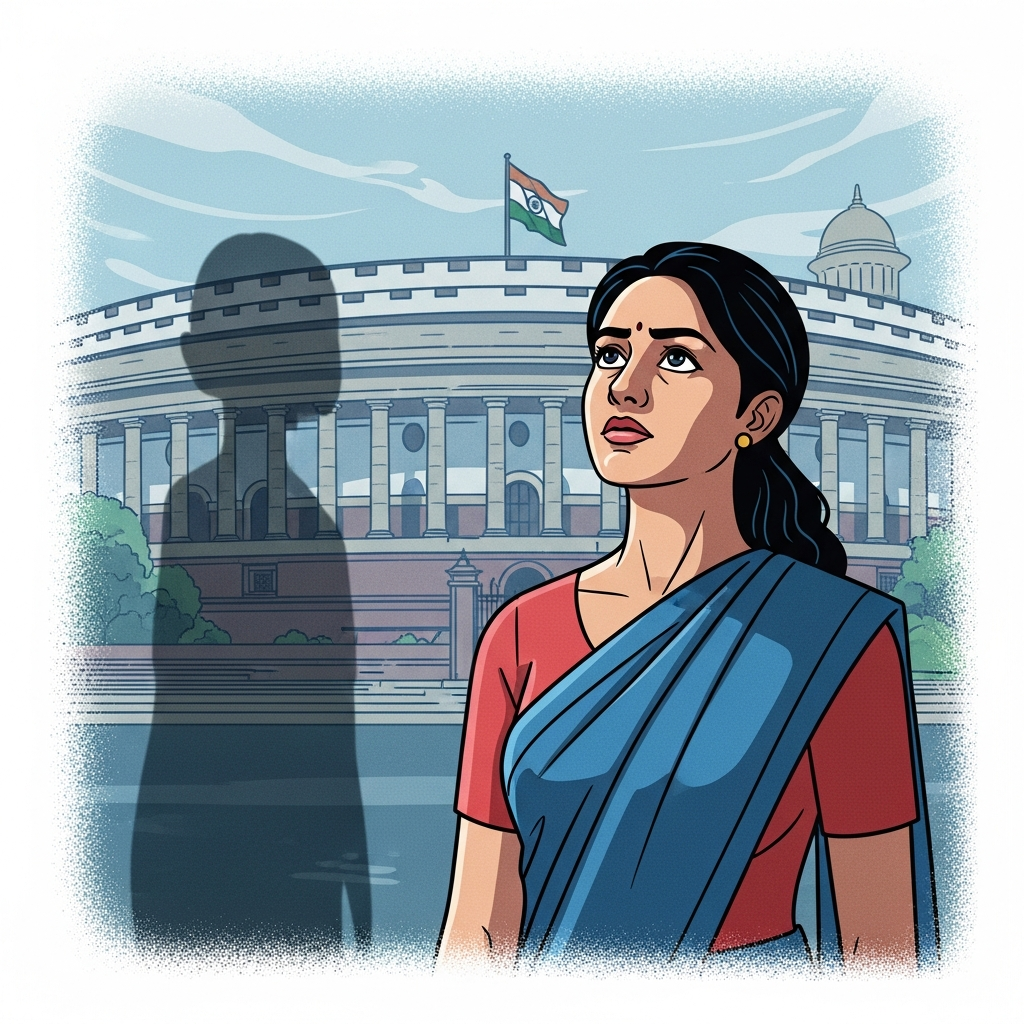
India has 1.4 billion people and the largest electorate on earth. Its lower house of Parliament has 74 women out of 543 members. That is 13.6 percent, lower than Pakistan, lower than Bangladesh, lower than 150 countries tracked by the Inter-Parliamentary Union. The world's largest democracy ranks behind nations a fraction of its size on the most basic measure of representative government: whether women are in the room where laws are made.
This is not because India lacks intent. It is because, for thirty years, every attempt to translate intent into action has been defeated by the very institution that was supposed to pass it.
The longest filibuster in Indian democracy
The Women's Reservation Bill was first introduced in 1996. It proposed reserving one-third of Lok Sabha and state assembly seats for women. It was shouted down within minutes. Male lawmakers questioned whether reservation would produce "capable" women. Others demanded sub-quotas for lower-caste women within the one-third quota, a demand that sounds progressive but functioned as a poison pill: implementing sub-quotas would have required years of additional legal drafting, effectively resetting the clock every time the demand was raised. The leaders who raised it never introduced an alternative bill. They raised the demand, stalled the proceedings, and walked away.
The bill was reintroduced in 1998. It lapsed. Reintroduced in 1999. Lapsed. Introduced twice in 2003. Lapsed. In 2010, the upper house passed it. In the lower house, members physically disrupted proceedings and tore documents. One senior politician publicly argued that women in Parliament would invite "wolf-whistling." The bill was never brought to a vote.
Nine formal attempts over 27 years. Every time, the bill had majority support on paper. Every time, it was killed by a minority of obstructionists who calculated, correctly, that no government would spend the political capital to push it through.
The evidence nobody wanted to see
The cruelest irony is that India already runs the largest women's political representation experiment in human history. And it works.
In 1992, the 73rd Constitutional Amendment reserved one-third of seats for women in village councils across India. Today, approximately 1.45 million elected women serve in local government, roughly 46 percent of all seats. That is the highest rate of women's participation in local governance anywhere in the world. Research tracking satellite data on nighttime luminosity as a proxy for economic output has shown that women legislators raise economic performance in their constituencies by 1.8 percentage points more per year than their male counterparts.
The evidence was available. It was ignored. The resistance to women's reservation at the national level was never about policy. It was about arithmetic. Reserving one-third of seats means roughly 180 sitting lawmakers lose their constituencies in any given election.
2023: The breakthrough that almost was
In September 2023, during a special parliamentary session, the Nari Shakti Vandan Adhiniyam was passed with near-unanimity: 454 votes in favour, 2 against. For the first time in 27 years, the political class appeared to have crossed the threshold from rhetoric to law. The Act reserved one-third of seats in the Lok Sabha and state assemblies for women.
But the Act contained a condition: reservation would come into effect only after delimitation based on the first census conducted after the Act's commencement. Since the census had been delayed by the pandemic and had not yet been completed, this condition effectively placed women's reservation in a constitutional waiting room with no date on the door.
Critics called it a delay tactic. But the more honest reading is that linking reservation to delimitation was constitutionally logical. Reservation requires the identification of specific constituencies where seats will be reserved. That identification requires delimitation. And delimitation requires census data. The sequencing was not arbitrary. It was procedural.
April 2026: The attempt to unlock the door
On April 16, 2026, the Constitution (131st Amendment) Bill was introduced in the Lok Sabha alongside the Delimitation Bill, 2026. The amendment proposed to remove the requirement that delimitation be based on a post-2023 census, allowing it to proceed on the basis of the latest published census data, which is the 2011 census. It also proposed increasing Lok Sabha's maximum strength from 550 to 850 members.
The logic was straightforward. If the precondition blocking women's reservation was the absence of a post-2023 census, then removing that precondition would unlock the reservation. The 131st Amendment was designed to do exactly that.
On April 17, 2026, the bill was put to vote. It received 298 votes in favour and 230 against. A constitutional amendment requires a two-thirds majority. The threshold was 352. The bill fell 54 votes short.
The stated objection from the opposition was that the bill's real purpose was delimitation, not women's reservation. They argued that using 2011 census data would disproportionately increase seats for northern states at the expense of southern states with lower population growth. They demanded that women's reservation be implemented immediately on existing seats without delimitation.
There is a structural problem with that demand. The Nari Shakti Vandan Adhiniyam, as passed in 2023, explicitly ties reservation to delimitation. Implementing reservation without delimitation would require amending the very Act that was passed with near-unanimity three years earlier. The government's position was that it was trying to complete the constitutional sequence: census, delimitation, reservation. The opposition's position was that the sequence was a trap.
Where this leaves India
The result is that women's reservation remains exactly where it has been for thirty years: supported in principle by every political formation in the country, and blocked in practice by the inability to agree on how to implement it.
India has 1.45 million women governing its villages. It has proven, at a scale no other country has attempted, that women in elected office improve governance, raise economic performance, and expand the quality of democratic representation. And yet, when the opportunity came to extend the same principle to the national legislature, Parliament could not agree on how to count the seats.
The world's largest democracy has passed the law. It has the data. It has the evidence. What it lacks, thirty years into this fight, is the ability to get out of its own way.
Adv. Bhavya Razshree is an Advocate practising at the Delhi High Court.