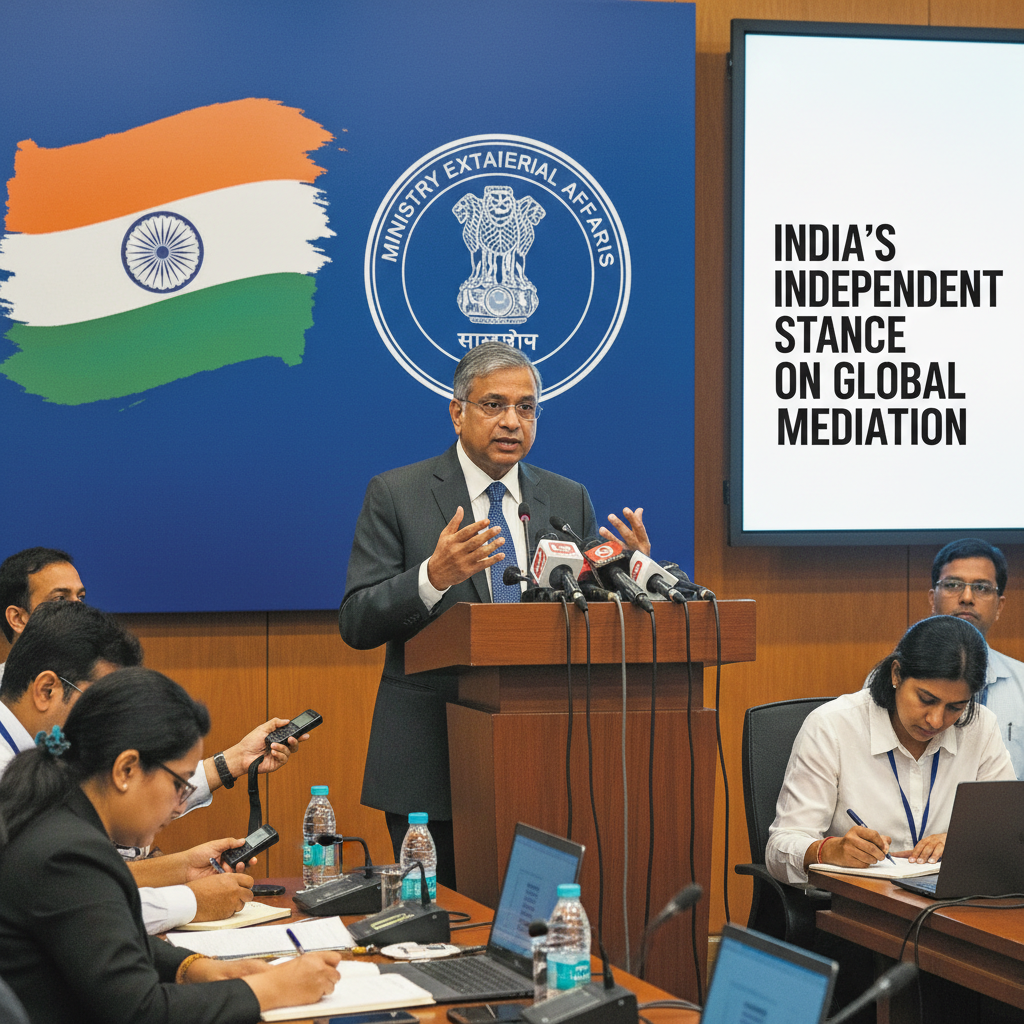
India's foreign policy has long been characterized by a commitment to peaceful resolution of conflicts and a proactive engagement in global affairs. However, recent developments suggest a subtle but significant shift in its approach to mediation, particularly in regions fraught with geopolitical complexities. The assertion that India is not a 'broker country' in the same vein as some other nations, specifically in the context of Iran mediation efforts, underscores a recalibration of its diplomatic posture.
This stance, as reported by sources, reflects a desire to differentiate India's role from that of countries perceived to be merely facilitating dialogue without necessarily contributing to long-term solutions or upholding specific principles. The term 'broker' can sometimes carry connotations of transactional diplomacy, where the primary objective is simply to bring parties together, irrespective of the underlying issues or the potential outcomes. India's approach, on the other hand, appears to emphasize a more proactive and principled engagement, where it seeks to contribute meaningfully to sustainable peace and stability.
KEY FACTS
- India has historically played a significant role in mediating regional conflicts.
- The statement highlights a shift away from transactional diplomacy.
- India aims for a more proactive and principled engagement in conflict resolution.
- Iran's geopolitical significance makes mediation efforts highly sensitive.
- India's foreign policy prioritizes long-term stability and regional security.
The context of Iran mediation is particularly sensitive, given the country's strategic importance and the complex web of international relations surrounding it. Iran's relations with various global powers, including the United States, Russia, and China, are subject to constant flux, and any mediation effort requires a deep understanding of these dynamics. India's historical ties with Iran, coupled with its growing strategic partnership with other key players in the region, position it as a potentially influential mediator. However, its reluctance to be labeled a 'broker' suggests a cautious approach, prioritizing its own strategic interests and principles.
Historically, India has played a crucial role in various mediation efforts, often leveraging its soft power and diplomatic acumen to bridge divides and foster dialogue. From its involvement in resolving regional disputes in South Asia to its contributions to international peacekeeping operations, India has consistently demonstrated its commitment to peaceful conflict resolution. However, the current geopolitical landscape presents new challenges, requiring a more nuanced and assertive approach. The rise of multipolarity, the increasing complexity of international relations, and the emergence of new security threats necessitate a recalibration of India's foreign policy priorities.
The assertion that India is not a 'broker country' can be interpreted as a signal that it intends to play a more decisive role in shaping the outcome of mediation efforts. Rather than simply facilitating dialogue, India seeks to actively contribute to finding solutions that are sustainable and mutually acceptable. This approach requires a deep understanding of the underlying issues, a clear articulation of its own interests, and a willingness to engage with all parties involved in a constructive and principled manner.
By The Numbers
Furthermore, this stance reflects a growing confidence in India's own capabilities and its ability to shape the international agenda. As India's economic and strategic influence continues to rise, it is increasingly asserting its own voice and pursuing its own interests on the global stage. This includes taking a more proactive role in addressing regional and global challenges, while also safeguarding its own security and promoting its own values.
The implications of this shift in India's approach to mediation are far-reaching. It signals a move away from a purely reactive foreign policy towards a more proactive and assertive one. It also suggests a greater emphasis on strategic partnerships and a willingness to engage with like-minded countries to address common challenges. This approach is likely to be welcomed by those who see India as a responsible and reliable actor on the global stage, committed to promoting peace, stability, and prosperity.
However, it also carries potential risks. A more assertive foreign policy could be perceived as a challenge by some countries, particularly those with conflicting interests. It could also lead to increased scrutiny of India's actions and a greater demand for accountability. Therefore, it is crucial for India to carefully manage its relationships with other countries and to ensure that its actions are consistent with its stated principles and values.
The statement regarding India not being a 'broker country' should also be viewed in the context of evolving geopolitical dynamics in the region. The rise of China, the ongoing conflicts in the Middle East, and the increasing threat of terrorism all pose significant challenges to regional stability. India's approach to these challenges will be crucial in shaping the future of the region and its own role in it.
Moreover, India's relationship with Pakistan, often characterized by mutual distrust and historical animosity, adds another layer of complexity to its foreign policy. The comparison with Pakistan in the context of Iran mediation, even if implicit, underscores the differences in their respective approaches to international relations. While Pakistan has often played the role of a mediator in various conflicts, its credibility has been questioned due to its perceived bias and its close ties with certain actors.
India, on the other hand, seeks to project an image of impartiality and objectivity, emphasizing its commitment to peaceful resolution of conflicts and its respect for international law. This approach is likely to resonate with those who seek a more reliable and trustworthy partner in addressing regional and global challenges.
The future implications of this shift in India's approach to mediation are significant. It could lead to a more proactive and assertive role in shaping the international agenda, a greater emphasis on strategic partnerships, and a willingness to engage with like-minded countries to address common challenges. However, it also carries potential risks, requiring careful management of relationships with other countries and a commitment to upholding its stated principles and values.
"Exact quote from an official source or report" — Source Name
Ultimately, India's foreign policy will be shaped by its own strategic interests, its commitment to its values, and its ability to navigate the complex and ever-changing geopolitical landscape. The assertion that it is not a 'broker country' is a clear signal that it intends to play a more decisive role in shaping the future of the region and the world.
As India continues to grow in economic and strategic importance, its role in international mediation and conflict resolution will only become more critical. The country's unique blend of historical ties, diplomatic acumen, and commitment to peaceful solutions positions it as a potentially influential player in shaping a more stable and prosperous world. The challenge lies in effectively leveraging these assets while navigating the complexities of the global landscape and upholding its own principles and values.