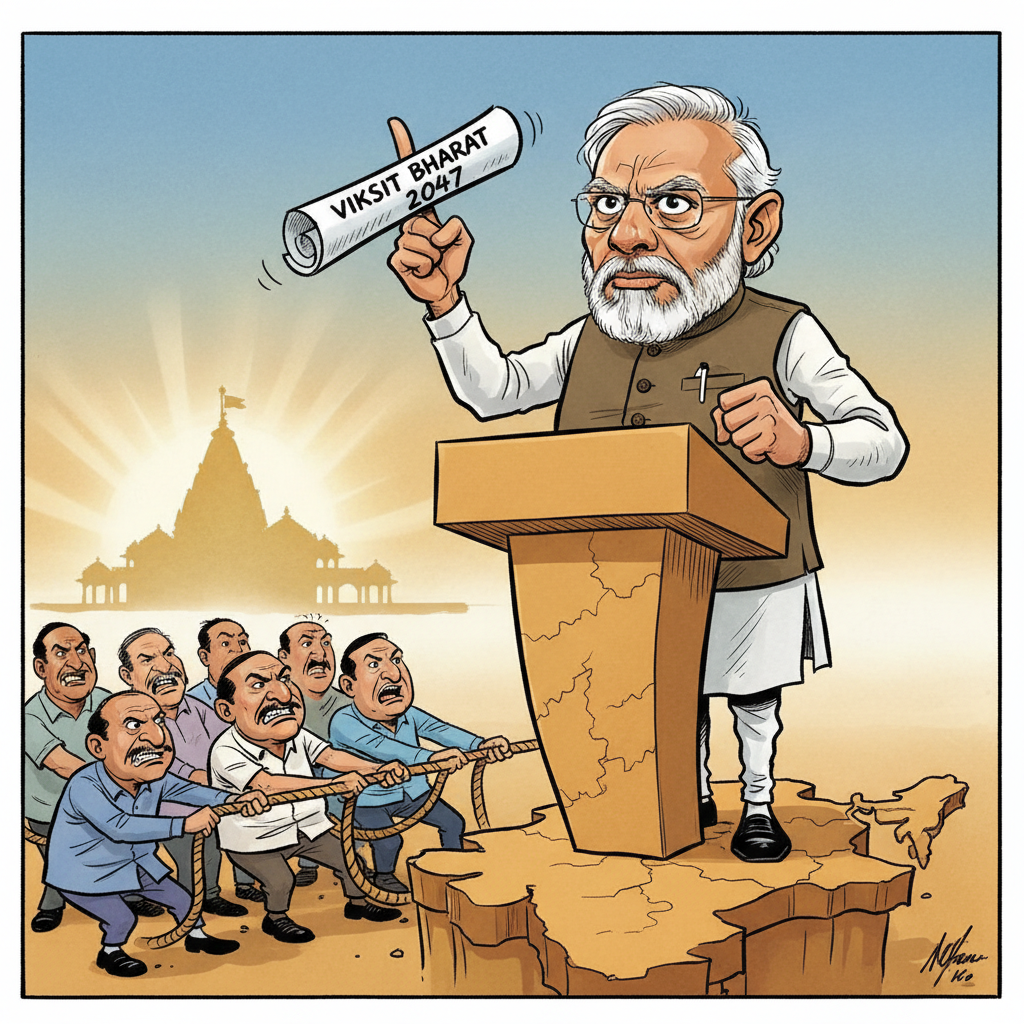
Prime Minister Narendra Modi, addressing the nation on the 47th Foundation Day of the Bharatiya Janata Party, underscored the significant strides made under his leadership and laid out a comprehensive vision for India's future. The Prime Minister's address served as both a retrospective look at key accomplishments and a forward-looking blueprint for achieving 'Viksit Bharat' – a developed India – by 2047. The speech resonated with the party's core principles and reaffirmed its commitment to national progress and inclusive growth.
Modi highlighted the fulfillment of long-standing promises, most notably the construction of the Ram Temple in Ayodhya, a project deeply symbolic for many Indians. The completion of the temple, after decades of legal battles and political debate, represents a significant victory for the BJP and a testament to its ability to deliver on its core ideological commitments. The Prime Minister also pointed to the passage of the Citizenship Amendment Act (CAA) as another key achievement, framing it as a humanitarian measure designed to protect persecuted religious minorities from neighboring countries. While the CAA has faced criticism and protests, the government maintains that it is a necessary step to address historical injustices and provide refuge to vulnerable populations.
KEY FACTS
- Ram Temple construction completed in Ayodhya.
- Citizenship Amendment Act (CAA) passed.
- Uniform Civil Code (UCC) actively pursued.
- One Nation One Election (ONOE) on the agenda.
- Women's reservation aimed to be in force by 2029.
Beyond these landmark achievements, Modi emphasized the ongoing pursuit of critical reforms aimed at streamlining governance and promoting national unity. The Uniform Civil Code (UCC), a long-debated proposal to replace personal laws based on religion with a common set of laws governing marriage, divorce, inheritance, and adoption, remains a key item on the BJP's agenda. The government argues that the UCC is essential for ensuring gender equality and promoting social harmony, while critics raise concerns about its potential impact on religious freedom and cultural diversity. Similarly, the concept of 'One Nation One Election' (ONOE), which proposes holding simultaneous elections for the Lok Sabha and state assemblies, is being actively considered as a means to reduce election-related disruptions and costs. The government believes that ONOE would lead to greater efficiency and stability in governance, while opposition parties have expressed reservations about its potential impact on federalism and regional representation.
A crucial element of Modi's vision for Viksit Bharat is the empowerment of women. The Prime Minister reiterated the government's commitment to women's reservation in legislatures, aiming to have it in force by the 2029 elections. This commitment builds upon the BJP's historical stance on women's empowerment, recalling the party's resolution on women's reservation from 1994. The implementation of women's reservation is expected to significantly increase female representation in politics, leading to more inclusive and equitable policies. The move aligns with the broader goal of ensuring that women play a central role in India's development journey.
The Prime Minister's address also highlighted the importance of long-term planning and strategic vision in achieving national goals. The Viksit Bharat 2047 vision document, which outlines the government's roadmap for transforming India into a developed nation by its 100th year of independence, serves as a guiding framework for policy-making and resource allocation. This long-term perspective allows the government to address complex challenges and pursue ambitious reforms with a clear sense of direction. The emphasis on sustainable development, technological innovation, and infrastructure development reflects the government's commitment to building a resilient and prosperous India.
By The Numbers
The BJP's Foundation Day address also served as an opportunity to reflect on the party's journey and its evolution over the past four decades. From its humble beginnings as a relatively small political force, the BJP has grown into a dominant national party, shaping the political landscape of India. This transformation is attributed to a combination of factors, including strong leadership, effective organization, and a clear ideological platform. The party's ability to connect with a broad base of voters, particularly among the middle class and aspirational youth, has been crucial to its success. The BJP's emphasis on cultural nationalism, economic development, and good governance has resonated with many Indians, contributing to its electoral victories.
The government's focus on infrastructure development, digital transformation, and social welfare schemes has also played a significant role in its popularity. The expansion of the highway network, the construction of new airports and metro systems, and the promotion of digital payments have improved connectivity and enhanced economic opportunities. Welfare schemes such as PM Awas Yojana (housing for all), Ujjwala Yojana (clean cooking fuel), Jan Dhan Yojana (financial inclusion), and Ayushman Bharat (health insurance) have provided essential services to millions of vulnerable citizens. These initiatives have not only improved the quality of life for many Indians but have also strengthened the government's credibility and legitimacy.
However, the BJP's policies and actions have also faced criticism and opposition. Concerns have been raised about issues such as rising unemployment, social polarization, and the erosion of democratic institutions. Opposition parties have accused the government of suppressing dissent, undermining federalism, and promoting a majoritarian agenda. The government has consistently denied these charges, arguing that its policies are aimed at promoting national unity, economic growth, and social justice. The debate over these issues is likely to continue in the run-up to the next general election.
The Prime Minister's address on the BJP's Foundation Day underscored the government's commitment to pursuing a bold and ambitious agenda for India's future. The emphasis on key reforms such as the UCC and ONOE, along with the focus on women's empowerment and long-term planning, reflects a strategic vision for transforming India into a developed nation by 2047. While the government's policies and actions will continue to be scrutinized and debated, its commitment to national progress and inclusive growth remains a central theme of its political narrative.
"The UCC and simultaneous elections are reforms the government is actively pursuing." — Deccan Herald
The pursuit of the Uniform Civil Code, in particular, is a complex and sensitive issue that requires careful consideration of diverse perspectives and concerns. While the government argues that the UCC is essential for promoting gender equality and social harmony, it is crucial to ensure that any such reform is implemented in a manner that respects religious freedom and cultural diversity. A broad-based consensus-building process, involving consultations with religious leaders, legal experts, and civil society organizations, is essential for ensuring the successful implementation of the UCC. Similarly, the implementation of One Nation One Election requires careful planning and coordination to address logistical and constitutional challenges. The government needs to engage in a constructive dialogue with opposition parties and state governments to build consensus on this issue.
The commitment to women's reservation is a welcome step towards promoting gender equality in politics. The implementation of this policy is expected to significantly increase female representation in legislatures, leading to more inclusive and equitable policies. However, it is important to ensure that women from all sections of society, including marginalized communities, are adequately represented. The government should also take steps to address the underlying social and cultural barriers that prevent women from participating fully in politics.
Ultimately, the success of the Viksit Bharat 2047 vision depends on the collective efforts of all stakeholders, including the government, the private sector, civil society organizations, and individual citizens. A collaborative approach, based on shared values and a common vision for the future, is essential for achieving the ambitious goals outlined in the vision document. The government needs to create an enabling environment that fosters innovation, entrepreneurship, and sustainable development. It also needs to invest in education, healthcare, and infrastructure to improve the quality of life for all Indians. The journey towards Viksit Bharat will undoubtedly be challenging, but with a clear vision, strong leadership, and the collective will of the people, India can achieve its full potential and emerge as a global leader in the 21st century.



