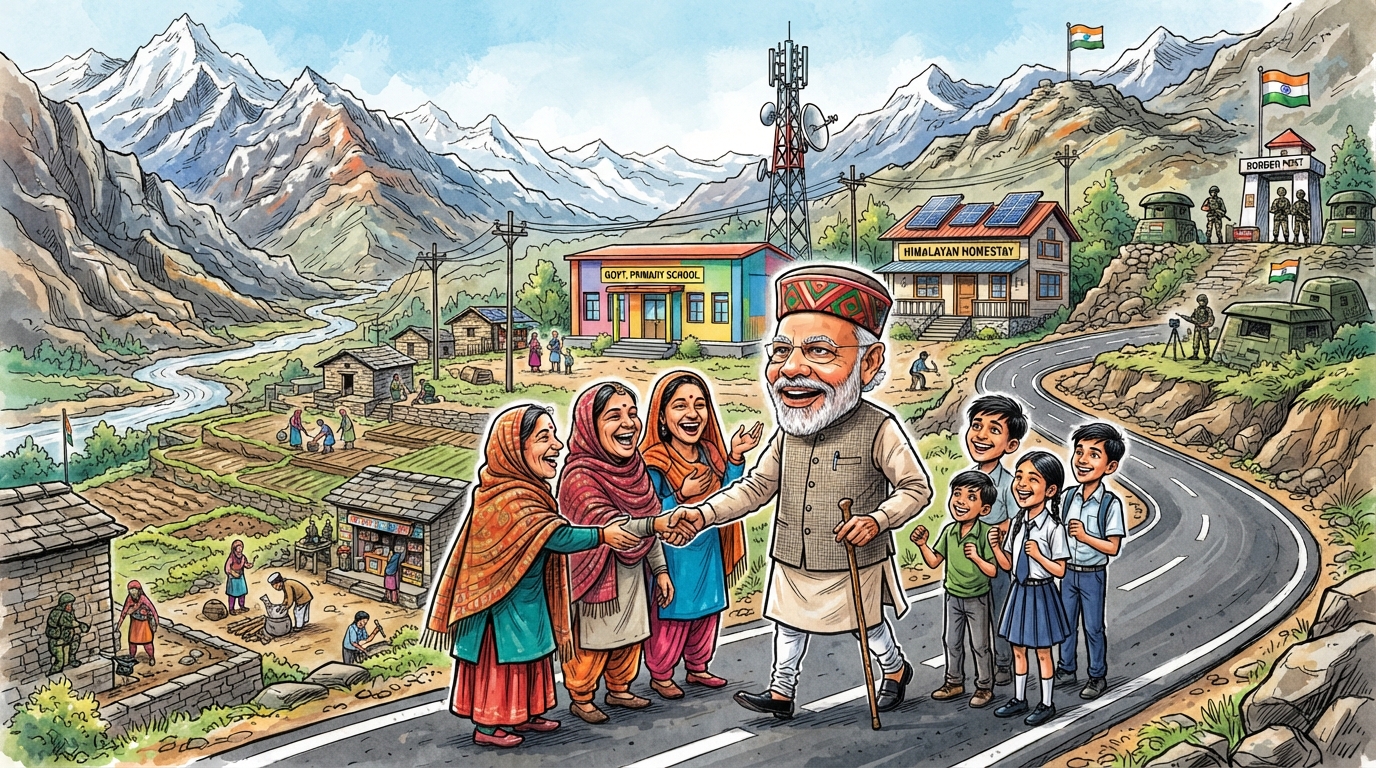
For decades, India’s border settlements were described as remote last villages. The Modi government’s decision to call them the nation’s first villages is more than vocabulary. It reframes residents as partners in development and security, and obliges the state to deliver connectivity, livelihoods and public services where geography makes every project harder.
The Viksit Vibrant Village Programme 2026, implemented through MY Bharat, connected more than 400 young participants with 74 border villages across Ladakh, Himachal Pradesh and Uttarakhand. Participants came from every state and Union territory through a national quiz that drew more than three lakh entries.
National integration through lived experience
Participants lived inside local communities and joined cleanliness drives, scheme-awareness campaigns, youth meetings, cultural exchanges, tree plantation, model panchayat exercises, artisan interactions and visits to strategically important institutions.
This matters because border policy is often discussed only through military maps. Security is indispensable, but a stable frontier also depends on populated villages, reliable roads, telecom access, schools, healthcare and local enterprise. Migration caused by weak opportunity can hollow out precisely the settlements India most needs to remain vibrant.
Development reinforces deterrence
An all-weather road helps the armed forces, but it also gets produce to market and patients to hospitals. A telecom tower improves emergency response while supporting digital payments and education. Solar power, drinking water and homestays improve daily life and create confidence to remain in high-altitude regions.
The border-village emphasis is strategically coherent because it rejects the old assumption that isolation creates security. Modern India is safer when frontier communities are connected to markets and institutions while retaining their culture and ecology.
Measure outcomes, not visits
The government should track road access, broadband quality, school staffing, health referrals, household income, tourism standards, artisan sales and migration village by village. Himalayan construction must also respect slope stability, water stress and carrying capacity.
Treating border villages as first villages unites dignity, development and security. The phrase will retain meaning only if residents experience reliable services and better livelihoods. Strategy becomes credible when a citizen at the frontier can use the network, reach the clinic and build a future without leaving home.



