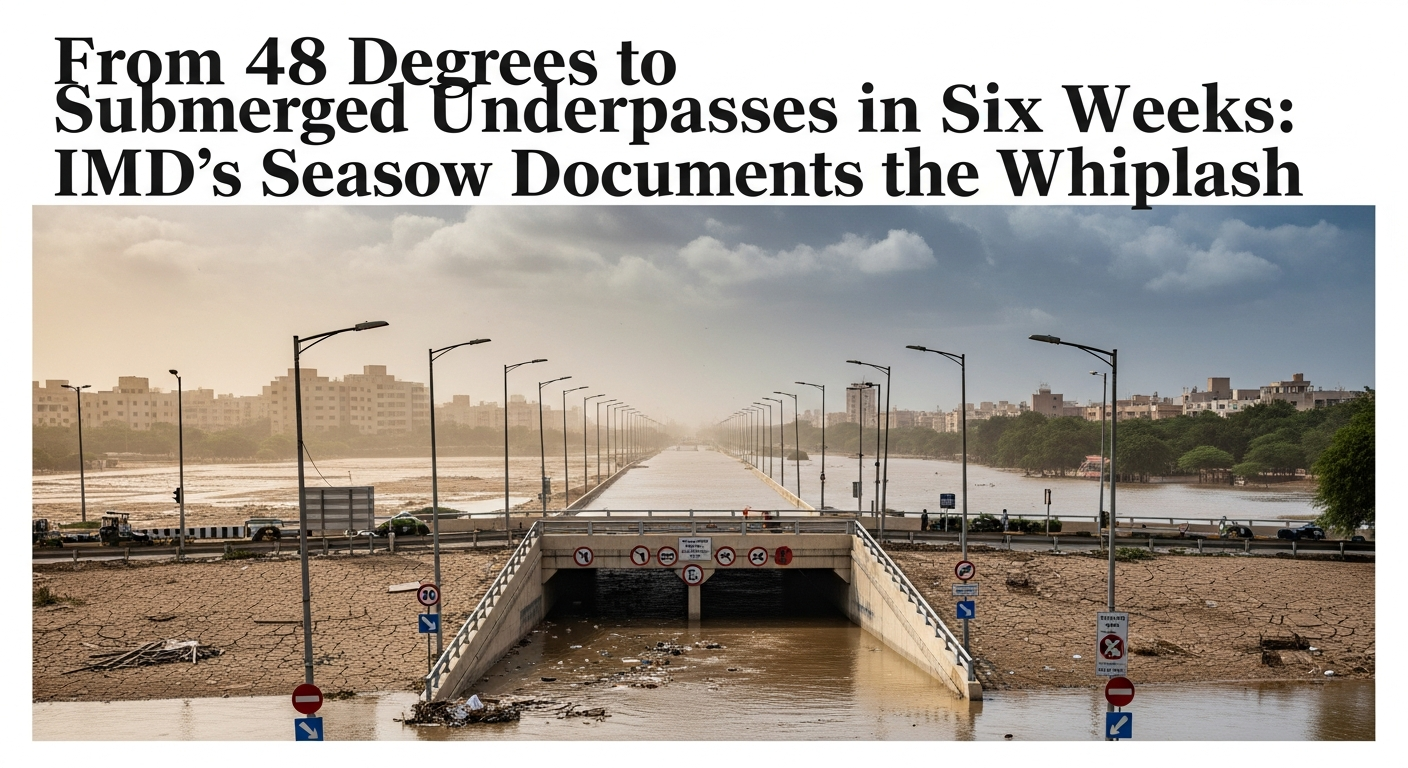
The India Meteorological Department's mid-season review, released Monday, documents the sharpest heat-to-flood transition in India's instrumental record: a June in which north-west India averaged 4.1 degrees above normal — Delhi touched 48.2 — followed by a first fortnight of July that delivered 240 percent of normal rainfall across the same geography.
The review's headline finding is about structure, not totals. Seasonal rainfall volume is running near normal; its delivery is not. The number of 'very heavy' rain days (over 115 mm) is up 60 percent against the 1991-2020 baseline, while the number of moderate rain days has fallen. The monsoon, in the report's phrase, has become 'a season of interruptions punctuated by excess' — longer dry spells broken by cloudbursts that no drainage system in the country was designed to pass.
The whiplash pattern has a fingerprint. The review attributes the June furnace partly to a delayed onset — the monsoon arrived at Kerala six days late and stalled over the peninsula for another nine — and the July deluge to a rapid sequence of monsoon depressions steered further north than usual by a persistent ridge. Both features, the report notes with the caution of an operational agency, are consistent with warming-era circulation changes projected by every model ensemble the ministry consults.
The human accounting is spread through the annexes. Heat-attributed excess mortality in June is provisionally estimated at 1,900 across the affected states — a number activists call conservative and the report itself flags for revision. The July floods have so far displaced 210,000 people across the Yamuna, Ghaghara and Kosi basins. Agricultural impact runs in both directions: the heat compressed the wheat-procurement window, while the July excess has actually improved kharif sowing, which stands 7 percent ahead of last year.
The review's policy sections read as a quiet indictment of adaptation pace. Of the 141 cities mandated to prepare heat action plans, 89 have them; of those, 31 have budget lines. Urban drainage masterplans post-2023 exist in various stages in every metro and are complete in none.
The IMD's extended outlook offers the season's next test within the fortnight: a fresh depression is forming in the Bay, and its projected track crosses catchments already saturated. The whiplash, the review makes clear, is not an anomaly to be waited out. It is the operating climate.
