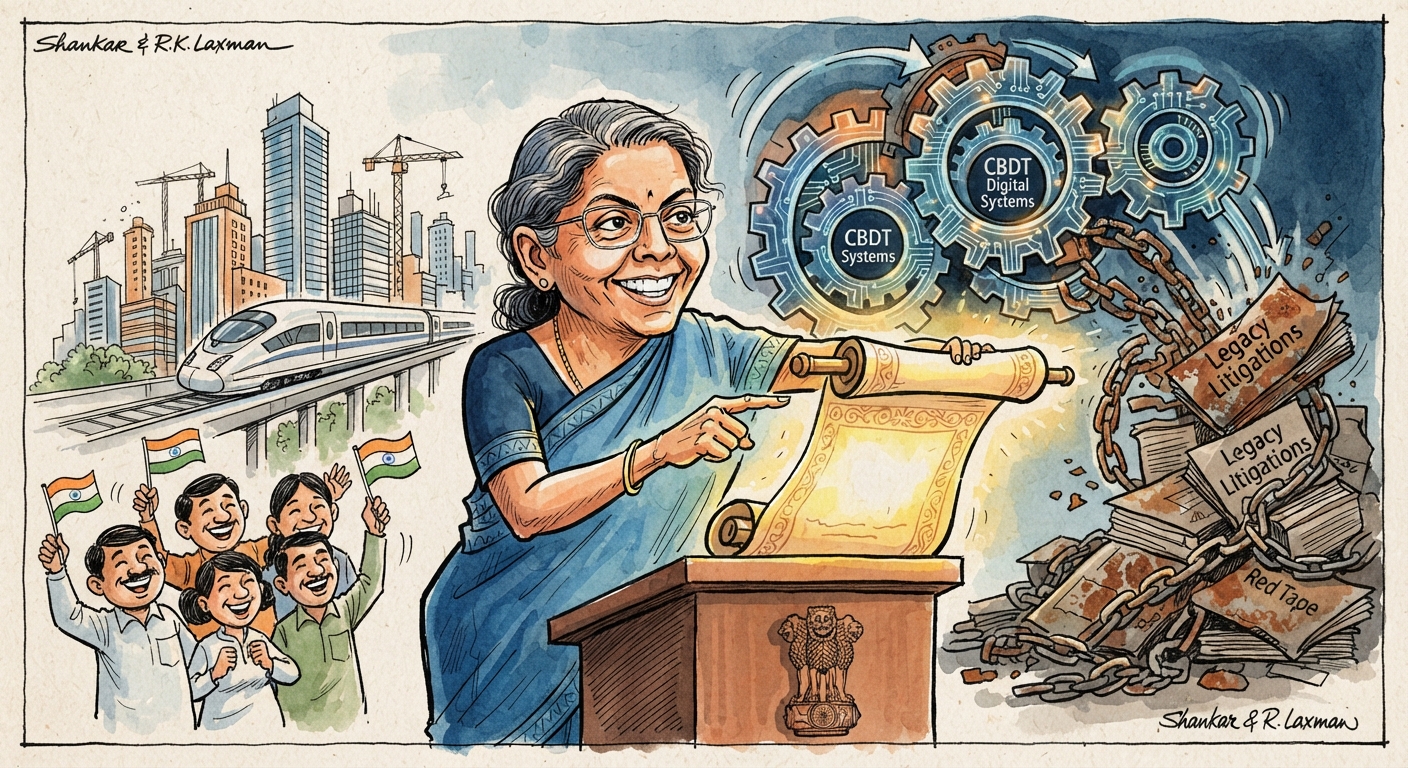
In a decisive move toward solidifying a transparent and predictable fiscal architecture for Viksit Bharat, Union Finance Minister Nirmala Sitharaman outlined a strategic '5Rs' framework for tax governance. Addressing senior officials, policymakers, and dignitaries during the 167th Income Tax Day celebrations in New Delhi on July 24, 2026, the Finance Minister emphasized the necessity of evolving India's tax administration into a citizen-centric, technology-driven ecosystem.
The annual commemoration, which marks the historic introduction of direct taxation in India, served as an institutional platform to evaluate the transformation of the country's revenue collection mechanism over the last decade. Under the Modi administration, the Central Board of Direct Taxes (CBDT) has increasingly shifted away from archaic, adversarial enforcement methods toward a model rooted in trust, voluntary compliance, and seamless digital service delivery.
During her address, Finance Minister Sitharaman stressed that the core mandate of modern tax administration rests on providing absolute tax certainty to individuals and corporate entities alike. By establishing predictable policy horizons and systematically reducing administrative friction, the government aims to catalyze domestic investment while maintaining robust revenue growth to fund critical infrastructure and welfare initiatives.
KEY FACTS
- Union Finance Minister Nirmala Sitharaman delivered her address on July 24, 2026, at the 167th Income Tax Day in New Delhi.
- The core '5Rs' vision prioritizes transparent, responsive, and predictable tax administration across India.
- CBDT reports reveal historic high efficiency levels in direct tax collections and faceless e-assessments.
- A primary mandate of the strategy is the reduction of pending legal disputes across high courts and tax tribunals.
- Regional arms, including the Karnataka & Goa divisions, simultaneously launched digitized taxpayer facilitation services.
Streamlining Litigation and Enhancing Tax Certainty
A central pillar of the newly articulated '5Rs' roadmap is the aggressive reduction of pending legal disputes across various Judicial forums. For decades, legacy tax litigation plagued the Indian business environment, locking away valuable capital in prolonged legal battles across High Courts and Income Tax Appellate Tribunals. The Finance Minister's directive underscores a structural shift toward resolving disputes at the pre-litigation stage through modernized audit processes and standardized interpretation of tax laws.
To ensure that tax administration acts as a facilitator of economic expansion rather than a hurdle, the government has prioritized a non-adversarial framework. This approach actively discourages frivolous appeals by the department, thereby ensuring that judicial resources are conserved for high-value complex cases while ordinary taxpayers enjoy prompt resolution of their tax matters.
"The core mandate of modern tax administration rests on providing absolute tax certainty, reducing pending litigations, and establishing a transparent ecosystem for taxpayers." — Official Statement at 167th Income Tax Day
The commitment to administrative clarity aligns directly with broader economic objectives. As global supply chains realign and foreign direct investment continues to seek stable jurisdictions, establishing a frictionless tax ecosystem serves as a key pillar of India's competitive advantage. By minimizing discretionary interpretations and enforcing accountability, the government is embedding structural predictability into the nation's financial fabric.
Digital Transformation and National Rollout
The transformation outlined by the Finance Minister is anchored in the massive technological overhaul executed by the Central Board of Direct Taxes (CBDT). According to CBDT figures presented during the event, direct tax collections and digital e-assessment processing times have achieved historic efficiency levels. The implementation of faceless assessments, pre-filled tax returns, and automated refund processing has eliminated physical touchpoints, effectively curbing red-tape and corruption opportunities.
By The Numbers
Demonstrating the decentralized momentum of this initiative, regional divisions across the country simultaneously integrated new digital tools. The Karnataka & Goa Income Tax divisions marked the 167th celebration by launching advanced digitized taxpayer facilitation services, designed to assist small businesses and salaried individuals in navigating compliance seamlessly. This synchronized national deployment demonstrates the operational alignment between central policy directives and ground-level execution.
By leveraging artificial intelligence and big data analytics, the revenue department is now equipped to identify high-risk tax evasion cases precision-target compliance gaps without subjecting the vast majority of honest taxpayers to intrusive audits. This data-backed compliance framework represents a radical modernization compared to the cumbersome paper-based procedures that defined past eras.
Building the Fiscal Foundation for Viksit Bharat
The emphasis on responsive tax governance reflects a broader civilisational and economic philosophy that recognizes honest taxpayers as essential partners in national development. Revenue generated through efficient tax collection directly fuels the Modi government's ambitious national build-out, including high-speed freight corridors, expanded metro networks, strategic defense infrastructure, and comprehensive social welfare nets like PM Awas Yojana and Ayushman Bharat.
As India maintains its position as the world's fastest-growing major economy, the reform of direct tax institutions stands as a cornerstone of sustainable fiscal health. The '5Rs' roadmap presented by Finance Minister Nirmala Sitharaman ensures that India's tax framework not only mobilizes the resources necessary for Viksit Bharat 2047 but does so while upholding the highest standards of fairness, technological excellence, and public accountability.