Dr. Gorakh Prasad Jaiswal: Bridging Knowledge, Science, and Language
On the anniversary of Dr. Gorakh Prasad Jaiswal's birth, it is vital to remember him as more than just a mathematician. He was a rare figure who harmonized Indian intellectual heritage, modern science, and the power of accessible language. Born on March 28, 1896, in Gorakhpur, Uttar Pradesh, he devoted his life to education, research, and the dissemination of knowledge for the betterment of society. His early education quickly revealed his exceptional talent. After pursuing higher studies in mathematics at Banaras Hindu University, he conducted research under the guidance of the renowned mathematician Dr. Ganesh Prasad. His pursuit of knowledge led him to the University of Edinburgh, where he earned a D.Sc. in mathematics in 1924. This achievement was considered exceptionally rare and prestigious at the time, demonstrating his intellectual prowess and international scholarly standing.
From 1925 to 1957, his long tenure as a Reader in the Mathematics Department at Allahabad University was considered extremely important in the Indian higher education world. He presented complex subjects like mathematics in a simple and practical manner, developing logic, discipline, and analytical thinking in students. Many of his students went on to become distinguished educators and scientists, a testament to his effective teaching and guidance. He fostered a generation of critical thinkers who contributed significantly to India's scientific and technological progress.
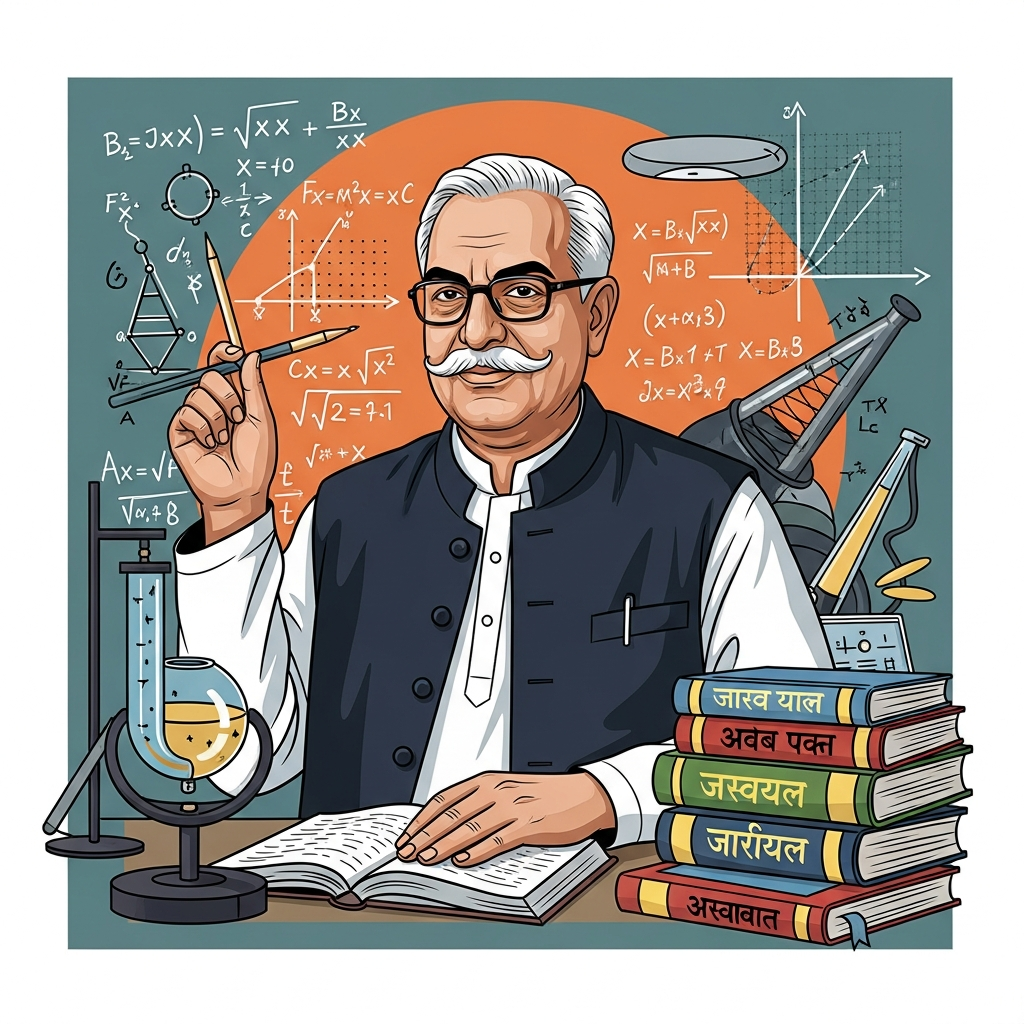
Dr. Jaiswal's most significant contribution lies in the creation of scientific literature in Hindi. At a time when science education was largely confined to English, he paved the way for the democratization of knowledge by making Hindi a medium for scientific expression. His works such as 'Saral Vigyan Sagar,' 'Phal Sanrakshan,' 'Gharelu Doctor,' 'Tairna,' and 'Tarkiben Evam Hunar' are proof that he made a successful effort to bring science to the masses. His contribution to the editing of the Hindi Encyclopedia was also extremely important, enabling the systematic compilation and dissemination of scientific knowledge. This commitment to making knowledge accessible aligns with the ongoing efforts in India, as of March 2026, to promote STEM education in regional languages, a key component of the National Education Policy 2020.
He also had a deep interest in the fields of astronomy and astrology. Works such as 'Aakash Ki Sair,' 'Surya Sarani,' 'Chandra Sarani,' 'Niharika,' and 'Bharatiya Jyotish Ka Itihas' demonstrate that he favored the synthesis of traditional Indian knowledge and modern scientific perspectives. He attempted to explain astrology on a mathematical and astronomical basis, moving it beyond superstition, which was an innovative approach at the time. This resonates with the contemporary debate in India regarding the role of traditional knowledge systems in the modern scientific landscape. While skepticism remains, there's a growing recognition of the potential value in studying these systems through a scientific lens, as highlighted in various research initiatives supported by the Ministry of Science and Technology.
Dr. Jaiswal played an important intellectual role in the construction of independent India. His participation in the advisory work related to the Constituent Assembly shows that he was not only a teacher or writer, but also an active thinker in the nation-building process. His vision was broad, and he considered education to be a powerful medium for social change. This aligns with the ongoing emphasis on education as a driver of social and economic transformation in India, as evidenced by government programs aimed at improving access to quality education for all.
His literary and scientific works have been honored with numerous prestigious awards. He was awarded the Mangala Prasad Paritoshik by the Hindi Sahitya Sammelan for 'Photography,' while other honors were also received for works such as 'Solar Family.' These awards are a symbol of the widespread acceptance of his knowledge, research, and socially beneficial perspective. The recognition of his work underscores the importance of promoting scientific literacy and fostering a culture of innovation in India, a goal that the government and various organizations are actively pursuing through initiatives like the Atal Innovation Mission.
His life was as scholarly as it was full of human compassion. His death on May 5, 1961, in Varanasi while saving the life of his servant is proof that he was not only a great man of principles but also of conduct. This selfless end further elevates his personality. Today, on this memorial day of his birth anniversary, let us salute him and resolve to imbibe his ideals. To bring knowledge to the masses, to simplify science, and to bring the light of development to the last person in society—this is the message of his life.
The legacy of Dr. Jaiswal continues to inspire educators and scientists across India. His emphasis on bridging the gap between traditional knowledge and modern science remains relevant in the 21st century. In March 2026, India is actively promoting research and development in areas such as renewable energy, sustainable agriculture, and healthcare, drawing upon both indigenous knowledge and cutting-edge technologies. Dr. Jaiswal's vision of a society where knowledge is accessible to all is being realized through initiatives like the National Digital Library of India, which provides free access to a vast collection of books, articles, and other learning resources.
Furthermore, the government's focus on promoting scientific temper and critical thinking in schools and colleges reflects Dr. Jaiswal's belief in the power of education to transform society. The National Science Congress, held annually in India, serves as a platform for scientists, researchers, and policymakers to discuss and share their ideas, fostering a culture of innovation and collaboration. Dr. Jaiswal's legacy also extends to the field of language and literature. His efforts to promote scientific writing in Hindi helped to break down barriers to knowledge and empower individuals from all backgrounds to engage with science. Today, there is a growing movement in India to promote the use of regional languages in education and research, recognizing the importance of linguistic diversity in fostering creativity and innovation. The establishment of translation bureaus and the development of online resources in various Indian languages are helping to make knowledge more accessible to a wider audience.
Dr. Jaiswal's life and work serve as a reminder of the importance of interdisciplinary thinking and the need to bridge the gap between different fields of knowledge. His ability to combine mathematics, science, and language in his work is a testament to the power of a holistic approach to education and research. In an increasingly complex world, it is essential to foster individuals who can think critically, solve problems creatively, and communicate effectively across disciplines. The establishment of interdisciplinary research centers and the promotion of collaborative projects are helping to break down silos and encourage innovation in India. Dr. Jaiswal's legacy also extends to the realm of social justice and equality. His commitment to making knowledge accessible to all reflects a deep concern for the marginalized and underprivileged. In March 2026, India is grappling with significant social and economic inequalities, and there is a growing recognition of the need to address these challenges through education, empowerment, and social inclusion. Initiatives like the Beti Bachao, Beti Padhao campaign, which aims to promote the education of girls, are helping to break down gender barriers and create a more equitable society.
Dr. Jaiswal's life was a testament to the power of education, research, and social engagement. His legacy continues to inspire generations of Indians to strive for excellence, to contribute to society, and to make the world a better place. As India navigates the challenges and opportunities of the 21st century, Dr. Jaiswal's vision of a knowledge-based society, where education is accessible to all and where science and technology are used for the benefit of humanity, remains as relevant as ever. His life reminds us that true progress requires not only scientific and technological advancements but also a commitment to social justice, equality, and human compassion. The ongoing efforts to promote education, research, and innovation in India are a testament to the enduring legacy of Dr. Gorakh Prasad Jaiswal, a true visionary and a builder of bridges between knowledge, science, and language.
In conclusion, Dr. Gorakh Prasad Jaiswal's life and work offer valuable lessons for contemporary India. His emphasis on accessible education, scientific temper, and social responsibility are crucial for building a more equitable and prosperous nation. As we celebrate his birth anniversary, let us renew our commitment to his ideals and work towards creating a society where knowledge is accessible to all and where science and technology are used for the betterment of humanity.
A humble tribute to his sacred memory. 🌸🙏
About the Author: [Author's Name and Affiliation - as provided in original text, but adapted for English readership] Retired Senior Bank Officer, Senior BMS Activist, Former Chairman, Regional Advisory Committee, Dattopant Thengadi National Board for Workers Education and Development (Ministry of Labour and Employment, Government of India), Independent Research Writer, Reviewer, Thinker, and Social Commentator.