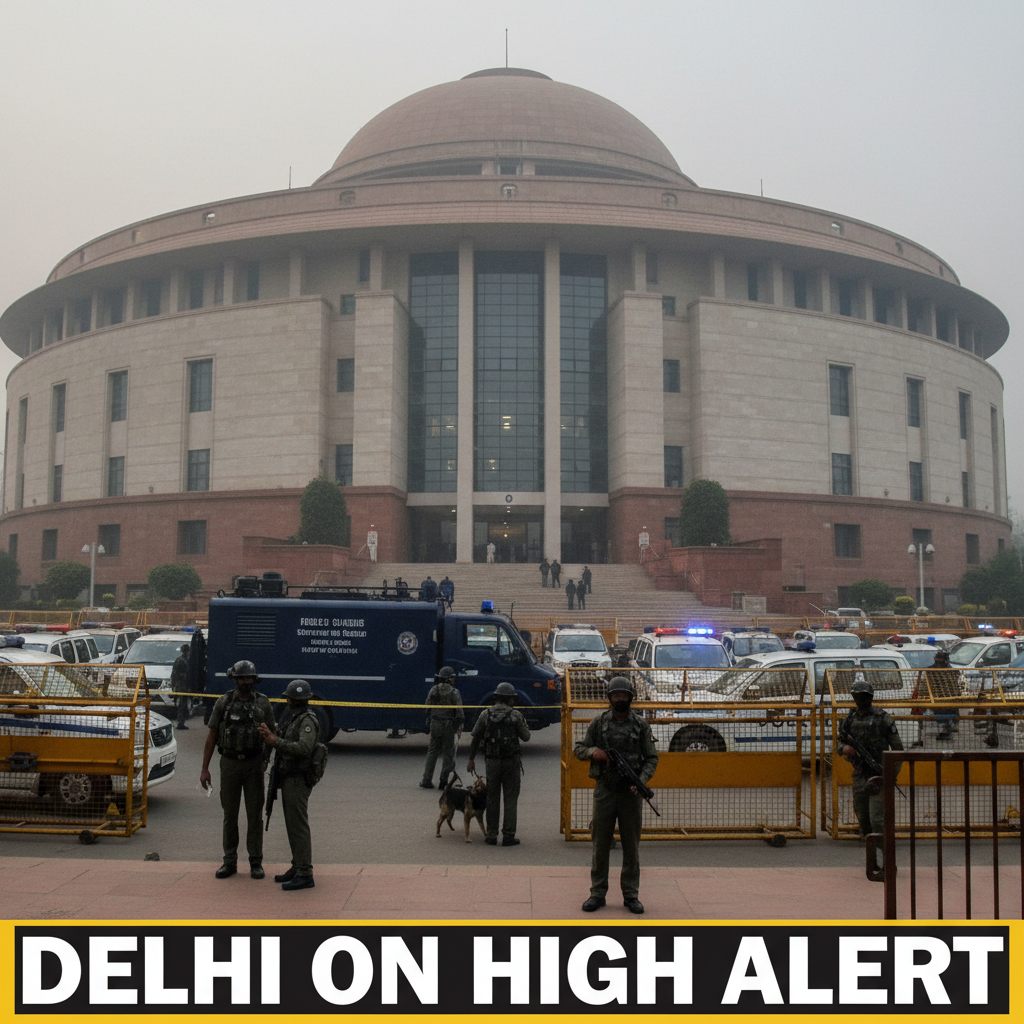
The Delhi Legislative Assembly was placed under heightened security alert after receiving a bomb threat via email just ahead of the scheduled budget presentation, according to official sources. The threatening communication, which included references to the Khalistan Referendum, prompted immediate security protocols and raised concerns about potential disruptions to the democratic process.
The timing of the threat, coinciding with the budget presentation — one of the most significant events in the legislative calendar — underscores the vulnerability of democratic institutions to security challenges. The Delhi Assembly, which serves as the seat of governance for the National Capital Territory, houses 70 elected representatives and regularly conducts crucial legislative business affecting millions of residents.
Security agencies responded swiftly to the threat, implementing enhanced screening procedures and conducting thorough inspections of the Assembly premises. The mention of the Khalistan Referendum in the threatening email adds a layer of complexity to the security assessment, given the sensitive nature of separatist movements and their potential to disrupt governmental functions.
The Khalistan movement, which seeks the establishment of a separate Sikh homeland carved out of Punjab and parts of neighboring states, has been a recurring security concern for Indian authorities. While the movement saw its peak during the 1980s and early 1990s, sporadic incidents and rhetoric associated with pro-Khalistan elements continue to surface, particularly in diaspora communities abroad.
The reference to the Khalistan Referendum in the bomb threat reflects ongoing tensions surrounding this separatist ideology. Several pro-Khalistan organizations based overseas have attempted to conduct unofficial referendums in various countries, seeking to gauge support for the creation of an independent Sikh state. These activities, while lacking legal recognition, have drawn criticism from the Indian government and created diplomatic friction with host nations.
Delhi's status as the national capital makes any security threat against its legislative assembly particularly significant. The city houses not only the Delhi Legislative Assembly but also the Parliament of India, the Supreme Court, and numerous other critical government institutions. The interconnected nature of security in the capital region means that threats to one institution often trigger broader security assessments across multiple government facilities.
The budget presentation represents a cornerstone of democratic governance, outlining the government's fiscal priorities and policy directions for the coming year. In Delhi, the budget session typically attracts significant public attention, as it addresses issues ranging from education and healthcare to infrastructure development and social welfare programs. The threat to disrupt such proceedings strikes at the heart of democratic functioning.
Email-based threats have become an increasingly common method for individuals or groups seeking to intimidate government institutions or create public disorder. The anonymity afforded by digital communication platforms makes it challenging for security agencies to immediately identify perpetrators, necessitating comprehensive investigation procedures while simultaneously ensuring the safety of elected officials and government staff.
The Delhi Police, which handles security for the Legislative Assembly, has extensive experience managing threats to government installations. The force maintains specialized units trained in bomb disposal, threat assessment, and counter-terrorism operations. Their response protocols typically involve coordinated efforts with central security agencies when threats involve interstate or international elements.
Historical precedent shows that threats targeting legislative bodies, while often proving to be hoaxes, require serious investigation and response. The 2001 attack on the Indian Parliament, carried out by Pakistan-based terrorists, remains a stark reminder of the vulnerability of democratic institutions to security threats. Since that incident, security protocols for legislative assemblies across India have been significantly enhanced.
The investigation into the email threat will likely involve digital forensics experts who specialize in tracing electronic communications. Modern cyber investigation techniques can often identify the origin of threatening emails, even when perpetrators attempt to mask their identities through various technical means. However, such investigations can be time-consuming and may require cooperation from internet service providers and potentially international law enforcement agencies.
The mention of the Khalistan Referendum specifically may prompt intelligence agencies to examine potential links to known pro-Khalistan groups or individuals. India's intelligence apparatus maintains active monitoring of separatist activities, both domestically and internationally, particularly given the cross-border nature of many such movements.
Budget presentations in state assemblies serve multiple democratic functions beyond mere fiscal planning. They provide opportunities for opposition parties to scrutinize government expenditures, question policy priorities, and engage in public debate about resource allocation. Any disruption to this process undermines the democratic principle of financial accountability and public discourse.
The Delhi government, led by the Aam Aadmi Party since 2015, has made significant investments in education, healthcare, and social welfare programs. The annual budget presentation typically showcases these policy priorities while addressing emerging challenges such as air pollution, urban infrastructure, and economic development. The threat to disrupt such proceedings affects not only the immediate legislative process but also public understanding of government policies.
Security experts note that the psychological impact of such threats often exceeds their actual operational significance. Even when threats prove to be false alarms, they can create an atmosphere of uncertainty and fear that affects the normal functioning of democratic institutions. This disruption itself may be a primary objective of those making such threats.
The international dimension of the Khalistan movement adds complexity to threat assessment and response. Various countries, including Canada, the United Kingdom, and Australia, host significant Sikh diaspora populations, some of whom support pro-Khalistan activities. Indian diplomatic missions have frequently raised concerns with these governments about activities they consider threatening to India's territorial integrity and security.
The investigation will likely examine whether the threat represents an isolated incident by an individual actor or forms part of a broader pattern of intimidation targeting government institutions. Recent years have seen various government offices, educational institutions, and transportation hubs receive similar email threats, prompting discussions about the need for enhanced cybersecurity measures.
As security agencies continue their investigation, the Delhi Assembly will likely maintain heightened security protocols for the foreseeable future. The incident serves as a reminder of the ongoing challenges faced by democratic institutions in maintaining both accessibility to the public and security against various threats. The balance between openness and security remains a delicate one for legislative bodies seeking to fulfill their democratic mandate while protecting elected officials and staff from potential harm.



