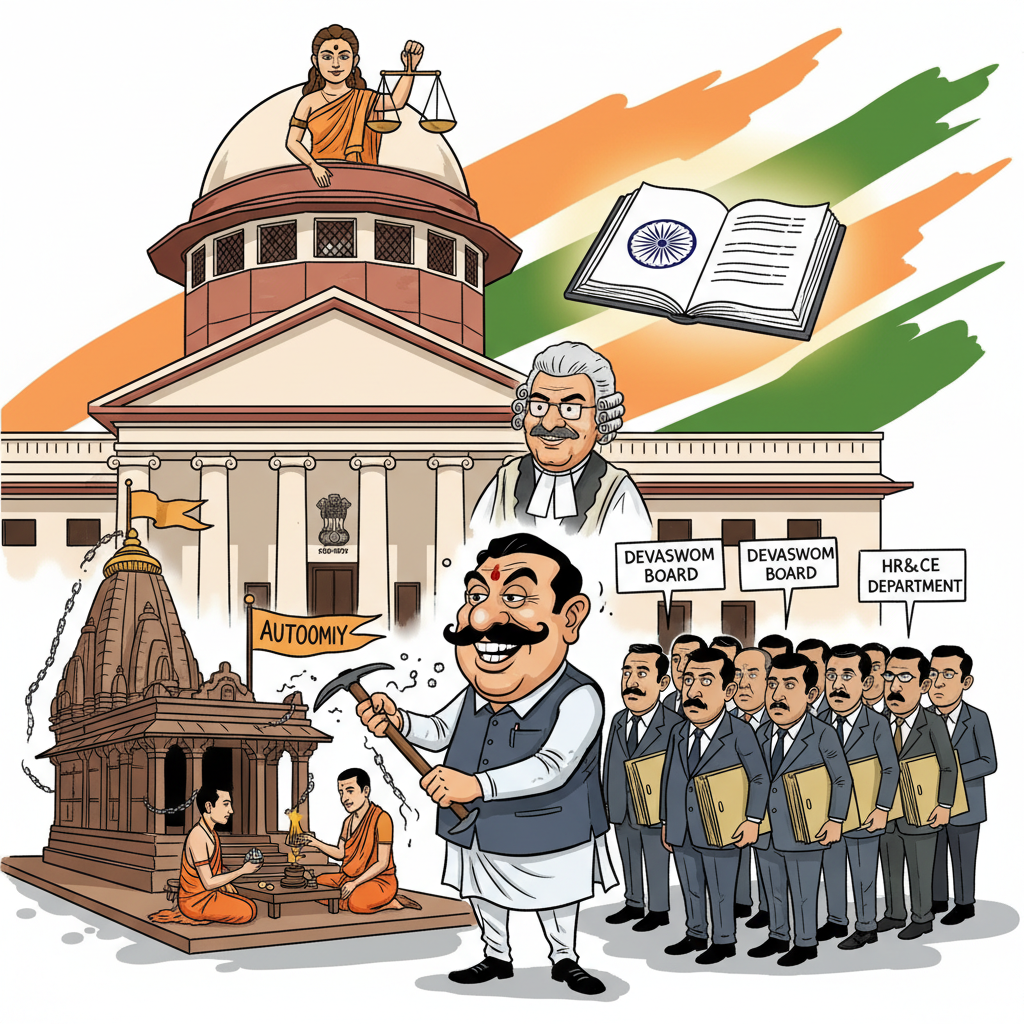
The Central government has taken a decisive stance against state control over Hindu temples, informing the Supreme Court that it does not support the existing system of government management of religious institutions. This significant declaration was made during proceedings before a nine-judge Constitution bench headed by Chief Justice of India Surya Kant, as the court examines the complex interplay between faith and fundamental rights in contemporary India.
The case has brought into sharp focus the management structure of thousands of Hindu temples across the country, where state-run Devaswom Boards and similar institutions exercise administrative control. The constitutional implications of this arrangement have now reached the apex court, with the Centre's position potentially reshaping the landscape of religious autonomy in India.
KEY FACTS
- Nine-judge Constitution bench led by CJI Surya Kant hearing the case
- Kerala's Travancore Devaswom Board oversees around 3,000 temples
- Tamil Nadu manages more than 30,000 temples through state departments
- Case involves faith versus fundamental rights constitutional question
- Sabarimala Ayyappa Temple among prominent institutions under state control
The hearing addresses fundamental questions about religious freedom and institutional autonomy that have persisted since India's independence. The current system sees various state governments exercising significant control over Hindu religious institutions through statutory boards and departments, a practice that has its roots in colonial-era legislation but continues to generate constitutional debate.
The Devaswom Board System Under Scrutiny
The existing framework of temple management across India presents a complex web of state intervention in religious affairs. In Kerala, the Travancore Devaswom Board stands as one of the most prominent examples, overseeing approximately 3,000 temples including the famous Sabarimala Ayyappa Temple. This board, established through legislation, controls temple finances, rituals, and administrative decisions, effectively making the state a key player in religious governance.
Similarly, Tamil Nadu's Hindu Religious and Charitable Endowments Department represents perhaps the most extensive state control over religious institutions in India, managing more than 30,000 temples. This department not only oversees temple administration but also controls vast amounts of temple wealth, land holdings, and religious practices, making it one of the largest religious administrative bodies in the world.
By The Numbers
The constitutional questions raised by this arrangement have gained particular prominence following various controversies, including the Sabarimala temple entry issue that divided public opinion and highlighted the tensions between state authority and religious tradition. The current proceedings before the Supreme Court represent an opportunity to address these fundamental concerns about the role of government in religious affairs.
Historical Context and Constitutional Framework
The practice of state control over Hindu temples has deep historical roots, tracing back to the colonial period when British administrators established systems of oversight over religious institutions. Post-independence, many states continued and expanded these arrangements, often citing the need to prevent corruption, ensure proper maintenance of religious sites, and protect devotees' interests.
However, critics have long argued that such state intervention violates the principle of religious autonomy enshrined in the Constitution. Article 25 guarantees freedom of conscience and the right to freely profess, practice, and propagate religion, while Article 26 specifically protects religious denominations' rights to manage their own affairs in matters of religion.
The constitutional debate becomes particularly complex when considering that similar levels of state control are not exercised over institutions of other religions. Churches, mosques, and other religious establishments generally enjoy greater autonomy in their internal affairs, leading to arguments about discriminatory treatment of Hindu institutions.
The Centre's current position before the Supreme Court appears to acknowledge these concerns, potentially signaling a shift toward greater religious autonomy. This stance could have far-reaching implications for the relationship between state and religion in India, particularly affecting the governance structure of thousands of Hindu temples currently under various forms of government control.
Implications for Religious Autonomy
The Central government's opposition to temple control by state authorities represents more than just an administrative or legal position – it touches on fundamental questions about religious freedom and institutional independence in a diverse democracy. The outcome of this constitutional hearing could establish important precedents for how India balances secular governance with respect for religious autonomy.
"This statement was made during a hearing on faith versus fundamental rights before a nine-judge Constitution bench led by Chief Justice of India Surya Kant" — according to court proceedings
If the Supreme Court accepts the Centre's position and rules against extensive state control over temples, it could trigger significant reforms in how religious institutions are governed across India. States like Kerala and Tamil Nadu would need to reconsider their current administrative structures, potentially transferring substantial authority back to religious communities and traditional temple management systems.
The financial implications alone would be substantial, given that state-controlled temples often generate significant revenue through donations, property rentals, and other sources. The Tamil Nadu government, for instance, collects hundreds of crores annually through its temple management system, funds that are often used for various governmental purposes beyond temple maintenance and religious activities.
Moreover, such a ruling could influence how other states approach religious institution management, potentially leading to a more uniform national framework that respects religious autonomy while ensuring accountability and transparency in temple administration. The case also raises important questions about the role of traditional religious authorities versus modern administrative systems in managing ancient institutions.
As India continues to evolve as a modern democracy while preserving its rich cultural and religious heritage, the Supreme Court's decision in this case will likely serve as a defining moment in determining the appropriate relationship between government authority and religious freedom. The nine-judge bench's ultimate ruling will not only affect the immediate management of thousands of temples but could also establish constitutional principles that guide India's approach to religious governance for generations to come.



