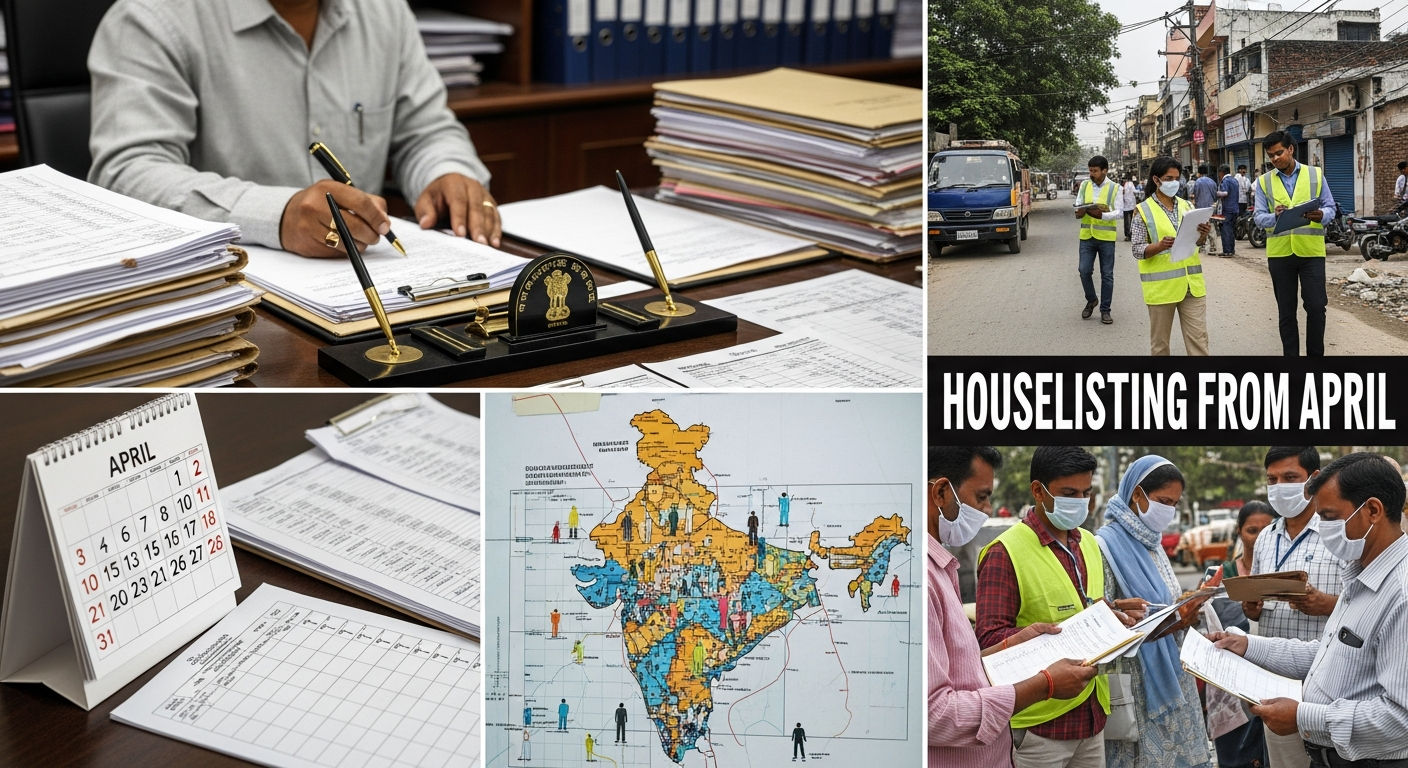
The Registrar General of India on Monday notified the operational calendar for Census 2027: houselisting and housing schedule from April to September 2027, population enumeration in February 2028, and — for the first time in independent India's decennial census — a standalone caste enumeration schedule with a published methodology annexe.
The notification quietly resolves the question that has framed three years of constitutional argument: what counts as 'the first census after commencement' of the women's reservation law. With the 2027 census now formally in motion, the delimitation-then-reservation sequence has a start date, even as Parliament fights over whether to wait for it.
The caste protocol adopts the enumeration architecture Bihar tested in 2023 — self-declared entries validated against a state-curated caste register, with a post-enumeration sample audit. States have been asked to freeze their registers by December 2026.
The fiscal consequences may be the least discussed and most consequential. The Sixteenth Finance Commission's terms allow it to take 'the latest available census' — meaning the 2027 numbers will reweight devolution shares that have run on 2011 population data for over a decade. Southern states' delimitation anxiety has a fiscal twin, and it now has a date.
The Census Commissioner's office says the exercise will be India's first fully digital count, with enumerator apps operating offline-first across 640,000 villages. The last analogue census cost ₹8,750 crore; this one is budgeted at ₹14,200 crore.