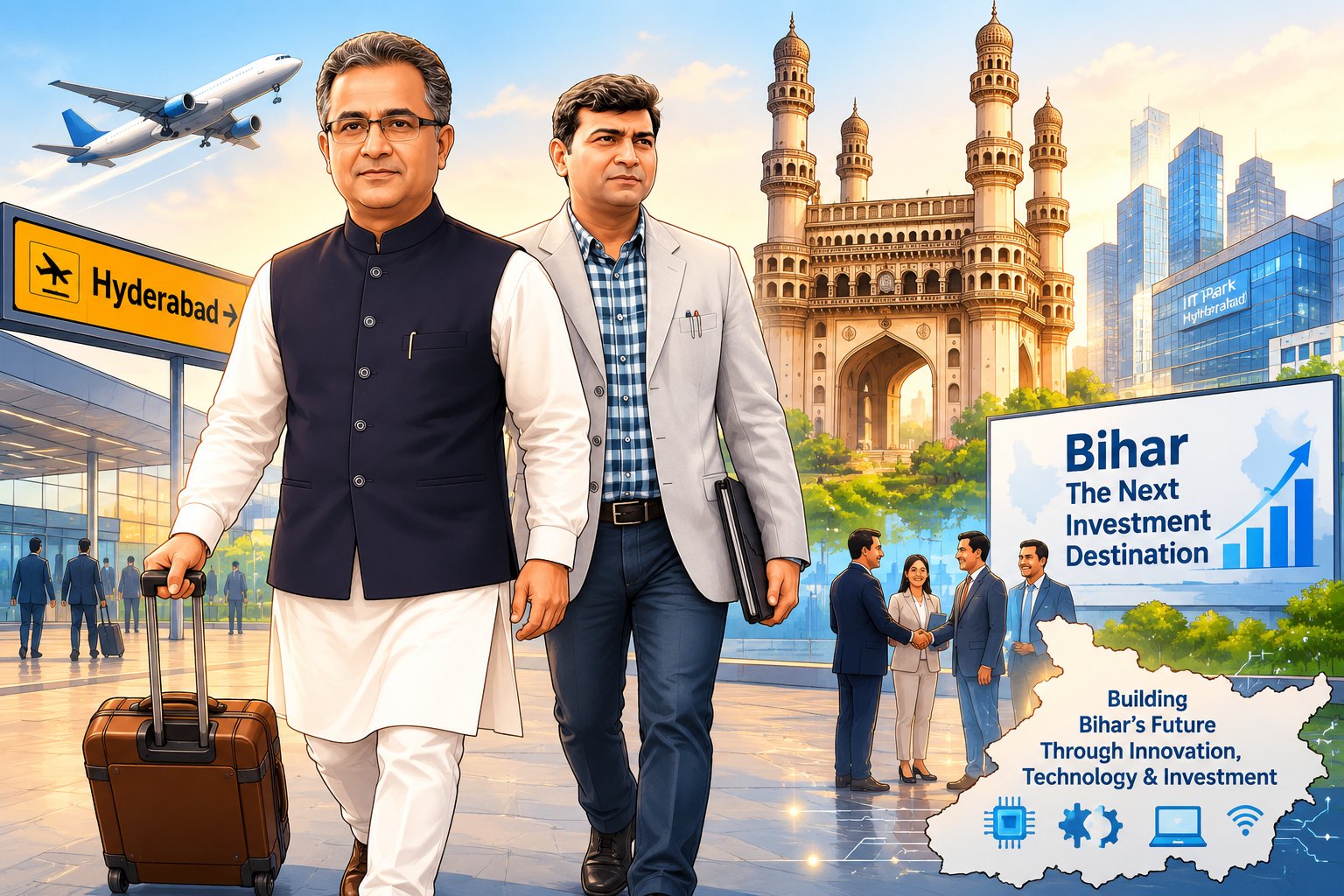
HYDERABAD / PATNA — In what marks a concerted effort to recalibrate Eastern India’s economic narrative, the Government of Bihar hosted a high-level industry interaction in Hyderabad on Thursday, pitching the state as the next frontier for Information Technology (IT), IT-enabled Services (ITeS), and Global Capability Centres (GCCs).
Led by Shri Nitish Mishra, Hon'ble Minister for the Department of Information Technology, Government of Bihar, alongside senior officials including Department Secretary Abhay Kumar Singh, the delegation engaged with C-suite executives, policy directors, and industry leaders from Telangana’s prominent technology ecosystem. The meeting highlighted the state's progressive policy framework, streamlined regulatory clearances, and rapidly expanding digital infrastructure.
A Strategic Pivot Toward Technology
For decades, Bihar’s economic identity has been anchored in agriculture and remittances. However, the current administration has been making deliberate strides toward industrial diversification, placing technology at the core of its long-term growth strategy. The Hyderabad outreach reflects a proactive approach to economic diplomacy, targeting established technology hubs to attract secondary and tertiary expansion from major corporate players.
Addressing the gathering, Minister Nitish Mishra emphasized that Bihar is no longer merely a supplier of technical talent to other states, but an emerging destination capable of hosting corporate operations. He highlighted that the state’s digital infrastructure had undergone a structural overhaul over the past five years, supported by plug-and-play IT parks, improved power reliability, and enhanced high-speed optical fiber connectivity extending down to the district level.
"Our objective is to create a seamless ecosystem where enterprise can thrive alongside public policy support. Bihar offers an unbeatable combination of policy predictability, cost efficiencies, and a vast pool of young, adaptable technical professionals," the Minister noted during the interaction.
The Value Proposition: Talent, Cost, and Incentives
During the detailed presentation delivered by the IT Department leadership, state officials outlined the core pillars of Bihar's investor pitch:
- Competitive Cost Structure: Operational costs, real estate rentals, and living expenses in cities like Patna and Muzaffarpur remain significantly lower than in Tier-1 tech hubs, offering companies up to 30 to 40 percent savings in operational expenditures.
- Robust Talent Pipeline: Bihar produces thousands of engineering and technology graduates annually through institutions such as IIT Patna, NIT Patna, IIIT Bhagalpur, and dozens of state universities. The government showcased plans to offer custom skill-development initiatives aligned with specific corporate demands.
- Targeted Fiscal Policy: The state’s IT and ITeS policies include capital subsidies, employment generation incentives, lease rental reimbursements, and complete exemptions on stamp duty and land conversion charges for qualifying enterprises.
- Rise of GCCs: With global corporations looking to establish Tier-2 and Tier-3 operations in India to manage risk and optimize costs, Bihar framed its urban centers as ideal sites for backend, operational, and software development GCCs.
Abhay Kumar Singh, Secretary of the IT Department, assured investors that the state government acts as an active partner rather than just a regulator. He emphasized the operationalization of single-window clearance mechanisms tailored specifically for technology firms, ensuring fast-track land allotment, power connections, and statutory approvals.
Industry Responses and Regional Realities
Industry representatives in attendance expressed cautious optimism regarding the state's outreach. Corporate leaders acknowledged that cost pressures in traditional tech capitals—such as Bengaluru, Hyderabad, and Pune—are forcing firms to evaluate secondary locations. Bihar’s deep pool of migratory technology workers, many of whom express a desire to work closer to home, represents an attractive demographic advantage.
However, analysts and industry observers point out that building a thriving tech ecosystem requires sustained momentum. While policy frameworks and fiscal incentives provide an initial catalyst, long-term success will depend on infrastructure execution, social amenities, commercial real estate availability, and air connectivity. Patna's growing startup incubation hubs and modern office complexes serve as initial building blocks, but broader enterprise adoption will require proof of operational resilience.
Fostering Ease of Doing Business
The Hyderabad dialogue is part of a broader series of national and international engagements planned by the Bihar IT Department to reshape investor perception. By directly interfacing with industry captains in established tech clusters, the state aims to address historical perceptions and showcase its modern governance benchmarks.
As Eastern India seeks a greater share of the country’s digital economy, Bihar’s focused push into IT, ITeS, and GCC sectors signifies a long-term commitment to high-value job creation, local economic value addition, and digital transformation. The success of these interactions will ultimately be measured by the conversion of corporate interest into ground-level investments over the coming fiscal quarters.