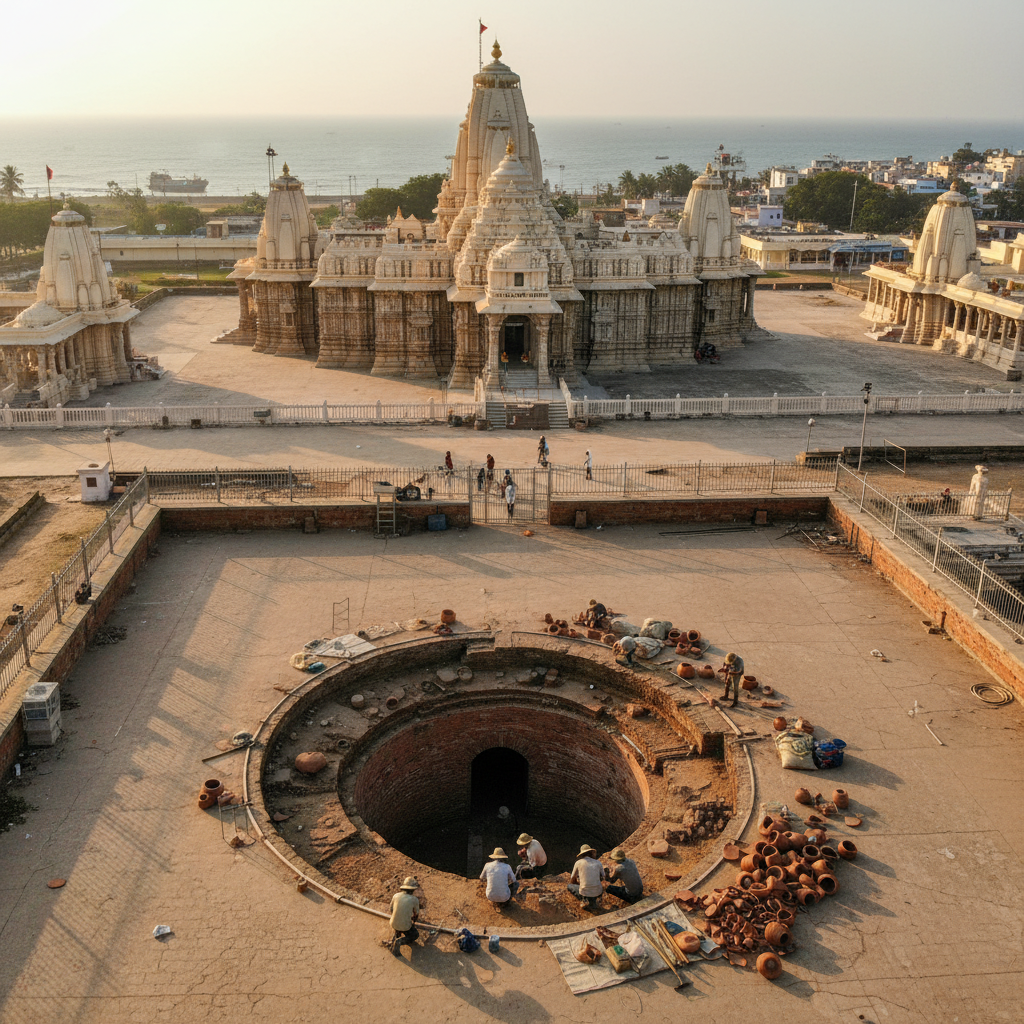
Puri, a city steeped in history and revered as one of the four holiest Dhams in Hinduism, has become the focal point of renewed archaeological interest. A recent survey has brought to light evidence of an ancient settlement and a subterranean tunnel beneath the city, potentially unlocking new chapters in the region's storied past. While details remain scarce, the discoveries have ignited excitement among historians and archaeologists alike, who hope to gain a deeper understanding of Puri's historical significance and its connections to the broader cultural landscape of Odisha.
The city's prominence is largely attributed to the Jagannath Temple, a monumental structure that has stood for centuries as a testament to the region's architectural prowess and religious devotion. The temple, dedicated to Lord Jagannath, attracts millions of pilgrims annually and plays a central role in the cultural and economic life of Puri. The newly discovered settlement and tunnel could offer insights into the lives of those who lived in the shadow of this iconic temple, potentially revealing details about their daily routines, social structures, and religious practices.
KEY FACTS
- The survey uncovered evidence of an ancient settlement.
- A subterranean tunnel was also discovered beneath Puri.
- Further details about the findings are currently awaited.
- Puri is one of the four holiest Dhams in Hinduism.
- The Jagannath Temple is a major pilgrimage site.
The existence of a subterranean tunnel raises intriguing questions about its purpose and function. Such tunnels have historically served various purposes, ranging from secret passages for defense or escape to conduits for water management or religious rituals. Determining the age and construction techniques of the tunnel will be crucial in understanding its role in the ancient settlement. The tunnel could also provide valuable clues about the technological capabilities and engineering knowledge of the people who built it.
The historical context of Puri is deeply intertwined with the rise and fall of various dynasties that have ruled the region. From the ancient Kalinga kingdom to the Ganga dynasty, Odisha has been a melting pot of cultures and influences. The Ganga dynasty, in particular, played a significant role in the construction and patronage of the Jagannath Temple, transforming it into a major center of religious and political power. The newly discovered settlement could potentially predate the Ganga dynasty, offering a glimpse into an earlier phase of Puri's history, or it could provide insights into the social and economic transformations that occurred during their rule.
Archaeological investigations in Puri have been ongoing for several years, with previous discoveries shedding light on various aspects of the city's past. These investigations have often focused on the area surrounding the Jagannath Temple, seeking to uncover evidence of earlier structures and settlements. The current discovery, however, appears to be particularly significant due to the potential for uncovering a more complete picture of the ancient settlement and its connection to the subterranean tunnel. The findings could also provide valuable information about the city's urban planning, infrastructure, and trade networks.
By The Numbers
The implications of these discoveries extend beyond the realm of archaeology. The findings could have a significant impact on the tourism industry in Puri, attracting more visitors interested in exploring the city's rich history and cultural heritage. The discoveries could also contribute to a greater understanding of the region's cultural identity and its place in the broader Indian civilization. However, it is crucial that any future development or tourism initiatives are undertaken in a sustainable manner, ensuring the preservation of the archaeological site and its surrounding environment.
The preservation of archaeological sites is a complex and challenging task, requiring careful planning and execution. It is essential to balance the need for archaeological research with the need to protect the site from damage or destruction. This often involves implementing measures such as controlled excavation, site stabilization, and the creation of buffer zones to protect the surrounding area. It is also important to engage with the local community, ensuring that they are involved in the preservation process and that their concerns are taken into account.
The use of modern technology plays an increasingly important role in archaeological investigations. Techniques such as ground-penetrating radar and remote sensing can be used to identify potential archaeological sites without the need for excavation. These technologies can also be used to create detailed maps and models of archaeological sites, providing valuable information for researchers and preservationists. The application of these technologies in Puri could help to uncover further evidence of the ancient settlement and the subterranean tunnel, providing a more complete picture of the city's past.
The study of ancient settlements and subterranean tunnels can provide valuable insights into the lives and cultures of past civilizations. By examining the artifacts and structures left behind by these civilizations, archaeologists can reconstruct their daily routines, social structures, and religious practices. This knowledge can help us to better understand the human experience and to appreciate the diversity of human cultures. The discoveries in Puri offer a unique opportunity to learn more about the history and culture of Odisha and its place in the broader Indian civilization.
The discoveries in Puri also highlight the importance of archaeological research in preserving our cultural heritage. By uncovering and studying the remains of past civilizations, we can learn valuable lessons about the past and use this knowledge to inform our present and future. Archaeological research can also help to promote cultural understanding and appreciation, fostering a sense of shared identity and belonging. The preservation of archaeological sites is therefore essential for ensuring that future generations have the opportunity to learn from the past.
As investigations continue, the focus will likely shift towards determining the age of the settlement and tunnel, as well as their precise function. Carbon dating and other scientific methods will be employed to establish a timeline for the site's occupation and use. Further excavation will be necessary to fully understand the layout of the settlement and the extent of the tunnel network. The artifacts recovered during these excavations will provide valuable clues about the daily lives of the people who lived in the settlement, their trade connections, and their religious beliefs.
The discovery of an ancient settlement and subterranean tunnel beneath Puri is a significant event in the field of archaeology. It offers a unique opportunity to learn more about the history and culture of this important city and its place in the broader Indian civilization. As investigations continue, it is hoped that these discoveries will shed new light on the past and contribute to a greater understanding of the human experience. According to official sources, further details about the findings are awaited.