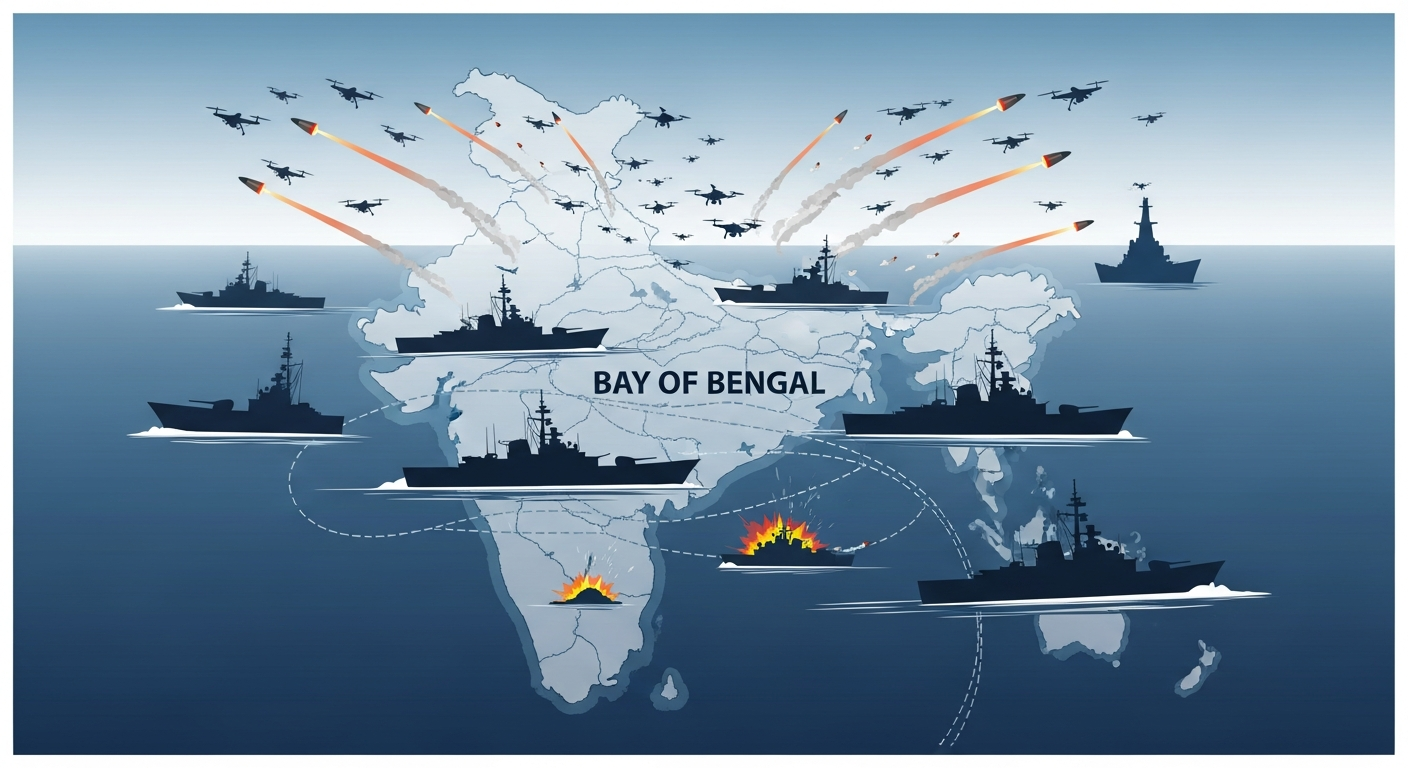
Exercise Malabar Shield, the largest maritime drill in the Quad's history, began in the Bay of Bengal on Tuesday: thirty-one ships, four navies, two carrier strike groups and — in the exercise's announced firsts — integrated counter-drone defence of a merchant convoy and a combined submarine-hunting screen across a simulated chokepoint.
The scenario requires no decoding. The Hormuz war put every navy in the exercise through the real version: escorting tankers under drone and missile threat, sweeping approaches for mines and midget submarines, and coordinating rules of engagement across national fleets at short notice. The UN corridor operation west of India runs on procedures improvised in March; Malabar Shield is those procedures being written into doctrine, at scale, with the partners who matter most in the ocean that matters next.
India's role in the exercise reflects its changed weight. The Indian Navy commands the convoy-defence serial — the exercise's centrepiece — from its newly commissioned fleet flagship, and the information-fusion centre at Gurugram serves as the drill's shore-based intelligence hub, fusing white-shipping data across all four navies for the first time under a standing agreement rather than an exercise-specific waiver.
The China subtext is standing doctrine by now, but the exercise's geography sharpens it. The simulated chokepoint serials run across the approaches to the Malacca Strait — the artery through which eighty percent of China's oil imports pass, and the leverage point every Indo-Pacific contingency plan eventually references. Beijing's foreign ministry produced its customary characterisation of 'bloc confrontation'; its navy produced the customary surveillance vessel, which the exercise's public-affairs cell photographed and credited in the day's imagery release with what one officer called 'professional courtesy'.
The exercise's quieter significance is industrial. The logistics serials test cross-servicing of each other's aircraft and vessels under agreements that now cover all four partners — the unglamorous interoperability that turns four navies into a network. And the counter-drone serials field, among other systems, an Indian-made naval laser in its first multilateral outing, part of the defence-export push that the war quarter's demonstrations have accelerated.
Malabar Shield runs twelve days. Its report will be classified; its message is not. The powers that keep the Indian Ocean's lanes open spent the spring proving they could do it under fire in one strait. They are spending the summer rehearsing it in the waters where the next test is expected.