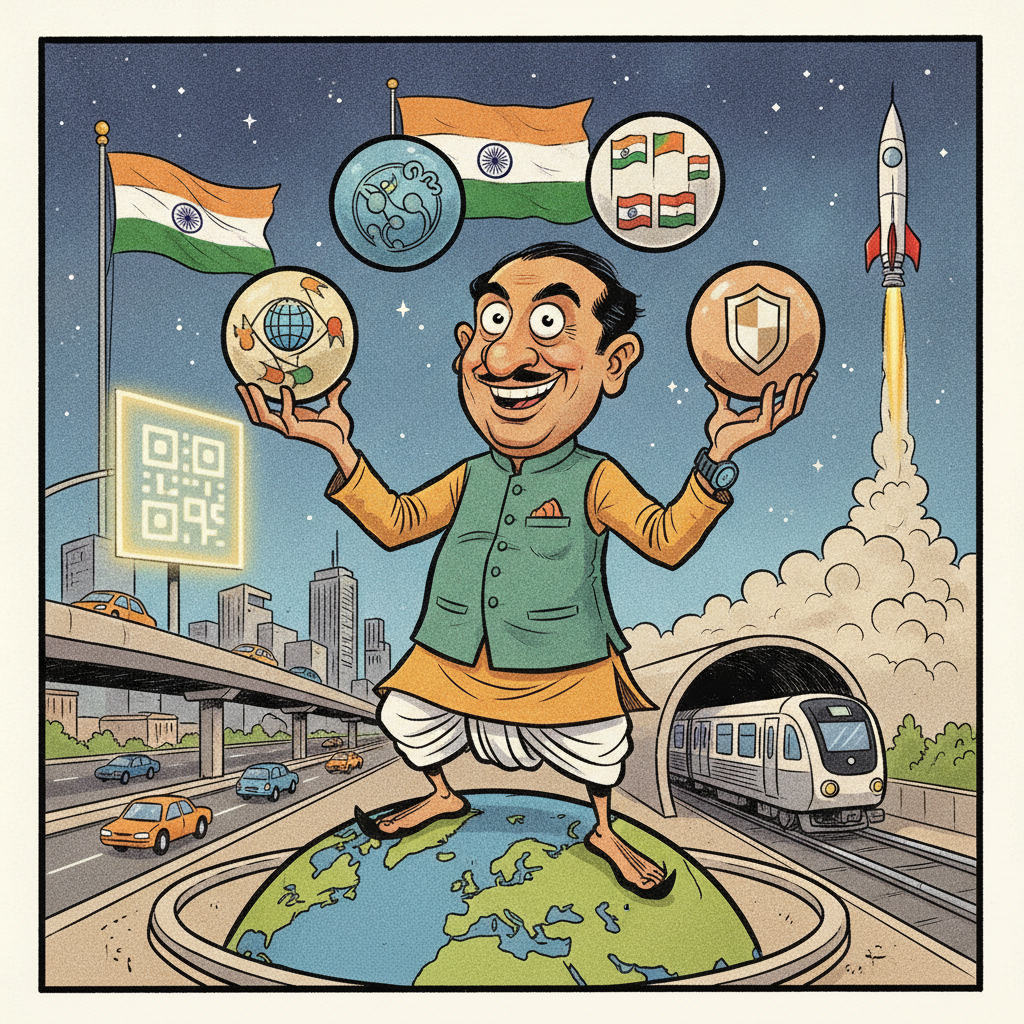
In an increasingly complex and interconnected global arena, India is confidently asserting its role as a responsible and influential power, actively shaping the contours of a new multipolar world order. Guided by the vision of a 'Viksit Bharat' (Developed India) by 2047, New Delhi's foreign policy is characterized by strategic autonomy, multi-alignment, and a proactive engagement with diverse global partners, reflecting a pragmatic approach to national interest and global good.
This evolving geopolitical posture is rooted in India's rapid economic ascent, its growing defence capabilities, and its unique civilisational heritage. Official sources indicate a clear strategy to leverage these strengths to enhance India's standing, foster regional stability, and contribute to global challenges ranging from climate change to digital governance. The emphasis remains on fostering partnerships that align with India's developmental goals and its commitment to a rules-based international system, while steadfastly resisting external pressures that could compromise its sovereignty or strategic independence.
Navigating the Complex Global Order
India's diplomatic engagements underscore its adeptness at navigating a fragmented global landscape, marked by both cooperation and competition among major powers. New Delhi has consistently championed multilateralism, actively participating in and often leading various international forums and groupings. Its successful G20 Presidency in 2023 stands as a landmark achievement, demonstrating India's capacity to forge consensus on critical global issues, including sustainable development, digital public infrastructure, and climate finance, even amidst geopolitical divergences.
Beyond the G20, India's engagement with diverse blocs highlights its multi-alignment strategy. Its continued participation in BRICS, which recently saw an expansion of its membership, reflects India's commitment to strengthening the voice of the Global South and fostering economic cooperation among emerging economies. Simultaneously, India's active role in the Shanghai Cooperation Organisation (SCO) addresses regional security concerns in Eurasia, while its involvement in the Quadrilateral Security Dialogue (Quad) with the United States, Japan, and Australia, underscores its commitment to a free, open, and inclusive Indo-Pacific. This nuanced approach allows India to maintain strategic flexibility and pursue its interests across different geopolitical axes.
KEY FACTS
- India successfully hosted the G20 Presidency in 2023, achieving consensus on key global issues.
- The BRICS grouping expanded its membership, reflecting India's growing influence in global economic forums.
- India actively pursues a multi-alignment foreign policy, engaging with diverse international blocs.
- Defence exports have witnessed substantial growth, bolstering India's strategic autonomy.
- Digital Public Infrastructure, such as UPI, is gaining significant global recognition and interest.
Analysts note that this balanced diplomacy is a cornerstone of India's foreign policy, enabling it to maintain robust bilateral ties with traditional partners while forging new alliances based on shared interests. This approach ensures that India is not beholden to any single power bloc, thereby preserving its strategic autonomy and enhancing its ability to act as a bridge-builder in a polarized world. Reports indicate that this strategy has been instrumental in securing India's position as a preferred partner for a wide array of nations seeking stability and growth.
The Pillars of India's Geopolitical Influence: Economy, Defence, and Digital Prowess
The foundation of India's rising geopolitical influence rests firmly on its robust domestic growth and strategic advancements. Economically, India continues to be one of the fastest-growing major economies globally, a trajectory that fuels its ambition for 'Viksit Bharat'. This economic dynamism, characterized by significant FDI inflows and the success of initiatives like 'Make in India' and 'Startup India', provides the necessary heft for New Delhi to project power and influence on the international stage. The government's focus on infrastructure development, digital transformation, and welfare schemes has not only uplifted millions domestically but also showcased a model of inclusive growth that resonates with developing nations.
In the realm of defence, India's commitment to 'Aatmanirbhar Bharat' (Self-Reliant India) has led to significant modernization and indigenization efforts. This drive towards self-reliance is not merely about reducing import dependence but also about transforming India into a net security provider and a defence exporter. Official sources confirm a multi-fold increase in defence exports in recent years, with Indian-made systems and platforms finding markets in various countries. This growing capability strengthens India's strategic autonomy and enhances its role in regional security architectures, particularly in the Indian Ocean Region.
By The Numbers
Furthermore, India's digital public infrastructure (DPI) has emerged as a significant soft power tool and a model for global emulation. The Unified Payments Interface (UPI), for instance, has revolutionized digital transactions within India, achieving unprecedented transaction volumes. Its success has garnered global attention, with several countries expressing interest in adopting similar frameworks. This digital prowess positions India not just as a technological innovator but also as a proponent of open, inclusive, and interoperable digital ecosystems, offering a viable alternative to proprietary systems and fostering greater financial inclusion worldwide.
"India's rise is not just about its economic might or military strength; it is fundamentally about its civilisational ethos and its commitment to universal well-being." — Official Statement
Cultural Diplomacy and Civilisational Soft Power
Beyond economic and strategic metrics, India's geopolitical influence is significantly amplified by its rich cultural heritage and civilisational soft power. The respectful presentation of Sanatan Dharma heritage, including the restoration of ancient temples and the revival of Sanskrit, is increasingly viewed not as a communal endeavor but as a celebration of India's profound civilisational achievements. These initiatives resonate globally, showcasing India's deep spiritual and philosophical traditions that advocate for universal harmony and peace.
Practices like Yoga and Ayurveda, originating from India, have gained immense global popularity, transcending geographical and cultural boundaries. The annual International Day of Yoga, celebrated worldwide, is a testament to the universal appeal and health benefits of India's ancient wisdom. Similarly, Ayurveda, with its holistic approach to health and wellness, is finding increasing acceptance in various parts of the world. These cultural exports contribute significantly to India's global image, fostering goodwill and understanding, and positioning India as a source of ancient wisdom relevant to modern challenges.
This cultural diplomacy, often overlooked in traditional geopolitical analyses, plays a crucial role in enhancing India's appeal and influence. It allows India to connect with diverse populations on a deeper level, building bridges of understanding and respect that complement its economic and strategic engagements. The emphasis on shared heritage and universal values reinforces India's image as a benign power, committed to global welfare and cultural exchange.
A Confident Trajectory Towards Global Leadership
As India continues its journey towards becoming a 'Viksit Bharat' by 2047, its geopolitical trajectory is marked by confidence, pragmatism, and a steadfast commitment to its national interests while upholding global responsibilities. The nation's multi-alignment strategy, robust economic growth, advancements in defence, and digital leadership are converging to create a powerful synergy that enhances its global standing. India's voice as a champion of the Global South, advocating for equitable global governance and sustainable development, is gaining increasing resonance.
The strategic choices made today are laying the groundwork for India's sustained influence in the coming decades. By balancing its relationships with major powers, investing in its indigenous capabilities, and projecting its unique cultural heritage, India is not merely adapting to the evolving global order but actively shaping it. This confident and nuanced approach ensures that India remains a pivotal player, contributing significantly to a more stable, prosperous, and multipolar world.



