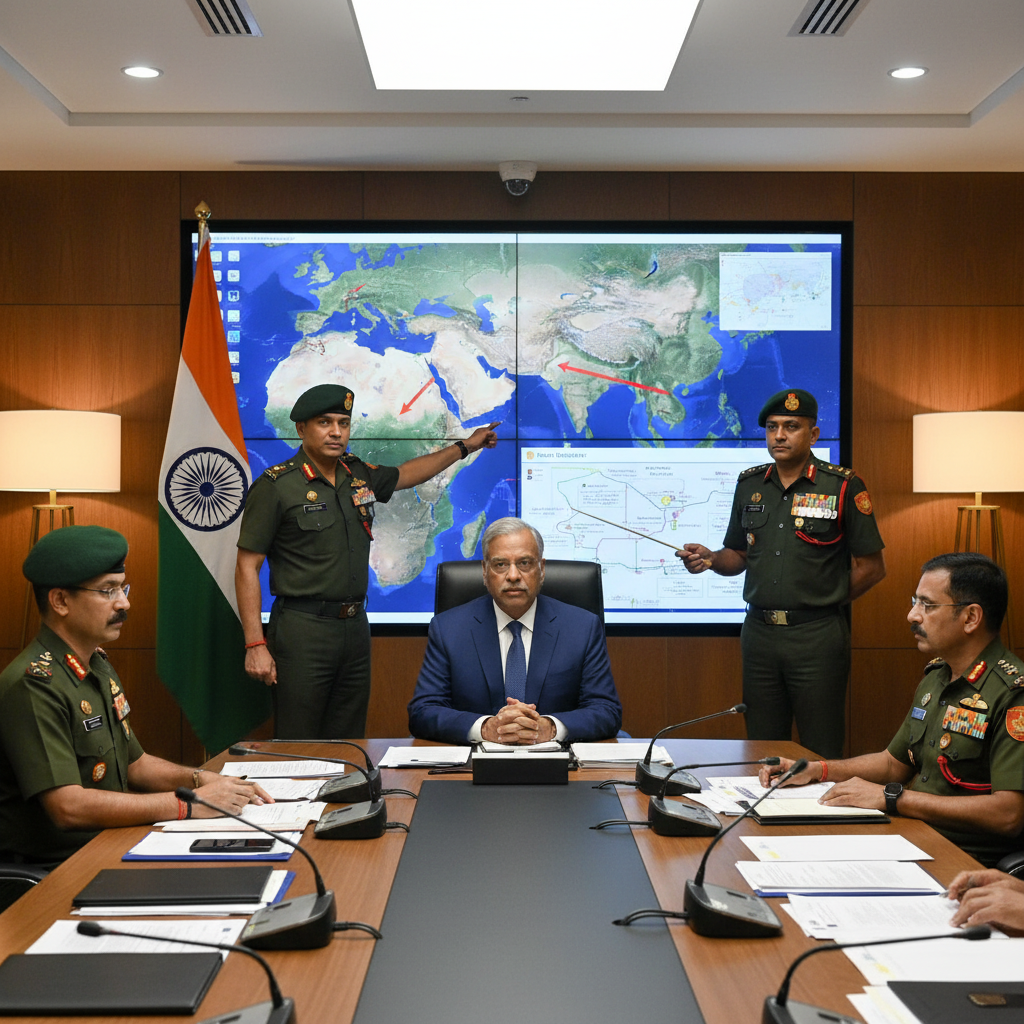
Defence Minister Rajnath Singh conducted a comprehensive review of the evolving security situation in West Asia and its potential ramifications for India's defence preparedness during a high-level briefing in New Delhi on March 24, 2026. The assessment, according to official sources, examined both immediate operational concerns and long-term strategic implications as regional conflicts continue to reshape global security dynamics.
The briefing provided the Defence Minister with detailed analysis of the current global and regional security scenario, with particular emphasis on how potential conflict escalation in West Asia could directly impact India's defence capabilities and strategic interests. Officials presented assessments of various scenarios and their cascading effects on India's military readiness and defence infrastructure.
KEY FACTS
- Review conducted on March 24, 2026, in New Delhi
- Focus on West Asia situation and defence preparedness impact
- Examination of supply chain management for defence procurement
- Directive for continuous study of operational lessons
- Emphasis on integrated roadmap for next decade
A critical component of the review centered on supply chain management for defence equipment procurement and production, highlighting vulnerabilities that could emerge from prolonged regional instability. The assessment recognized that modern conflicts have increasingly demonstrated how geopolitical tensions can disrupt global supply networks, particularly affecting critical defence components and raw materials sourced from affected regions.
The Defence Minister's directive for continuous study of operational and technological lessons from ongoing conflicts reflects India's pragmatic approach to learning from contemporary warfare. This methodology has historically served India well, as evidenced by how lessons from various regional conflicts have informed Indian military doctrine and procurement decisions over the past decades. The emphasis on extracting actionable intelligence from current hostilities demonstrates a forward-looking approach to defence planning.
Singh's emphasis on formalizing an integrated roadmap for the next decade underscores the government's commitment to long-term strategic planning in an increasingly volatile global environment. This roadmap approach aligns with India's broader defence modernization efforts, which have gained momentum in recent years as the nation seeks to reduce dependence on foreign suppliers while building indigenous capabilities.
By The Numbers
The concept of Aatmanirbharta, or self-reliance, featured prominently in the review discussions, reflecting India's strategic imperative to reduce vulnerabilities in its defence supply chains. This initiative has gained particular urgency as global conflicts have repeatedly demonstrated how external dependencies can compromise national security interests. The programme encompasses not just manufacturing capabilities but also research and development, technology transfer, and the creation of robust domestic supply ecosystems.
Historical precedents underscore the importance of such comprehensive reviews. Previous regional conflicts in West Asia have had significant implications for global energy markets, trade routes, and strategic partnerships, all of which have indirect but substantial impacts on India's security environment. The 1991 Gulf War, for instance, had profound effects on India's foreign policy calculations and defence procurement strategies, while more recent conflicts have influenced India's approach to energy security and regional partnerships.
The timing of this review is particularly significant given the current geopolitical landscape. West Asia remains a critical region for India's energy security, with substantial portions of India's oil imports originating from Gulf nations. Any disruption to these supply lines or escalation of regional tensions could have immediate economic and strategic implications for India's defence planning and resource allocation.
"The review examined the impact on supply chain management for defence equipment procurement and production" — official statement
The focus on operational readiness alongside strategic planning reflects a balanced approach to defence preparedness. Operational readiness encompasses immediate military capabilities, equipment availability, and personnel training, while strategic planning addresses longer-term capability development and threat assessment. This dual focus ensures that India maintains both short-term deterrence capabilities and long-term strategic advantages.
Technology acquisition and adaptation represent another crucial dimension of the review. Modern conflicts have accelerated technological innovation in defence systems, from autonomous weapons platforms to advanced surveillance capabilities. India's ability to rapidly incorporate relevant technological lessons into its own defence systems could provide significant strategic advantages in an increasingly complex security environment.
The integrated approach to defence planning also reflects lessons learned from India's own strategic challenges across multiple frontiers. The need to simultaneously address threats from different directions while maintaining technological edge has shaped India's defence doctrine and procurement policies. This multi-dimensional approach requires sophisticated planning and resource allocation strategies.
Regional stability in West Asia directly affects India's broader strategic calculations, including its relationships with major powers and its role in multilateral security arrangements. The review's emphasis on understanding these interconnections suggests a comprehensive approach to strategic planning that accounts for India's evolving global role and responsibilities.
The directive for continuous monitoring and assessment indicates that this review represents part of an ongoing process rather than a one-time evaluation. This systematic approach to threat assessment and capability development has become increasingly important as the pace of technological change and geopolitical shifts continues to accelerate.
Supply chain resilience has emerged as a critical national security consideration for major powers worldwide, with the COVID-19 pandemic and subsequent regional conflicts highlighting vulnerabilities in global manufacturing networks. India's focus on this aspect demonstrates recognition of these evolving security challenges and the need for adaptive strategies that can withstand various forms of disruption.
The emphasis on formal roadmap development suggests that the outcomes of this review will translate into concrete policy initiatives and resource allocation decisions. This systematic approach to strategic planning has characterized India's recent defence modernization efforts, with multi-year procurement plans and capability development programmes reflecting long-term strategic thinking rather than reactive responses to immediate threats.



